Fortress St. George: Kefalonia’s Medieval Fortified Capital




Site at a Glance
- Rating
- 4.4
- Popularity
- Medium
- Country
- Greece
- Primary era
- Early Modern
- External website
- Open
- Eras represented
- Medieval, Early Modern
- Civilizations
- Byzantine, Norman, Venetian
- Site type
- Military
- Remains
- Fortified Town
On this page13 sections
History
Fortress St. George is a Byzantine fortress in Greece, on the island of Kefalonia near the modern village of Castro. Its construction is generally dated to the twelfth century, and it became the island’s principal fortified settlement and main population center from the Middle Ages until the eighteenth century. Venetian records called it Città di Cefalonia, or “City of Kefalonia.”
Byzantine and Norman Rule
The fortress is first documented in 1085, when it resisted an attack by Italo-Norman forces led by Roger Borsa. His father, Robert Guiscard, had died on Kefalonia during the same period. A Pisan fleet commanded by Dagobert attacked in 1099 but also failed to take the stronghold.
A Venetian fleet captured the fortress in 1125 or 1126. This victory prompted Emperor John II Komnenos, the Byzantine ruler from 1118 to 1143, to reconfirm Venetian privileges granted in 1082. The Venetians removed the relics of Donato of Euroea, a Christian bishop and saint, and later placed them in the Basilica of Saints Mary and Donato at Murano.
In the middle of the twelfth century, the Muslim geographer and cartographer al-Idrisi visited the island and its castle-town and described it as prosperous. In 1185, Margaritus of Brindisi, admiral of the Norman Kingdom of Sicily, seized Kefalonia and Zakynthos. The islands then became part of the County Palatine of Kefalonia and Zakynthos, a Latin feudal state created through Norman expansion in the Ionian region. The fortress was modified during this period.
The dedication to Saint George came from a small church within the original Byzantine fortification. It is recorded in 1264 and again in 1325, when John of Gravina, an Angevin prince, campaigned on Kefalonia to claim the county.
The Tocco Dynasty and Ottoman Conquest
During the late fourteenth and early fifteenth centuries, Fortress St. George served as a residence of the Tocco family. This Italian-origin dynasty ruled the County Palatine and held power in the Despotate of Epirus, a medieval Greek successor state in western Greece. Under Tocco rule, the fortress was rebuilt and enlarged as the seat of a feudal court. An earthquake seriously damaged it in 1469.
The Ottomans captured Kefalonia in August 1479 and besieged the fortress. Most of its garrison was killed, while inhabitants were deported to Constantinople. Control of the island and stronghold changed repeatedly before Venice recovered them in 1500.
Venetian Reconstruction and Expansion
A combined Venetian and Spanish force under the general command of Gonzalo de Córdoba captured the fortress at Christmas in 1500, after a siege lasting three months. The fortifications had suffered severe damage, and Kefalonia remained under Venetian administration after the war.
Venice rebuilt and strengthened the fortress in response to Ottoman and pirate attacks. Construction and expansion were directed by the engineer Nikolaos Tsimaras, especially from 1504, and further additions continued until 1545. The new outer wall built in 1504 was constructed by about 40 Venetian craftsmen working with local inhabitants.
A substantial settlement grew inside the defenses and spread beyond them into the borgo, a settlement outside a fortified enclosure. This suburb corresponds to the modern village of Castro. A census of 1583 counted 859 inhabitants in the fortress and settlement. Government officials and nobles occupied residences within the walls, while the suburb expanded around and below the fortifications.
Decline and Later Preservation
By the end of the sixteenth century, the fortress had lost its principal defensive importance because the island’s security increasingly depended on forts near the coast and ports. Earthquakes damaged it again in 1636 and 1637. Although nearby Argostoli eventually became more important economically and socially, Fortress St. George remained Kefalonia’s administrative capital until 1757, when the seat of government moved to Argostoli.
The settlement was gradually abandoned after the transfer of government. A small number of houses remain in the suburb outside the fortress, where some residents continue to live for emotional and community reasons. The Ionian earthquake of 1953 caused extensive destruction, and the site was also damaged during the Second World War. Later restoration and rehabilitation addressed buildings and monuments affected by the earthquake and aimed to preserve the settlement as a traditional protected community. Fortress St. George is protected as an archaeological and historic monument, with protection zones and building regulations established and revised during the twentieth century.
Remains
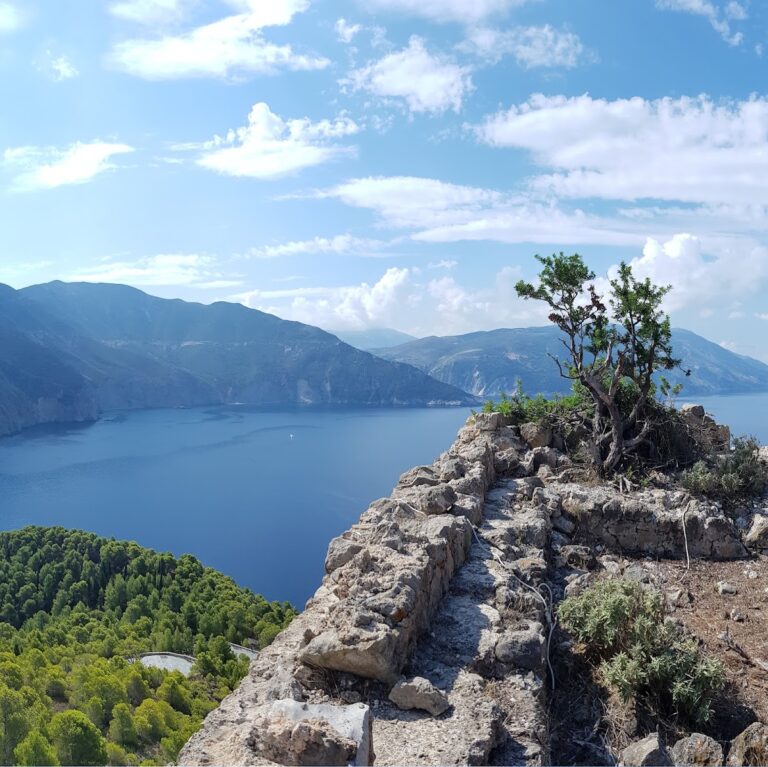
Fortress St. George occupies a limestone hill approximately 320 meters above sea level, about 7 kilometers from Argostoli and east of Castro. Its elevated position overlooks southern and southwestern Kefalonia, the fertile Livatho valley, the Gulf of Argostoli, and Livadi Bay, the island’s principal anchorage. Defenders could observe ships at a distance of about 20 kilometers.
Fortifications and Layout
The fortification has a polygonal plan covering approximately 16,000 square meters, with defensive walls extending for about 600 meters. An outer enceinte, meaning the main enclosing circuit of walls, surrounds a horseshoe-shaped inner enclosure. Near the center, a rocky summit contains the ruins of the so-called Old Fortress.
The Venetian defenses included three bastions, projecting parts of a fortification that allowed defenders to cover adjoining walls with flanking fire. One faced Argostoli, another controlled the seaward side, and the third faced the suburb. The suburb-side bastion was the strongest because the comparatively level ground there offered a more suitable approach for an attack.
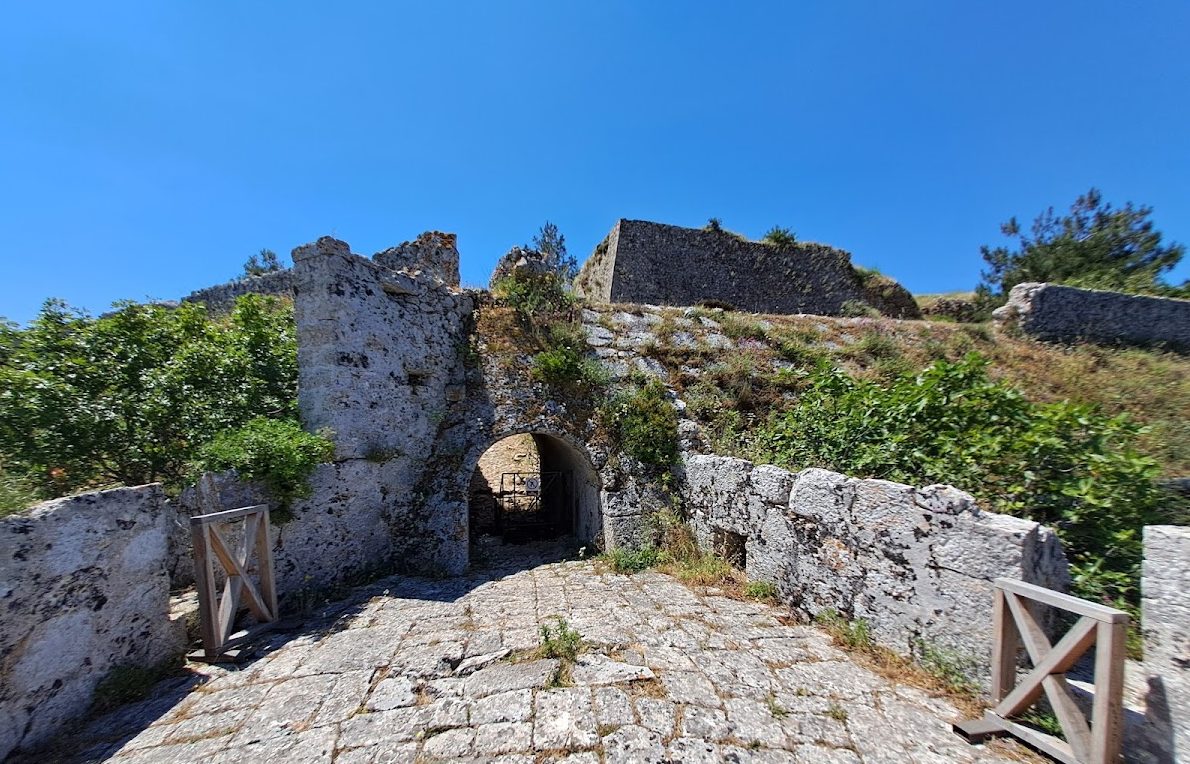
The northeastern wall and the section opposite the suburb received particular reinforcement. On the side facing Argostoli, earth embankments about 1.70 meters high supported parapets approximately 2 meters wide. The southwestern wall relied more heavily on steep, rocky ground as natural protection. A small section of the Byzantine walls survives, while the Venetian enclosure, its single gate, and its three bastions remain in comparatively good condition.
Buildings and Military Installations
Administrative and Military Buildings
The interior contained public and private buildings, churches, food and ammunition stores, barracks, hospitals, prisons, and water cisterns. Surviving or documented Venetian-period structures include the governor’s residence, barracks, cisterns, warehouses, and powder magazines. Noble coats of arms were reportedly set into many buildings. A reportedly secret tunnel was said to connect the fortress with Argostoli and to have served as an escape route.
Churches and Religious Collections
Numerous church ruins remain within the fortress. Near a small square in the courtyard stand the ruins of Saint Nicholas. Other surviving religious remains include the garrison chapel dedicated to the Virgin Mary, the Catholic Church of Saint Mark, and the Greek Orthodox Church of Saint Nicholas. Post-Byzantine icons, religious images produced in the Orthodox tradition after the Byzantine period, from ruined churches in the fortress are preserved within the complex.
Churches Outside the Fortress
Metropolitan Church of Evangelistria
East of the entrance, in the suburb, stands the Metropolitan Church of Evangelistria. Dated to 1420, it is described as a characteristic example of Ionian Baroque architecture and forms part of the religious landscape associated with the fortified settlement.
Monastery of Saint Andrew of Milapidia
South of the fortress is the historic Monastery of Saint Andrew of Milapidia. Its former katholikon, the principal church of an Orthodox monastery, houses an ecclesiastical museum containing notable icons.
The buildings and monuments of Fortress St. George remain partly ruined and partly restored after earthquake damage. The external suburb retains a small number of houses, while the fortifications preserve the layered remains of Byzantine, Norman, Tocco, and Venetian occupation.