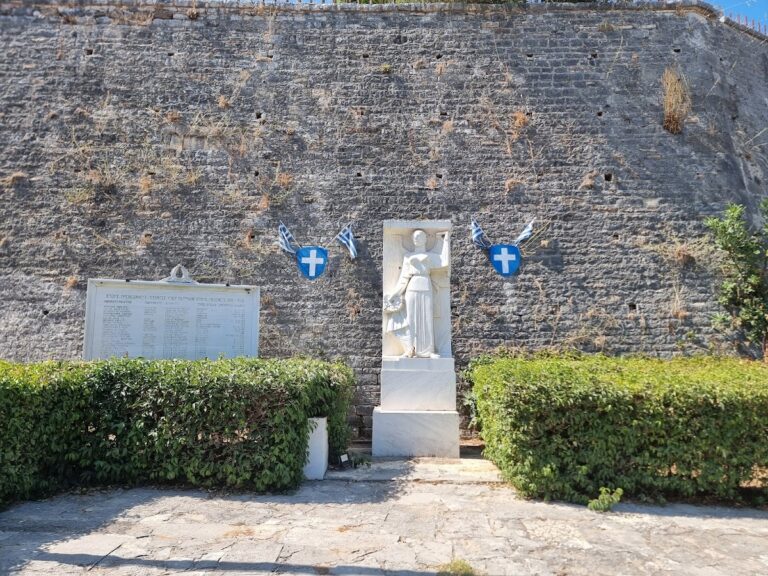
Assos Castle: A Venetian Fortress on Kefalonia


Site at a Glance
- Rating
- 4.4
- Popularity
- Low
- Country
- Greece
- Primary era
- Early Modern
- Eras represented
- Early Modern, Modern
- Civilizations
- Greek, Venetian
- Site type
- Military
- Remains
- Castle
On this page8 sections
History
Assos Castle is a Venetian fortification on Kefalonia, Greece, built between 1593 and 1596 to defend the island against Ottoman attacks and pirate raids. The Republic of Venice, a maritime state that protected its eastern Mediterranean possessions through castles, fortified ports, and administrative centers, planned the fortress as a new military and civic base for northern Kefalonia.
Venetian foundation
In 1584, Kefalonian nobles petitioned the Venetian Senate for a new fortress because the existing Castle of Saint George could not adequately protect the entire island. Construction at Assos began in 1593 under the supervision of Ambrosius Cornelius, a Venetian official responsible for overseeing its initial stages. The Venetian engineer and architect Marino Gentillini designed and carried out the work, later settling on Kefalonia.
Venice intended the fortress to contain a settlement and to receive the island’s military administration, which was gradually transferred from Saint George’s Castle. Assos became the capital of northern Kefalonia, although its population remained small and the planned fortified city never became densely settled. The seventeenth-century Greek adventurer Konstantinos Gerakis, who later became prime minister of Siam, was born inside the castle.
Changing strategic and political roles
Assos lost strategic importance after Venice captured Lefkas from the Ottomans in 1684. Pirate and Ottoman attacks then declined, while Argostoli became Kefalonia’s principal town in 1757. The Venetian provveditore, a senior governor responsible for administering and supervising a territory or fortress, nevertheless remained based at Assos until the Venetian Republic fell in 1797.
French forces controlled the castle from 1797 to 1799. Its later political affiliations included the Septinsular Republic, the short-lived Ionian state established after Venetian rule, and the United States of the Ionian Islands, the British-protected polity that governed the islands before their union with Greece in 1864.
Refugees, prison, and abandonment
In 1822, about 1,700 refugees from Souli settled within the fortress. Souli was a historical Greek community in Thesprotia whose inhabitants had been displaced during the Ottoman period. The castle also became a quarantine zone, and an internal settlement known as Souli developed there.
After the Ionian Islands joined Greece in 1864, only a small population remained at Assos, and the fortress had little military importance. A prison was established inside the castle in the late 1920s. From the end of the Second World War, it held political prisoners, who cultivated vineyards and cereal crops. The agricultural residents were known as the Kastrinoi, meaning “people of the castle,” and mainly grew olives and grapes.
The 1953 Ionian earthquake caused most residents to leave and led to the prison’s closure. The last six inhabitants recorded in 1961 departed in 1963. Assos Castle is owned by the Hellenic Ministry of Culture and is protected in Greece as an archaeological site and a legally protected building. British general Charles James Napier described the fortress as “stronger than Gibraltar,” linking its reputation to its defensive strength.
Remains
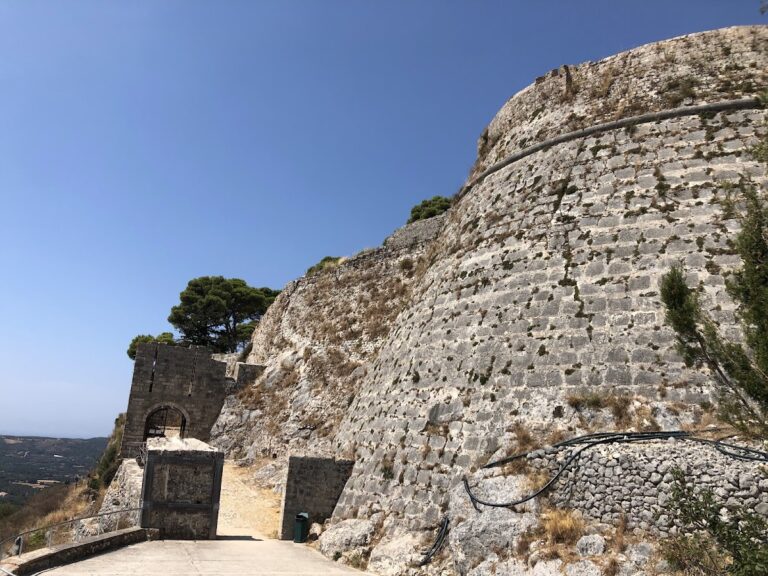
Assos Castle occupies the summit of a rocky hill about 170 metres high and extends across the small Assos peninsula overlooking the Bay of Agia Kyriaki, north of Paliki. A limestone defensive wall follows the peninsula’s perimeter for approximately 2,000 metres. The enclosed fortress covers about 44,000 square metres and preserves a combination of military defenses, civic buildings, churches, prison structures, and agricultural remains.
Walls, towers, and entrances
The fortification had five towers and originally four entrances, of which two survive. The principal surviving entrance is an arched gateway carrying the Venetian Lion of Saint Mark, the winged-lion emblem that served as both the patron saint’s symbol and a political emblem of Venice. Parts of the surrounding walls remain standing, while other sections survive in ruin.
Settlement and military facilities
The settlement within the fortress was planned with about 200 houses and 65 public buildings. Military facilities included food and ammunition stores, large cisterns for holding water, and a well excavation intended to supply the peninsula, which had no natural spring.
Other surviving structures include barracks, the house of the Venetian High Commissioner, and prison buildings. Buildings connected with the former agricultural prison have also been repaired. Together, these remains reflect the fortress’s changing use as a military center, administrative base, settlement, prison, and agricultural community.
Churches and associated buildings
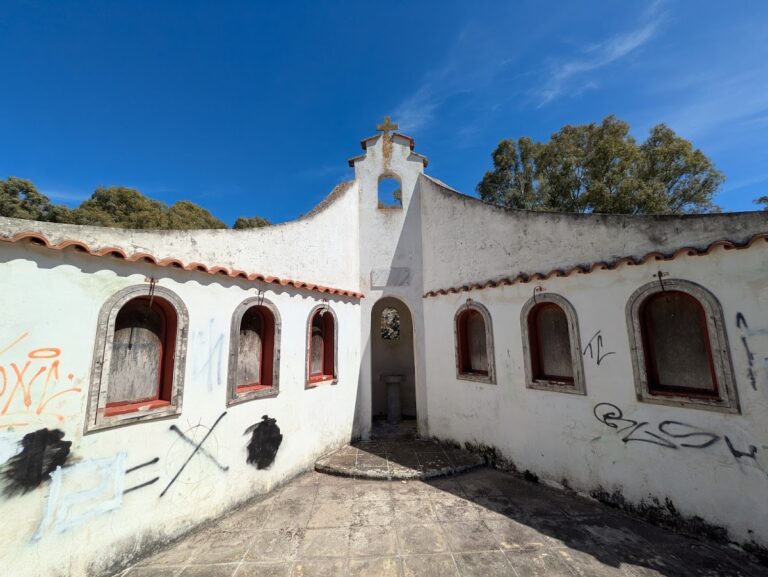
The small Catholic Church of Saint Mark dates to 1604. Another building, known as the “French Church,” was used by French forces during their control of the castle from 1797 to 1799. The Orthodox Church of the Prophet Elias was built in 1880 on the ruins of an earlier church dating from about 1500. Nearby are the ruins of a Venetian building associated with the Gentilini family.
The castle survives as a ruin, with its internal churches, administrative buildings, prison structures, and other components preserved in varying states of ruin or repair. The remaining walls and entrance gate define the fortified enclosure, while the surviving buildings preserve evidence of the settlement and the successive communities that occupied the peninsula.
Nearby sites