Gelgaudiškis Manor: A Historic Estate and Manor Ensemble in Lithuania


Site at a Glance
- Rating
- 4.7
- Popularity
- Medium
- Country
- Lithuania
- Primary era
- Modern
- External website
- Open
- Eras represented
- Modern
- Civilizations
- Russian
- Site type
- Domestic
- Remains
- Manor House
On this page11 sections
History
Gelgaudiškis Manor is a historic estate in Gelgaudiškis, Lithuania, whose present manor house was built between 1842 and 1846 in the Neoclassical style. The estate developed through the rule of several noble families and became a major landholding on the right bank of the Nemunas River. Its history reflects the changing political authority, religious life, economic organization, and land reforms of Lithuania from the fifteenth century to the modern period.
Medieval origins and the Sapieha estate
In written sources from the early fifteenth century, Gelgaudiškis was treated as part of Skirsnemunė Manor. The name is linked to Jurgis Gedgaudas, a diplomat of the Grand Duchy of Lithuania, who built a castle on the right bank of the Nemunas shortly after the Battle of Žalgiris, the 1410 defeat of the Teutonic Order by allied Lithuanian and Polish forces. The area was then known as Gedigoldiškis or Gedigaudiškis.
In 1504 or 1507, Grand Duke Alexander granted Gelgaudiškis and the woodland between the Nemunas and Siesartis Rivers to the nobleman Ivanas Sapiega. After Sapiega’s death, the estate passed to his widow, Elžbieta Sapiegienė, but Stanislovas Skopas, lord of Skirsnemunė, seized it by force. King Sigismund the Old intervened and restored the manor to the widow. Her death later led to a dispute among her stepsons.
After lengthy negotiations, Gelgaudiškis passed in 1566 to Povilas Sapiega, castellan of Kyiv and owner of the Zapyškis estate. He built the first church at Gelgaudiškis in 1578. Following his death in 1580, Andrius Sapiega leased the manor, its buildings and land, together with the Zapyškis estate, to Jan Hieronimowicz Chodkiewicz, Grand Stolnik of Lithuania and elder of Kaunas and Telšiai. The Grand Stolnik was a high-ranking court official associated historically with the grand duke’s table and household ceremonies.
Changing ownership and religious foundations
Sapieha rule ended as the manor changed hands repeatedly. Kasparas Oziemblovskis bought the estate in 1586. Records from 1640 name his sons Motiejus and Andrius Oziemblovskis, together with Stanislovas Oziemblovskis, Elder of Vilkmergė, as owners. The estate later passed by dowry to Danielius Chžonstovkis of Samogitia through his marriage to Elžbieta Oziemblovskaitė.
The Chžonstovskis family were Calvinists, members of a Protestant tradition that emerged during the Reformation, and they built a separate burial chapel. After Danielius Chžonstovskis died in 1665, an inventory listed the manor’s buildings and four entrances, including one adjoining the cheese cellar. From 1691, the manor belonged to Kazimieras Oziemblovskis, who built a second wooden church. The estate later passed to the Gelgaudas family.
The Czartoryski and von Keudell periods
During the second half of the eighteenth century, or possibly earlier, Gelgaudiškis was governed by the Czartoryski family, a prominent Polish-Lithuanian princely family active in the political life of the Polish-Lithuanian Commonwealth and its successor territories. In 1797, Prince Adam Kazimierz Czartoryski sold the estate to the German baron Theodor Friedrich von Keudell.
Von Keudell acquired Lower Gelgaudiškis for 75,000 ducats on preferential terms granted by Prussia, which had occupied the region. Upper Gelgaudiškis was acquired separately by Otonas Melkė. Lower Gelgaudiškis remained with four generations of the von Keudell family. After they acquired the Plieniškės estate in 1809, their holdings were probably the largest estate in Sudovia. In 1818, Teodor von Keudell applied to the authorities of Augustów Voivodeship, an administrative province of the Russian Empire, for permission to establish an Evangelical Lutheran parish.
Gustav von Keudell inherited the estate as a minor and later commissioned the present manor house, constructed from 1842 to 1846. After his daughter died, he established an orphanage for homeless children in her memory. When the old church burned in 1868, he built the existing church of Gelgaudiškis.
The von Keudells brought Germans to their lands in an effort to Germanise the region. Lithuanian peasants were subjected to exceptionally severe corvée, compulsory unpaid labour imposed by an estate owner on dependent peasants, reportedly working all seven days of the week. During the 1863 Uprising, rebels attacked the manor and took 1,500 silver roubles from its treasury.
The Komar family and the end of noble ownership
During the Lithuanian press ban, Gelgaudiškis Manor became an important centre for distributing illegal Lithuanian publications. At the end of the nineteenth century, a decree of the Russian tsar prohibited foreigners from owning estates in the empire’s border territories. The von Keudells therefore sold the estate and moved to Dresden.
Ona Konča-Komarienė bought the manor in 1898 and died about a year and a half later. Her son Medardas Komaras inherited it in 1900 and became its last noble owner. The Komar family substantially rebuilt the interior of the manor house without altering its exterior. Medardas Komaras and his family lived there until the First World War.
The estate was also affected by the Revolution of 1905. Around 400 estate workers went on strike, while about 140 demanded a 50-percent wage increase. On 20 June, Captain Pakrovski and Komar reached an agreement with the workers. On 11 December, workers destroyed parish-administration files and letters, after which the Russian authorities imposed a fine of 1,000 roubles on the inhabitants of Gelgaudiškis.
The Komars expanded the estate’s industrial activities. Their brickyard was probably the largest in Sudovia and produced bricks, hearth tiles, and terracotta pipes. Peat mining also contributed to the manor’s income, and the landlord built several narrow-gauge railway lines for estate transport. A narrow-gauge railway used tracks narrower than the standard gauge and was suited to short industrial routes.
War, land reform, and institutional use
At the outbreak of the First World War, Medardas Komar and his wife fled to Poland. In 1918, Jonas Budrys, representing the re-established Lithuanian government, was sent to the manor. Marlene, the widow of Franz von Keudell, the last German owner, was buried in the manor cemetery around 1920.
During Lithuania’s land reforms of 1919 to 1939, the manor territory was transferred to volunteers and soldiers of the Lithuanian Wars of Independence, the armed conflicts through which the newly re-established Lithuanian state defended its independence after the First World War, as well as to manor workers. In 1921, Medardas Komar sought to have the property managed by Mečislovas Šemeta, the former owner of Upper Gelgaudiškis. The state allotted Komar only 80 hectares, which Šemeta eventually bought from him.
In 1922, the state sold the manor house to the Lithuanian-American Sisters of Mercy, a Catholic women’s religious order devoted especially to charitable and social care. They donated the mansion to the Archdiocese of Kaunas, the senior Catholic ecclesiastical jurisdiction centred on Kaunas. With assistance from the Lithuanian Women’s Care Committee, the archdiocese established an orphanage in the building, which operated until 1941.
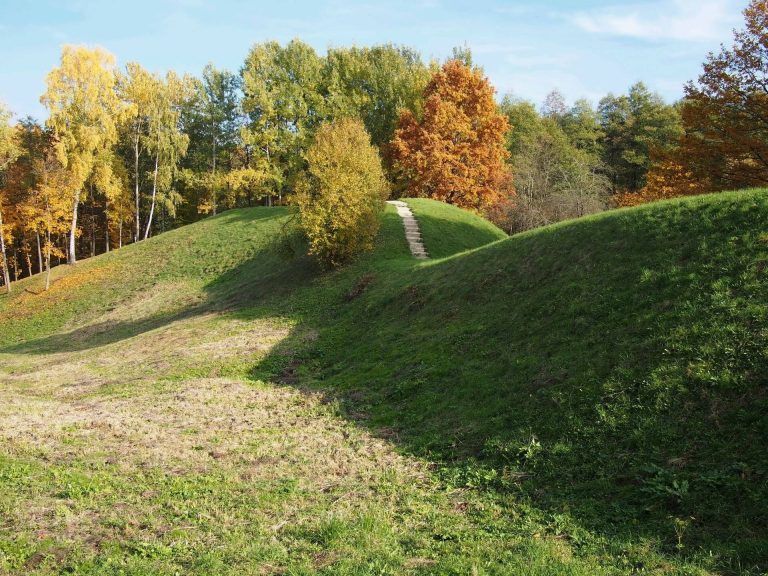
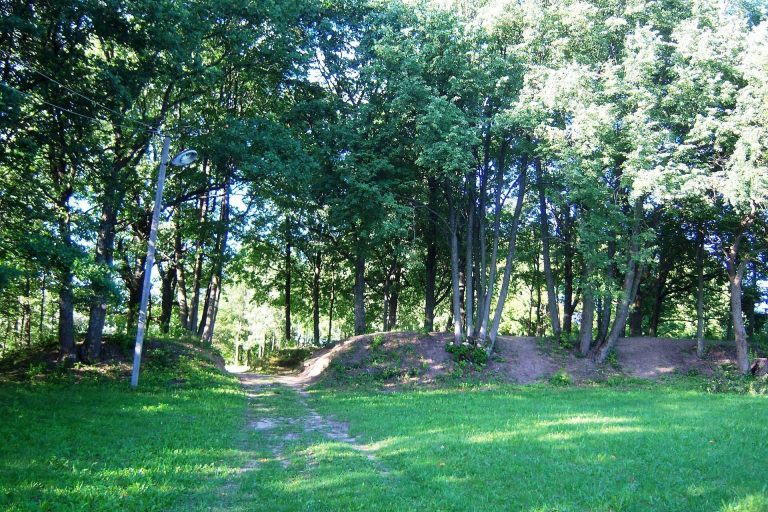
During the Soviet period, the main building housed a children’s home, followed later by a boarding school and a school. After approximately thirty years of disrepair, the manor house was fully restored in 2012. It is now used as a museum and is owned by Šakiai District Municipality. The Gelgaudiškis Manor ensemble lies within Panemuniai Regional Park, a protected landscape area along the Nemunas River, and has been incorporated into the natural landscape of the region. A carillon was installed in the park in 2015.
Remains
The manor house
The surviving manor house is a single-storey Neoclassical building with an attic. Neoclassicism drew on the symmetry, proportions, and forms of ancient Greek and Roman architecture. The architect is unknown. During the Komar period, the interior arrangement was redesigned and furnished with ornate furniture, while the exterior remained unchanged.
The ground floor was used mainly for guests and hunters, while the Komar family’s private apartments occupied the attic. A gunroom on the ground floor held Medardas Komar’s large collection of guns and old suits of armour, although he was not fond of hunting. The restored building now serves as a museum.
Estate buildings and agricultural layout
The manor ensemble includes the principal house, a barn, a winter garden, a water tower, cellars, and a park. The 1665 inventory provides an earlier picture of the estate’s organization. It listed four gates, one connected to the cheese cellar, as well as residential houses, barns, several granaries, a threshing floor, a malthouse, a bakery, and a sauna.
Religious and funerary features
Gelgaudiškis Manor is associated with a separate Calvinist burial chapel, a manor cemetery, and churches established by earlier owners. Povilas Sapiega built the first church in 1578, while Kazimieras Oziemblovskis built a second wooden church after 1691. The later church built by Gustav von Keudell followed the burning of the old church in 1868. The cemetery also contains the burial of Marlene von Keudell, who died as the widow of the last German owner and was buried there around 1920.
Industrial remains and infrastructure
The estate’s economic facilities included a large brickyard that produced bricks, hearth tiles, and terracotta pipes. Peat-mining operations added to the manor’s income. Several narrow-gauge railway lines connected these activities with the estate’s wider operations and supported the movement of materials.