Jurbarkas Manor: A Historic Estate in Lithuania


Site at a Glance
- Rating
- 4.6
- Popularity
- Medium
- Country
- Lithuania
- Primary era
- Modern
- External website
- Open
- Eras represented
- Early Modern, Modern
- Civilizations
- Russian
- Site type
- Domestic
- Remains
- Manor House
On this page10 sections
History
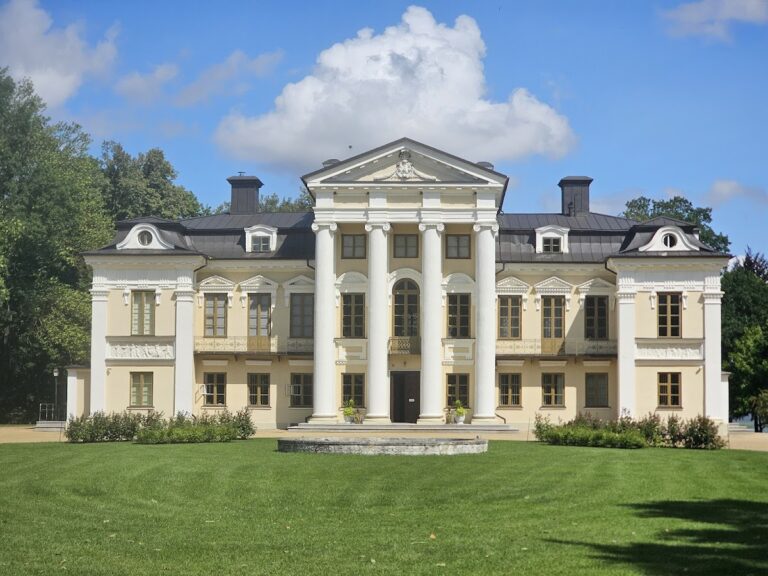
Jurbarkas Manor is a historic estate in Lithuania, in the town of Jurbarkas, whose stone Neoclassical mansion was probably begun around 1795 during the period of Russian imperial rule. The site developed from a royal holding into a large estate associated with prominent Polish-Lithuanian and Russian noble families, and it later became a centre of education, industry, culture, and public life.
Royal holding and noble ownership
Jurbarkas was a royal holding from the fourteenth century. Lithuanian rulers granted it to members of the royal family, including Queens Bona Sforza, Cecilia Renata, and Marie Louise Gonzaga. Bona Sforza, the wife of Grand Duke of Lithuania Sigismund I the Old, was the most prominent of these owners. She was a sixteenth-century queen of Poland and grand duchess of Lithuania through her marriage to Sigismund.
The estate later passed to the Radziwiłł family, one of the major noble houses of the Polish-Lithuanian Commonwealth. In 1685, Prince Dominik Mikołaj Radziwiłł and his wife, Anna Marianna Połubienska, became its rulers. On April 6, 1710, governance passed to Jan Radziwiłł and his wife Dorota, who received perpetual rights over Jurbarkas and Virbalis. Michał and Eleonora Czartoryski later assumed governance under similar rights but were forced to relinquish it. From 1774, Jurbarkas was assigned to Count Ignacy Potocki and Elżbieta Potocka, née Lubomirska.
From the late seventeenth to the early eighteenth century, plague, famine, the Lithuanian Civil War, conflict between the Sapieha and Ogiński families, and the Great Northern War caused severe losses in Jurbarkas. Military movements and deployments during wars in the first half of the eighteenth century continued to damage the town.
Zubov and Vassiltchikov ownership
After the fall of the Polish-Lithuanian Commonwealth, Empress Catherine the Great granted Jurbarkas to Count Platon Zubov, a Russian imperial favourite and court official. The stone mansion was probably built during his ownership, with construction beginning around 1795. In 1796, after Catherine’s death and the accession of Emperor Paul I, Zubov lost his offices and estates and was exiled to Germany.
In 1845, Emperor Nicholas I transferred Jurbarkas from the Zubov family to General Hilarion Vassiltchikov. Nicholas I ruled Russia from 1825 to 1855. The estate was later divided between Hilarion’s two sons and eventually passed solely to General Ilarion Illarionovich Vassiltchikov. After Ilarion’s death in 1862, control passed to his son Sergei Vassiltchikov.
The Vassiltchikov family expanded and administered the estate extensively. Sergei Vassiltchikov was especially associated with the modernization of the manor, the management of Jurbarkas, and the development of education and culture. A school opened through the family’s initiative in 1865, while the family also founded and financed a home for elderly people and the poor.
Economic activity formed an important part of the estate’s operation. Its brickyard and brewery worked for several decades. In the late nineteenth century, Duchess Maria Vassiltchikov established a Lithuanian textiles school. A large watermill with a sawmill and wool-spinning facilities was built in 1903, and cheese and butter production also developed. The family built Jurbarkas’s first power plant in the same year and traded in timber.
War, national culture, and later public use
The Vassiltchikovs did not oppose the Lithuanian National Revival, a movement promoting Lithuanian language, culture, and national consciousness. On November 2, 1905, they allowed the first Lithuanian cultural event in Jurbarkas, a performance of the comedy America in a Bathhouse, to take place in the manor barn.
During World War I, the family moved to Petrograd after Germany declared war on Russia on August 1, 1914. General Ilarion Sergeyevich Vassiltchikov became commander of a cavalry division. German troops burned the manor house after learning that it belonged to an enemy commander, destroying the building.
During the interwar period, the estate land was distributed among local farmers. The manor and park were assigned to Jurbarkas Gymnasium, and the park was opened to the public. One administrative building became the workplace and residence of sculptor Vincas Grybas.
During the Soviet annexation of Lithuania in 1940, members of the Vassiltchikov family left the country. Illarion remained for another six months before fleeing to Germany. In 1956, the crosses were removed from the former manor church, which was then used successively as a dance hall, exhibition hall, and vegetable warehouse.
The surviving buildings were later adapted for cultural and public purposes. The northern former servants’ quarters became the Jurbarkas Regional Museum, the southern building became the Jurbarkas Tourism and Business Information Center, and the former Orthodox church became the Jurbarkas Exhibition and Concert Hall. The Vincas Grybas Memorial Museum also occupies former manor buildings. The columns of the central manor palace were restored in 2015.
Remains
Estate layout and surviving buildings
The estate extended along the Mituva River, with the main house positioned at the end of a long driveway. A high red-brick wall enclosed the grounds, and fragments of the wall together with its gate posts survive. Agricultural and administrative buildings stood to the west, farther from the river, forming part of a wider group that included stables, a forge, an icehouse, a woodshed, a kitchen, a brick house near the Mituva, a blacksmith’s house, barns, a threshing barn, a mill, servants’ quarters, and a sauna.
The central manor house
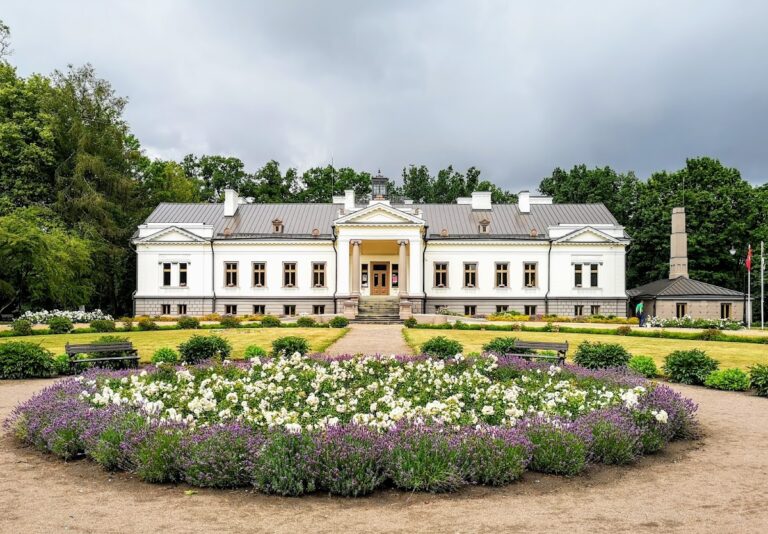
The principal house was a stone building approximately 50 metres long and 15 metres wide. Its Russian Empire design consisted of a two-storey central block with columns and single-storey side risalites, projecting sections of the building. Steps marked entrance approaches on both sides. An oval hall formed the most elaborate interior and was used by the duke when entertaining distinguished guests. The house was destroyed by fire during World War I, while its central columns were restored in 2015.
The servants’ quarters
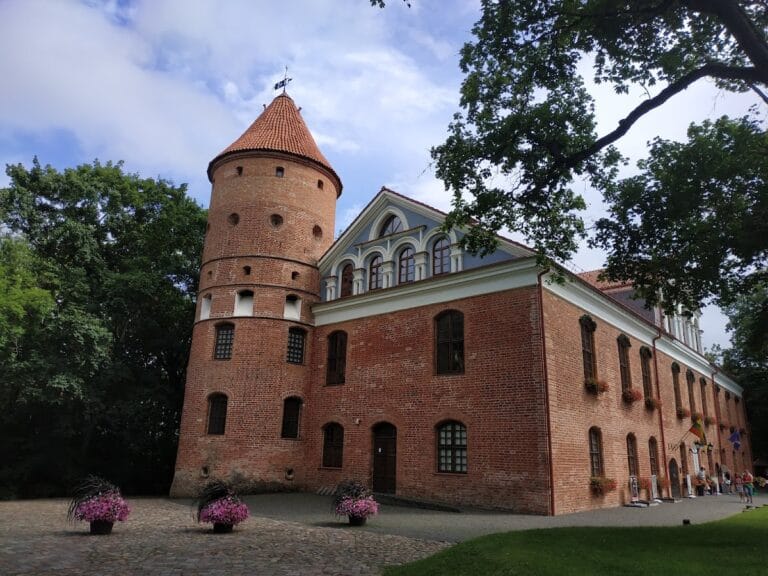
Two stone servants’ quarters stood within the estate. Servants lived in the southern building, while the more elegantly furnished northern building accommodated the owners and their guests. The northern structure is a nineteenth-century Classical-style building with ornate wooden interior decoration and a carved wooden ceiling. After renovation, it became the Jurbarkas Regional Museum. One museum exhibit concerns battles with the Teutonic Knights, a German Catholic military-religious order that campaigned in the Baltic region during the Middle Ages, fought near Jurbarkas during the thirteenth and fourteenth centuries.
The former Orthodox church
A former liquor storehouse beside the servants’ quarters was converted into a small Orthodox church in 1865. Built of brick, it is described as an example of Byzantine architecture, a Christian tradition associated with the Eastern Roman Empire and Orthodox Christianity. The building now houses the Jurbarkas Exhibition and Concert Hall.
Park and cultural buildings
The manor park covers approximately 30 hectares along the Mituva River. Its gently undulating ground includes walking alleys, a bridge across the river, and a circular garden feature at the centre. Recorded trees include maple, linden, birch, oak, and larch, together with other species.
Former manor buildings also accommodate the Vincas Grybas Memorial Museum, which preserves the sculptor’s working environment and models of his works. An adjacent art house is used for pottery and glass-jewellery workshops. Together with the regional museum and exhibition hall, these uses preserve the estate as a group of cultural institutions within its surviving historic fabric.
Nearby sites