Fort des Rousses: A Second Empire Frontier Fortress in France



Site at a Glance
- Rating
- 4.5
- Popularity
- Medium
- Country
- France
- Primary era
- Modern
- External website
- Open
- Eras represented
- Modern
- Civilizations
- French
- Site type
- Military
- Remains
- Fort
On this page12 sections
History
Fort des Rousses is a large French military fortress built during the Second Empire, the period of Napoleon III’s rule from 1852 to 1870, on a commanding position west of Les Rousses near the Swiss border. It formed part of the Jura fortified curtain, a chain of defensive works protecting France’s Jura frontier, and was designed to control a valley barrier. By area, it is France’s second-largest fortress after Mont-Valérien.
Frontier Defences and Construction
Concerns about a possible violation of Swiss neutrality and an Austrian invasion led to renewed attention to the Jura frontier in 1815. Colonel Christin was ordered to organize the positions at Les Rousses and built five redoubts. In 1841, the Ministry of Finance approved funding for a permanent fort, and a site of 93 hectares southwest of the town was acquired.
Construction began in 1843 and continued for about twenty years. The entrance porch carries the date 1848, while completion is generally placed around 1862 or 1863. The fort received its artillery in 1868. A ministerial decision of 2 December 1867 assigned it 88 defensive guns, 27 security guns, and a garrison of 3,500 men. These provisions remained in force until December 1874.
Modification and Military Decline
Major repair and maintenance work took place between 1884 and 1887. The surrounding defensive system was also expanded during this period with the Rochat redoubt and Fort Risoux. The Rochat redoubt later disappeared.
Developments in siege artillery soon reduced the fort’s defensive value. It was classified among the third-class works from 1899, and planned construction of new rock shelters was stopped. The military continued to use Fort des Rousses until 1919, after which it was abandoned.
Wartime and Postwar Use
The fort returned to military service in the months before the Second World War. The 7th Company of the 73rd Regional Regiment occupied it from 28 August 1939 to 2 February 1940 to guard the Swiss border, while the regiment’s 6th Company was stationed there from 29 August 1939 to 1 February 1940 for defensive works in the surrounding area.
From 21 November 1939 to 2 February 1940, the fort served as the command post of the Morez sub-sector within the Jura fortified sector, a military administrative and defensive division organized around frontier fortifications. A military ski school operated there from 7 January to 4 March 1940. It trained ski reconnaissance units and taught formations of the Jura fortified sector to use skis for construction, communications, resupply, and reconnaissance. The fort’s status after the June 1940 Armistice is uncertain: it was either occupied by German forces or used by the Red Cross. French units took possession again in 1944.
After the war, Fort des Rousses became a regional center for military physical training and skiing and housed various battalions. From 1966, it accommodated the commando training center of the 23rd Infantry Regiment. The regiment remained there until the army abandoned the fort in June 1997. During the 1960s, the complex also hosted Easter and summer combined-arms courses for students in the PMS advanced military preparation program, allowing them to enter an officer-cadet platoon upon incorporation.
Civilian Transformation
In 1984, the fort also became known as Fort Général Henry Martin. Following the end of conscription and the creation of a professional army, the state sold it to the commune of Les Rousses in 1997. The complex was restructured for civilian production and commercial use, including facilities for the eyewear company Comotec and Fromageries Arnaud Frères.
Fromageries Arnaud Frères uses the former military rooms to mature Comté, a hard cheese produced in the Jura region. The fort also forms part of local social, recreational, and sporting activities, including an adventure and underground-exploration course. It remains owned by the commune of Les Rousses.
Remains
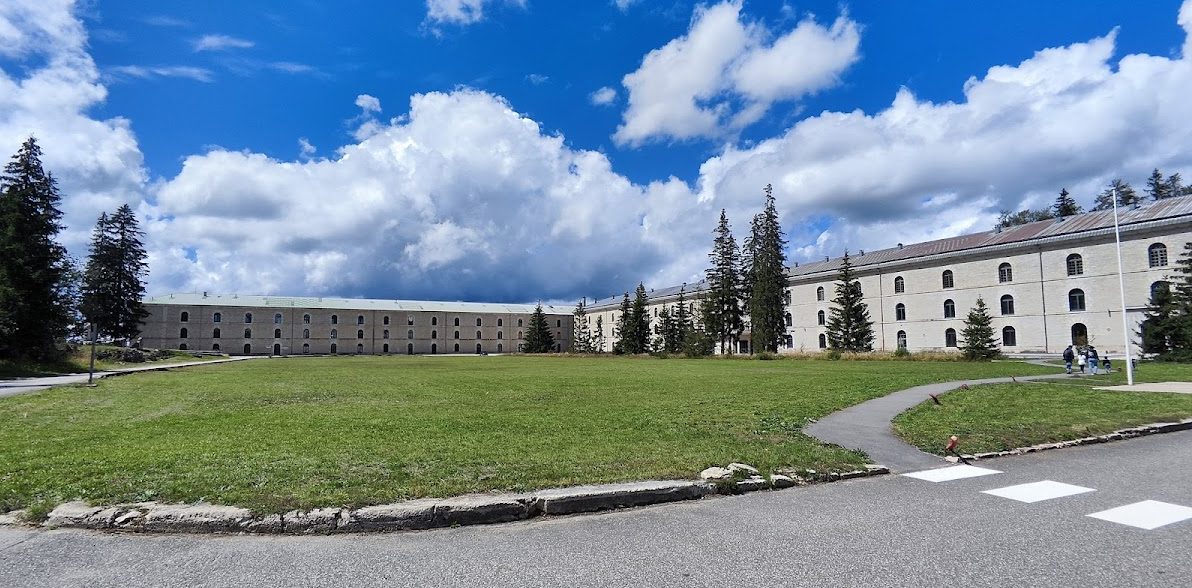
Fort des Rousses stands at approximately 1,150 metres above sea level. Its enclosure covers about 21 hectares and contains more than 50,000 square metres of vaulted rooms, together with several kilometres of galleries. The bastioned fortification, a defensive design with projecting bastions that allowed fire to cover the walls and approaches, is organized around three principal visible buildings: Cavalier, Quitry, and Saint-Germain. Locally quarried limestone forms the construction, while extensive earth covering protected the fort against bombardment.
Entrances and Defensive Works
Porte de France
On the northern side, the Porte de France is positioned between two vaulted covered passages. The entrance porch bears an inscription dated 1848, linking the surviving gateway to the fort’s construction period.
Porte de Suisse
The eastern Porte de Suisse was regarded as the principal entrance. A Poncelet drawbridge, a counterweighted military bridge designed to rise quickly, protected the approach, while a large tenaille, a V-shaped defensive work placed before a gate or wall, covered the entrance. Three monumental barracks formed part of the fort’s built military accommodation.
Vaulted Interior and Water System
Cisterns and Underground Galleries
The fort had no natural spring for its water supply. Rainwater and melting snow collected from the building terraces flowed into cisterns beneath each building. This arrangement served the extensive underground complex, whose vaulted rooms and galleries remain integral to the fort’s physical structure.
Cheese-Maturation Rooms
The underground vaults maintain a temperature of about 8 degrees Celsius throughout the year. Their stable cool conditions allowed them to be adapted for Comté maturation, and approximately 190,000 cheese wheels are stored in these former military spaces. A plaque commemorating General Henry Martin is also associated with the complex.
Nearby sites