Château de Divonne: A Historic Residence in France


Site at a Glance
- Rating
- 4.3
- Popularity
- Very Low
- Country
- France
- Primary era
- Early Modern
- Eras represented
- Medieval, Early Modern
- Civilizations
- Duchy of Savoy, French
- Site type
- Domestic
- Remains
- Elite Residence
On this page8 sections
History
Château de Divonne is an eighteenth-century residence in Divonne-les-Bains, France, built by Claude-Antoine de La Forest, count of Divonne, to replace a fortified medieval castle destroyed in 1590. The site had been recorded as a castrum, a fortified settlement or castle, in 1131 and became the centre of an important lordship in the eastern French border region.
The medieval lordship
At the beginning of the twelfth century, the lords of Divonne held the lordship under the authority of the lords of Gex. Its territory extended south of the Pierre de Mourex, north to Asyin, and west beyond the wooded Jura ridges. Walcher, also known as Gaucher, and his brother Étienne de Divonne were among its earliest known holders. In 1123, they jointly donated property to Bonmont Monastery.
Later holders included Pierre de Divonne, named in 1154, Humbert in 1172, and Hugues in 1218. On 2 June 1225, Amédée II, lord of Gex, granted the fief of Divonne to Saint-Claude Monastery in allodial tenure, meaning that it was transferred without the usual feudal dependence on a superior lord. After the castle reverted to Léonète, lady of Gex, and her son Pierre, they paid homage to Amédée V of Savoy in 1285 and 1286. In 1295, a marriage contract reserved the usufruct, the right to use property and receive its benefits, for Jeanne, daughter of Louis of Savoy and wife of Guillaume of Joinville, lord of Gex.
From the Joinvilles to the La Forest family
Amé II of Joinville was lord of Divonne in 1356. His daughter Aymonette married Jacques de Gingins, and Laurent de Gingins became the last baron of Divonne from that lineage. Laurent’s widow, Jeanne de Symond, married Gilbert I de La Forest in 1653. Around 1660, Divonne was bequeathed to the La Forest family, whose descendants retained its use until 1789.
The Treaty of Lyon, signed on 17 January 1601, transferred the Pays de Gex, the historic territory around Gex and Divonne, from the sphere of Savoy to France. Divonne thereafter depended on the French crown and was regarded as the principal barony of the Pays de Gex, as well as the administrative centre of an important territory. Albert-Eugène de La Forest, heir of Gilbert de La Forest, left the Savoyard states, settled at Divonne, and became a French subject.
The eighteenth century and the Restoration
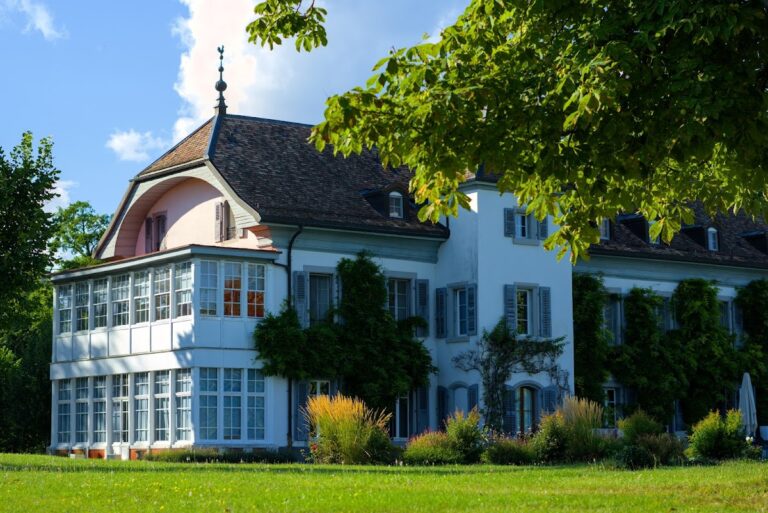
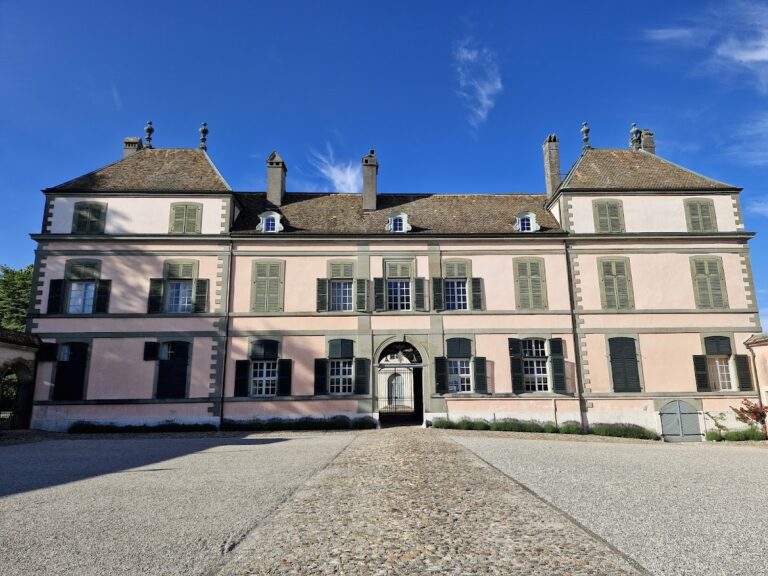
Claude-Antoine de La Forest built the present château during the eighteenth century as a residence, replacing the earlier fortifications. The French Revolution deprived the lords of almost all their property. During the French Restoration, the period when the Bourbon monarchy returned after Napoleon’s fall, Louis de La Forest Divonne recovered part of the estate and the Jura forests. These properties formed the majorat, an estate legally attached to a title and intended to pass with it to the holder and heirs, established for him when Charles X made him a hereditary peer of France in 1827.
The main building was enlarged with two square wings in 1860. During the Second World War, the château was requisitioned for use as an infirmary. Marcel Anthonioz, deputy-mayor of Divonne and minister of tourism, later leased it and converted it into a seasonal hotel-restaurant. After his death in 1976, the hotel business, which he had transferred to the commune, was operated by the municipality.
Hotel use, fire, and later projects
On 29 March 1984, the Grandes Étapes Françaises company bought the château-hotel business for one symbolic franc, while François-Paul de La Forest Divonne retained ownership of the building and received rent from the company. Grandes Étapes Françaises operated the château as a four-star hotel-restaurant until 2017.
On 18 January 2017, a fire began at about 7 p.m. in a storage room on the second floor. It caused extensive destruction to the château. Six hotel guests and the staff were evacuated, and firefighters controlled the blaze at about 11 p.m. without reported injuries. Eighty firefighters and thirty vehicles attended, including reinforcements from Geneva and the district of Nyon. In 2024, the Centaurus hotel group announced a rehabilitation project after the fire, but the project was cancelled at the end of 2025. A further fire affected the building on 28 June 2026.
The château park is included in the preliminary inventory of remarkable gardens, preserving an important part of the site’s historical setting.
Remains
The surviving site combines the eighteenth-century château, its later nineteenth-century enlargement, and a park containing the remaining trace of the medieval fortification. The earlier castle was heavily fortified, with an enclosure wall supported by several round towers. Most of those buildings had disappeared by the nineteenth century as the residential château replaced the medieval complex.
Medieval fortifications
A former postern gate from the twelfth century survives in the park. A postern is a small secondary entrance in a fortification or enclosure wall. It is the only remaining vestige of the original castle and provides a physical link with the fortified site that stood here before the construction of the present residence.
Eighteenth-century château and park
The present château was built as a residence during the eighteenth century and later enlarged by two square wings in 1860. Its building history reflects the replacement of the medieval defensive complex by a residential structure. The château was largely destroyed by the fire of 2017, and the building was affected again by the fire of 28 June 2026. The surrounding park remains associated with the medieval postern gate and forms part of the preliminary inventory of remarkable gardens.
Nearby sites