Castillo de San Gabriel: A Historic Fortress in Arrecife, Lanzarote


Site at a Glance
- Rating
- 4.3
- Popularity
- Medium
- Country
- Spain
- Primary era
- Early Modern
- External website
- Open
- Eras represented
- Early Modern
- Civilizations
- Spanish
- Site type
- Military
- Remains
- Castle
On this page6 sections
History
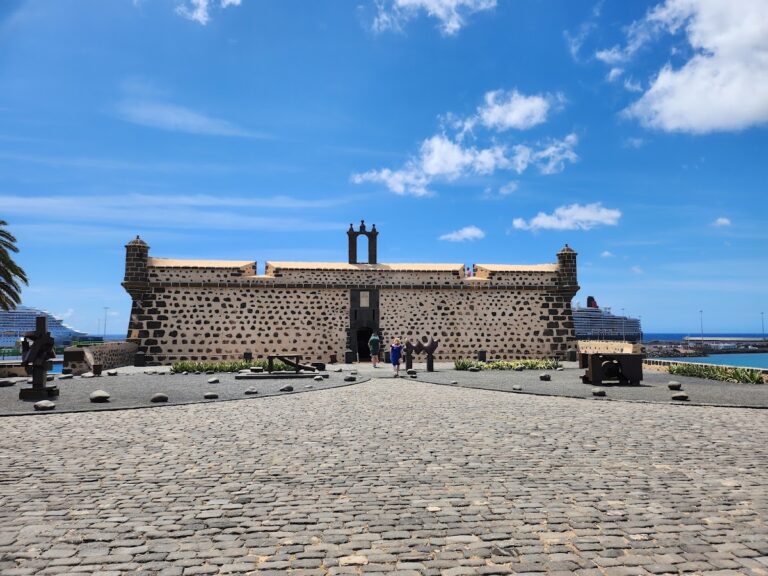
Castillo de San Gabriel is a fortress on a small islet off Arrecife in Lanzarote, Spain. Its first fortification was built in 1576, while the present castle was proposed in 1587 as part of a stronger defensive scheme for the islet. The site protected access near Arrecife and later became part of the city’s historical and cultural landscape.
Sixteenth-century fortification
The first structure on the islet now called del Quemado was made of wood. A Turkish-Algerian pirate attack destroyed it by fire in 1586, and this event apparently gave the islet its name. The following year, the military engineer and architect Leonardo Torriani proposed a replacement fortress on the same site. His plan called for walls around the entire islet, higher parapets, and interior facilities built in stone masonry rather than wood. A parapet is a low protective wall that shields defenders along the edge of a fortification.
Connection with Arrecife and later use
In the eighteenth century, the islet was connected with Arrecife by the construction of the Puente de las Bolas. From 1972, the castle housed an Archaeological and Ethnographic Museum with remains from different periods. After several years of closure, it was renamed the Museum of Arrecife History in 2014. Arrecife City Council owns the castle.
Castillo de San Gabriel was declared an Asset of Cultural Interest in 1979 as part of a monumental complex. The protected area includes the drawbridge and the paths linking the castle with the coast. A drawbridge is a bridge that can be raised or lowered to control access to a fortified site.
Remains
Fortress and defensive enclosure
The castle stands within the small islet that Torriani’s 1587 project intended to enclose completely with defensive walls. The scheme included raised parapets and stone-built interior facilities, replacing the vulnerable wooden construction of the earlier fortification. These elements express the intended defensive organization of the site, with the castle positioned inside the wider enclosure.
Bridge and coastal connections
The eighteenth-century Puente de las Bolas is a stone-built bridge connecting the islet with Arrecife. Two spheres crown the bridge, while the protected complex also includes the drawbridge and the paths extending between the castle and the coast.