Castillo de San José: A Historic Fortress and Art Museum in Spain


Site at a Glance
- Rating
- 3.8
- Popularity
- Medium
- Country
- Spain
- Primary era
- Early Modern
- External website
- Open
- Eras represented
- Early Modern
- Civilizations
- Spanish
- Site type
- Military
- Remains
- Fort
On this page6 sections
History
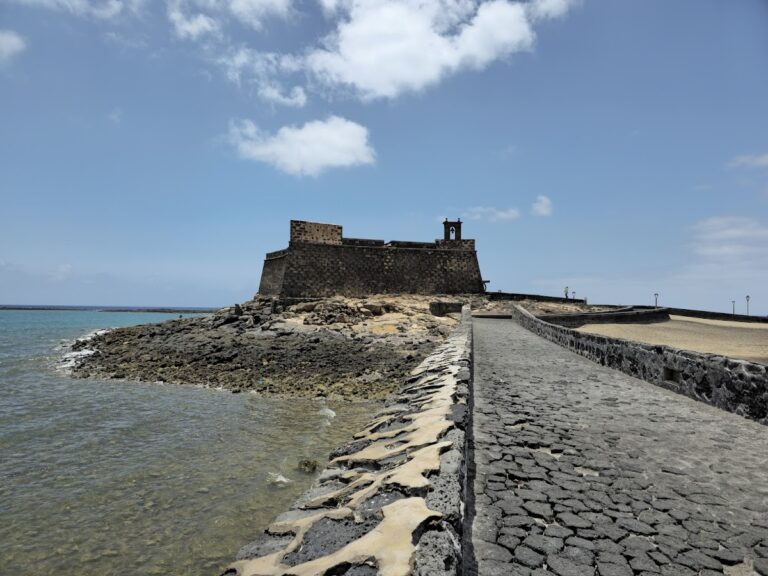
Castillo de San José is a historic fortress and art museum in Arrecife, Spain, built between 1776 and 1779 as a defensive stronghold and public-works project. Its construction took place during a period of famine and poverty on Lanzarote, giving the fort the enduring name Fortress of Hunger.
Famine and Construction
The hardship on the island had several causes, including severe drought and the Timanfaya volcanic eruption of 1730 to 1736, which devastated much of Lanzarote’s productive agricultural land. Charles III of Spain, a Bourbon king who ruled from 1759 to 1788 and promoted public works and administrative reform, ordered the fortress to be built in response to the islanders’ suffering. The project provided employment while also strengthening the defenses of Arrecife against pirate attacks.
From Fortress to Museum
During the 1970s, the fortress was renovated and its interior was redesigned by César Manrique, a Canarian artist, architect, and designer known for combining art, architecture, and Lanzarote’s volcanic landscape. The International Museum of Contemporary Art, known as MIAC, opened inside the fort in 1976. Castillo de San José is protected as a Spanish Asset of Cultural Interest in the monument category, under a formal declaration dated 12 July 1993.
Remains
Fortress Layout
The fort stands on a cliff above the Port of Naos. Its D-shaped plan has semicircular walls facing the sea, while two small turrets protect the rear wall on the landward side. A lifting drawbridge crosses the moat and reaches the main gateway. Masonry and regularly finished ashlar blocks made from volcanic stone form the structure. Inside, barrel-vaulted rooms, made with continuous semicircular vaulted ceilings, were used mainly as a powder magazine.
Museum and Annexe
The renovated interior houses MIAC, whose collection focuses mainly on works produced between 1950 and 1980. It includes modern sculpture, kinetic art, which incorporates actual or apparent movement, and geometric abstraction, which uses simplified geometric forms rather than representational imagery. The artists represented are mainly Spanish, including Joan Miró, Antoni Tàpies, Eusebio Sempere, and members of the El Paso group, a Spanish avant-garde movement associated with postwar abstract art. One section is dedicated to the Canarian artist Pancho Lasso. Outdoor sculptures and designs are displayed in the courtyard. Beneath the museum, an annexe was converted into a restaurant and is linked to the museum by a spiral staircase. Its dining room has curved floor-to-ceiling windows overlooking the harbour and docks below.