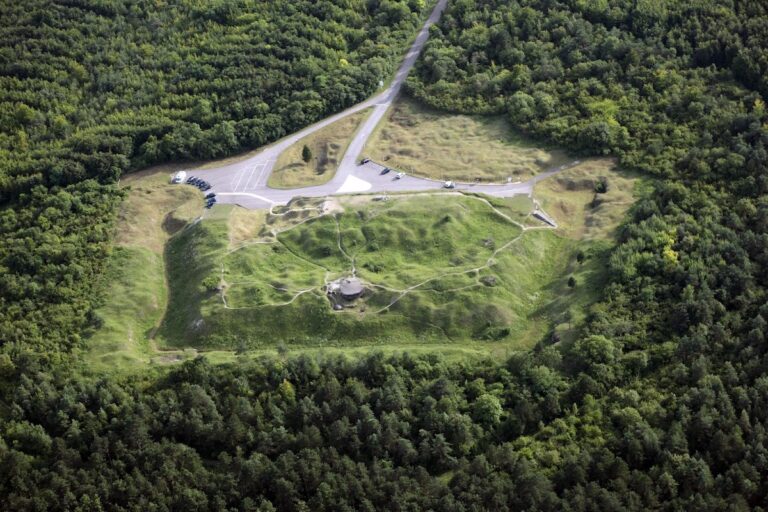
Verdun Citadel: A French Fortress and First World War Command Base


Site at a Glance
- Rating
- 4.1
- Popularity
- Medium
- Country
- France
- Primary era
- Early Modern
- External website
- Open
- Eras represented
- Early Modern, Modern
- Civilizations
- French
- Site type
- Military
- Remains
- Citadel
On this page8 sections
History
From Royal Capture to Fortification
Verdun Citadel is a French fortress in Verdun, France, whose upper citadel was established after King Henry II captured the city from the Holy Roman Empire in 1552 and ordered its medieval defenses strengthened. Construction of the upper citadel is dated to 1567–1634, although the French Wars of Religion delayed the work, which began in earnest only in 1624 during the Thirty Years’ War, a major European conflict of the seventeenth century.
Louis XIII instructed Marshal de Marillac, lieutenant-general of the Three Bishoprics and governor of Verdun, to accelerate completion. The plan drawn up in 1601 was modified in 1626. Construction followed the principles of the military engineer Jean Errard and was directed by the royal engineers and mathematicians Pierre de Conty d’Argencour, Jacques Aleaume, and Claude Chastillon.
French Royal Defense
The 1648 Treaty of Münster, part of the Peace of Westphalia that ended major phases of the Thirty Years’ War, confirmed the incorporation of Verdun and its bishopric into the French kingdom. Louis XIV subsequently commissioned Vauban, a French military engineer and architect whose bastioned fortification system shaped the modernization of French defenses, to improve the city’s defenses. Work began in 1674, stopped in 1692, and resumed in 1698.
The Séré de Rivières Fortress System
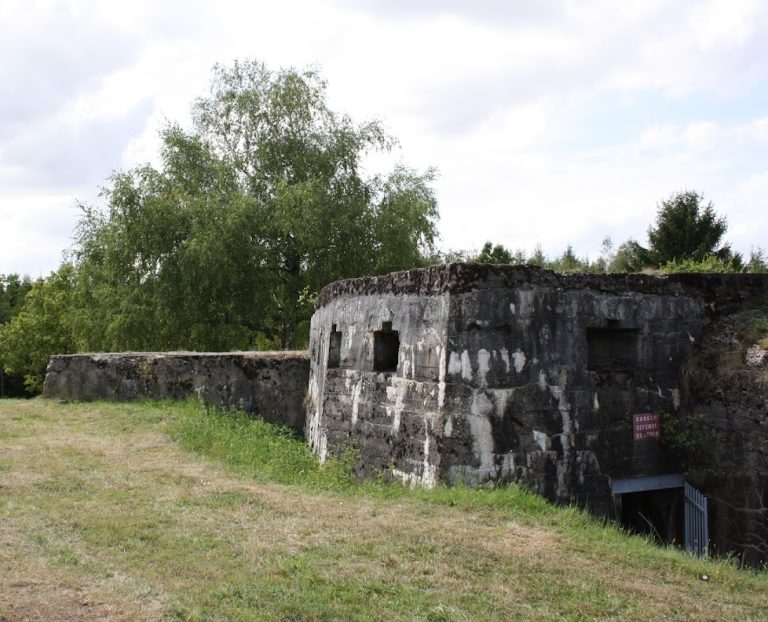
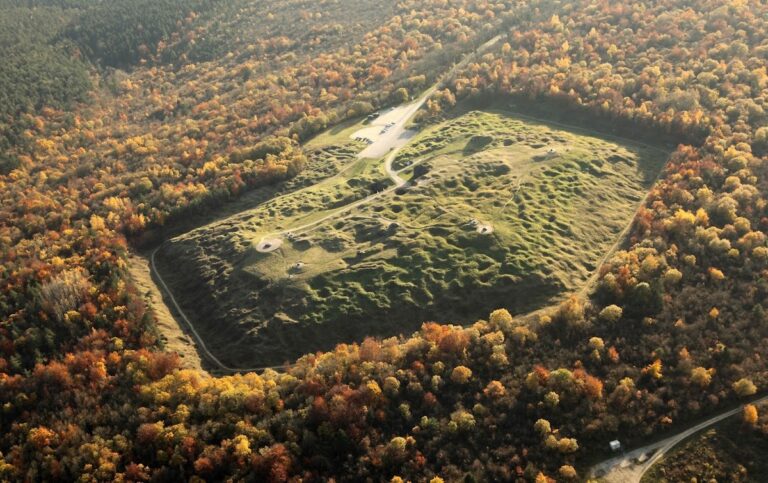
After the Franco-Prussian War of 1870, Verdun became part of the Séré de Rivières system, a late-nineteenth-century network of forts and defensive works built around important French cities. Nineteen forts were constructed around Verdun, including Vaux, Souville, and Douaumont, forming the fortified area of the city.
Military engineers Guinot and Rouillon de Gironville later planned to convert the citadel into a logistical base. From 1886 to 1893, galleries were excavated beneath the upper citadel, creating the underground complex that became central to the fortress’s military role.
First World War and the Unknown Soldier
During the First World War, the underground citadel served as a refuge, command post, and supply base. It was designed to accommodate 2,000 men, but as many as 10,000 soldiers sheltered there during the Battle of Verdun in 1916. Its bread ovens produced 28,000 rations each day.
On 8 November 1920, the National Assembly unanimously approved the burial beneath the Arc de Triomphe in Paris of an unknown French soldier who had died during the First World War. The battlefields were divided into nine sectors: Flanders, Artois, the Somme, the Marne, the Chemin des Dames, Champagne, Verdun, Lorraine, and Alsace. Eight coffins reached Verdun on 9 November, while a ninth body was excluded because its nationality was uncertain.
On 10 November, the underground citadel hosted the selection ceremony. One gallery had been arranged as a funeral chapel, with the coffins placed in pairs beneath tricolour flags. André Maginot, Minister of Pensions, gave a bouquet to Corporal Auguste Thin, who selected the sixth coffin. Thin later explained that he belonged to the 6th Corps and that the number of his regiment, the 132nd, also led him to the number six.
The chosen soldier was taken to Paris and buried beneath the Arc de Triomphe. The other seven coffins were transferred to the Faubourg-Pavé national cemetery, where they formed the “Square of the Seven Unknowns.” Verdun Citadel has been registered as a French historic monument since 24 October 1929 and is owned by the French state.
Remains
Upper Citadel
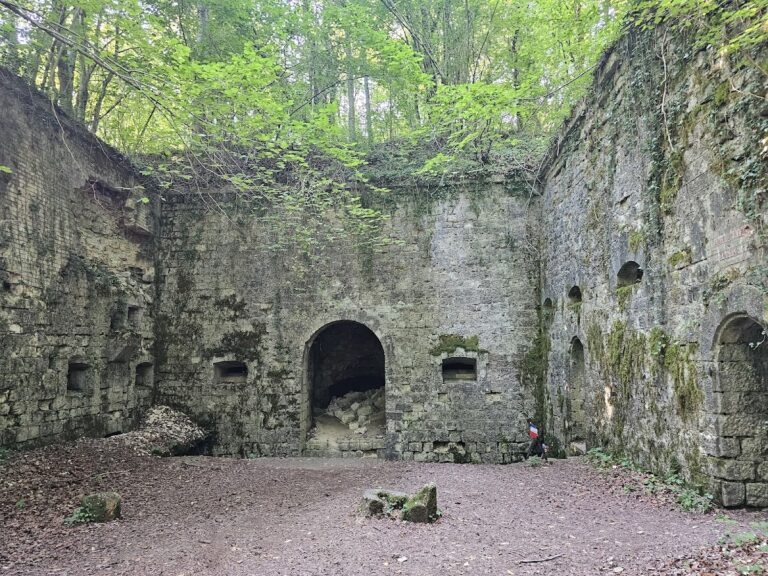
The upper citadel occupies approximately 20 hectares on Mont Saint-Vanne. Its fortified complex included several bastions, barracks, an arsenal, an artillery storehouse, a grain storehouse, and powder magazines. These elements formed the surface defense and support installations above the later underground galleries.
Underground Citadel
The underground, or lower, citadel was excavated beneath 16 metres of rock. Its galleries extended for approximately 4 kilometres in 1914 and reached 7 kilometres by the end of the First World War. Five principal galleries, each 4 to 6 metres wide, ran from west to east. Four narrower passages, about 2.50 metres wide, crossed them at right angles. These listening galleries were designed to detect or monitor activity outside the fortification.
The underground complex contained six powder magazines, seven ammunition stores, a bakery, a mill, a telephone and telegraph centre, water-lifting machinery serving the city and the surrounding forts, kitchens, and extensive storage areas. A gallery was temporarily converted into a funeral chapel for the 1920 Unknown Soldier ceremony, giving the underground fortress a further commemorative role alongside its military functions.
Nearby sites