Jasna Góra Monastery: Poland’s Pauline Sanctuary and Marian Fortress


Site at a Glance
- Rating
- 4.8
- Popularity
- Very High
- Country
- Poland
- Primary era
- Early Modern
- External website
- Open
- Eras represented
- Medieval, Early Modern, Modern
- Civilizations
- Kingdom of Poland, Polish–Lithuanian Commonwealth, Russian
- Site type
- Religious
- Remains
- Fortified Monastery
On this page22 sections
History
Jasna Góra Monastery is a Catholic sanctuary and Pauline monastery in Częstochowa, Poland, founded in 1382 and developed through Gothic and Baroque building phases. The Paulines are a Catholic monastic order founded in Hungary and named for Saint Paul the First Hermit. The monastery became the home of the Marian image commonly called the Black Madonna of Częstochowa and the principal Marian pilgrimage centre in Poland.
Foundation and the Marian Image
The monastery began on 22 June 1382, when Duke Władysław Opolczyk brought approximately sixteen Pauline monks from their mother monastery of Saint Lawrence at Buda in Hungary. A decree issued on 9 August established them beside the village of Stara Częstochowa. The first monks received a wooden parish church dedicated to the Blessed Virgin Mary. The parish was later transferred to the filial Church of Saint Sigismund in Częstochowa. A masonry watchtower beside the church may initially have provided the monks with accommodation.
Opolczyk first endowed the foundation with tithes. After losing his Silesian and Lesser Polish possessions, including Częstochowa, he secured renewed and more favourable grants for the Paulines from King Władysław Jagiełło on 24 February 1393. Further donations supported the construction of a Gothic monastic and ecclesiastical complex. The name Jasna Góra, meaning “Bright Mountain,” recalled the principal Pauline church at Buda. Its Latin form is Clarus Mons.
The Marian image reached the monastery in 1382 or, according to a Pauline tradition recorded in the sixteenth century, in 1384. The tradition says that Opolczyk brought it from Bełz and that the wagon carrying it stopped at Częstochowa when its horses refused to move. He interpreted the event as a divine sign. The later tradition places the formal deposition of the image at Jasna Góra on 31 August 1384. The image soon became associated with reported graces and miracles, and pilgrimage began in the fifteenth century. A manuscript called Translatio Tabulae, preserved in the monastery archive and dated 1474, records the transfer tradition.
Medieval Growth and Conflict
On 14 April 1430, raiders from Poland, Silesia, Bohemia, and Moravia attacked the monastery. They profaned the Marian image, removed its votive valuables, threw it to the ground, and struck it with sabres. Named participants included Jan Kuropatwa, Jakub Nadobny, and Frederick Ostrogski, although their precise affiliations remain uncertain. The damaged image was taken to Kraków for restoration and ceremonially returned to Jasna Góra in 1434.
The growth of pilgrimage encouraged the enlargement of the Gothic Marian chapel. By 1644 it had become a three-nave structure, while a masonry church built in 1425–1429 had replaced the original wooden church. The monastery also endured a siege by a Czech army in 1466. Its Pauline community continued to be governed by priors, beginning with Grzegorz Primipillus. The prior directed the monastery, while a subordinate custodian administered the sanctuary under the order’s constitution.
The Fortress and the Swedish Invasion
Jasna Góra acquired a fortified character in the seventeenth century. The Marian Fortress, or Fortalitium Marianum, was begun around 1620 at the initiative of King Zygmunt III Waza. The royal architect Andrei dell’Aqua designed a quadrilateral fortress with corner bastions. Walls and the entrance gate were built in 1621–1624, the eastern curtain wall and two bastions followed in 1631, and the western curtain wall and two further bastions were completed in the 1640s.
The fortifications became central to the monastery’s history during the Swedish invasion of the Polish-Lithuanian Commonwealth in 1655. From 18 November until the night of 26–27 December, the fortress resisted Swedish forces commanded by General Burchard Müller. Prior Augustyn Kordecki led approximately 160–170 soldiers, fewer than 100 monks, and members of the nobility in the defence. The Swedish forces withdrew after repeated refusals to surrender and made four further unsuccessful attempts to take the monastery.
The Marian image had been evacuated to the Pauline monastery at Mochów in Silesia on 17 November 1655 by Provincial Prior Teofil Bronowski, to protect it from profanation or plunder. The defence of Jasna Góra had primarily religious and symbolic importance rather than being a decisive military turning point. King Jan II Kazimierz Waza visited the monastery on 16 March 1657 to pray for the rescue of the Commonwealth. His Lviv vows of 1 April 1656 had placed the state under the protection of the Virgin Mary. That tradition was renewed in the National Vows of 26 August 1956, drafted by Cardinal Stefan Wyszyński.
Eighteenth-Century Sieges and the End of the Fortress
During the Lubomirski Rebellion, a conflict between King Jan Kazimierz and Jerzy Lubomirski, a battle took place below the monastery in August 1665. The Paulines closed the gates to avoid involvement. During the Great Northern War, Swedish forces made further attempts against Jasna Góra in 1702, 1704, 1705, and September 1709. General Nils Carlsson Guldenstiern approached with approximately 10,000 troops in August 1702, and General Carl Gustaf Rehnskiöld arrived with approximately 9,000 in February 1704. After the monastery refused to pay a contribution, General Nils Stromberg burned the nearby village of Częstochówka in April 1705. The fire threatened Jasna Góra but a sudden change of wind prevented it from spreading. General Ernst von Krassau withdrew in September 1709 when Russian and Saxon forces approached.
Jerzy Ignacy Lubomirski unsuccessfully tried to seize the fortress in 1716, although his forces plundered monastic property. He avoided punishment through royal protection. On 8 September 1717, Bishop Krzysztof Jan Szembek crowned the Marian image by papal decision of Clement XI, before approximately 200,000 worshippers. It was the first papally authorised coronation of a Marian image outside Rome in the Polish lands.
During the Bar Confederation, confederate forces occupied the fortress several times. Russian troops under General Ivan Drewicz, numbering about 3,000, failed to capture it on 8–9 January 1771. Approximately 1,300 defenders under Kazimierz Pułaski forced them to retreat. Russian forces entered Jasna Góra on 18 August 1772 after the king’s capitulation, and a military engineering corps partly rebuilt the fortress in 1783.
Polish forces captured Jasna Góra from its Prussian garrison on 19 November 1806. Colonels Dechamps and Miaskowski used 270 soldiers and local peasants to compel the surrender of approximately 800 Prussian troops. The fortress resisted Austrian forces in 1809, but its final siege came in April 1813. General Fabian Sacken’s forces cut off the water supply and breached the walls, and Colonel Antoni Górski surrendered with approximately 1,100 men on honourable terms. Between 1 April and 15 July 1813, local inhabitants dismantled the fortress walls.
After the Napoleonic period, Tsar Alexander I ordered the fortress dismantled. Upper wall sections, battlements, the moat, and earthworks were removed or levelled. Tsar Nicholas I permitted the clearing of the ruins and rebuilding of the walls in 1842. The reconstructed fortifications no longer served a defensive function.
Under Russian Rule and in the Twentieth Century
Under Russian rule, the number of monks was restricted, landed property was seized, and the sanctuary was plundered. On 24 October 1909, unknown perpetrators stole the Marian image’s Clementine crowns and dress. An attribution to the Pauline Damazy Macoch was never proved. The image was recrowned on 22 May 1910 with crowns sent by Pope Pius X, and received a coral dress funded by peasants from Rembieszyce and Złotniki.
Jasna Góra remained outside the main theatres of the First World War but formed an Austro-Hungarian-occupied enclave from 26 April 1915 to 4 November 1918. Captain Josef Klettlinger served as military commandant. Reforms followed during the interwar period.
German forces occupied part of the fortress from 3 September 1939 to 16 January 1945 and placed the monks under surveillance. Collective pilgrimages were restricted, and a copy replaced the original Marian image on the altar while the original was hidden within the monastery, including beneath the top of a library table. The monastery sheltered resistance members and Jews. German authorities attempted to use it for propaganda, and Governor Hans Frank visited twice. In January 1945, an attempt to burn the monastery failed during the rapid Soviet advance. A memoir by Boris Polevoy states that the monastery had also been mined and that monks helped remove 36 aerial bombs and two fuses.
In September 1956, approximately one million worshippers gathered at Jasna Góra for the National Vows of the Polish Nation and prayed for the release of the imprisoned Primate Stefan Wyszyński. Central religious celebrations marking the millennium of Poland’s baptism took place there on 3 May 1966. The monastery remained under surveillance by the authorities of the Polish People’s Republic, including a state militia search on 21 July 1957 for uncensored religious literature.
The daily Jasna Góra Appeal, an evening prayer to the Queen of Poland for Poland and the Church, was introduced in the 1950s in connection with prayers for Wyszyński. It is held at 21:00 in the Marian chapel. Pilgrimage has continued since the fifteenth century. The earliest officially documented pilgrimage came from Gliwice in September 1626, while organised walking pilgrimages expanded during the seventeenth century.
Pope John Paul II visited Jasna Góra six times, while Pope Benedict XVI and Pope Francis also visited. John Paul II donated a Golden Heart on 22 June 1982 and crowns for the Marian image, blessed on 1 April 2005 and presented on 3 May 2005. In August 1991, more than one million people, including many young visitors from the Soviet Union, came to Częstochowa for Catholic World Youth Day attended by John Paul II. The pilgrimage became a prominent public sign of the collapse of the Iron Curtain.
Jasna Góra was designated a Polish Historic Monument on 16 September 1994. It remains a male, enclosed Pauline priory and is described as a symbol of Polish national unity. It is also a candidate for UNESCO World Heritage listing.
Remains
The monastery and sanctuary occupy a hill approximately 293 metres high and cover about five hectares. The complex follows a fortified quadrilateral plan with arrow-shaped corner bastions. A park surrounds it on three sides, while a large eastern square occupies the fourth. The main entrance is on the south and a side entrance is on the west. The monastery itself is a monumental four-winged, three-storey Baroque building on an elongated rectangular plan with an internal courtyard. Its eastern and western wings contain monastic cells, and the complex also includes the Rosary Chapel, Refectory, Library, and representative rooms.
Fortifications and Entrances
Walls and Bastions
By late 1655, the fortress formed a rectangle approximately 130 by 104 metres, enclosed by a deep moat and earthen ramparts. Its defences included casemates, vaulted fortified chambers, and masonry slopes. Additional funds allocated by the Commonwealth Sejm in 1658 supported enlargement and maintenance of a garrison of approximately 120–150 people. Modernisation between 1700 and 1721 substantially rebuilt the bastions and curtain walls. An arsenal had been constructed in the 1680s, while a powder magazine, ball foundry, and a palisade of more than 15,000 stakes were added in the early eighteenth century.
The four bastions are the Morsztyn Bastion in the northwest, Saint Barbara or Lubomirski Bastion in the southwest, the Royal or Potocki Bastion in the southeast, and the Holy Trinity or Szaniawski Bastion in the northeast. The former moat survives as a depression in the monastery garden. That garden was laid out in the early twentieth century, and fourteen Stations of the Cross were built there between 1900 and 1913. Twenty stations of the Rosary Way, representing the twenty mysteries of the Rosary, were installed around the monastery between 1989 and 2005.
Southern Gates
The southern entrance consists of four gates. The Lubomirski Gate, built in 1722–1723 of brick faced with sandstone, was made by the Wrocław stonemason Jan Limberger with funding from Crown Chamberlain Jerzy Dominik Lubomirski. Its decoration includes a mosaic of the Virgin Mary Queen, a double-sided statue of Saint Michael the Archangel, statues of Saint Paul the First Hermit and Saint Anthony the Abbot, crossed weapons and banners, and the inscription Sub Tuum Praesidium, meaning “Under Your Protection.”
The Gate of Our Lady Victorious was built in 1767 for an anticipated visit by King Stanisław August Poniatowski, who did not arrive. Its present name dates from 1955, when a relief by Zofia Trzcińska-Kamińska showing Mary above defensive panoplies was installed. The gate leads through a tunnel to a pentagonal ravelin, an outwork placed outside the main wall to protect an entrance. The Gate of Our Lady of Sorrows was rebuilt in 1891 on the site of a wooden gate erected in 1767. Former drawbridges connected these gates with the Gate of the Ramparts.
Western Gate and Belfry
The western entrance, also called the Jagiellonian Gate, dates from the first half of the seventeenth century and was rebuilt in the eighteenth and nineteenth centuries. A portrait of Władysław Opolczyk was placed in its pediment in 1976. After the addition of the papal arms and the motto Totus Tuus, the former entrance gate was renamed the Gate of Saint John Paul II in 1987.
A provisional belfry with three bells stands within the ravelin. The historic bell Jesus Mary, founded by King Zygmunt I in 1544, weighs approximately five tonnes. It cracked during the 21:00 Appeal in 1990 and is now displayed on the southwest bastion. A copy was consecrated on the southeast bastion on 9 June 2001. Two other large bells, Saint Paul the First Hermit and Mary, were acquired from pilgrims’ donations in 1912.
Churches and Marian Chapels
Basilica of the Holy Cross
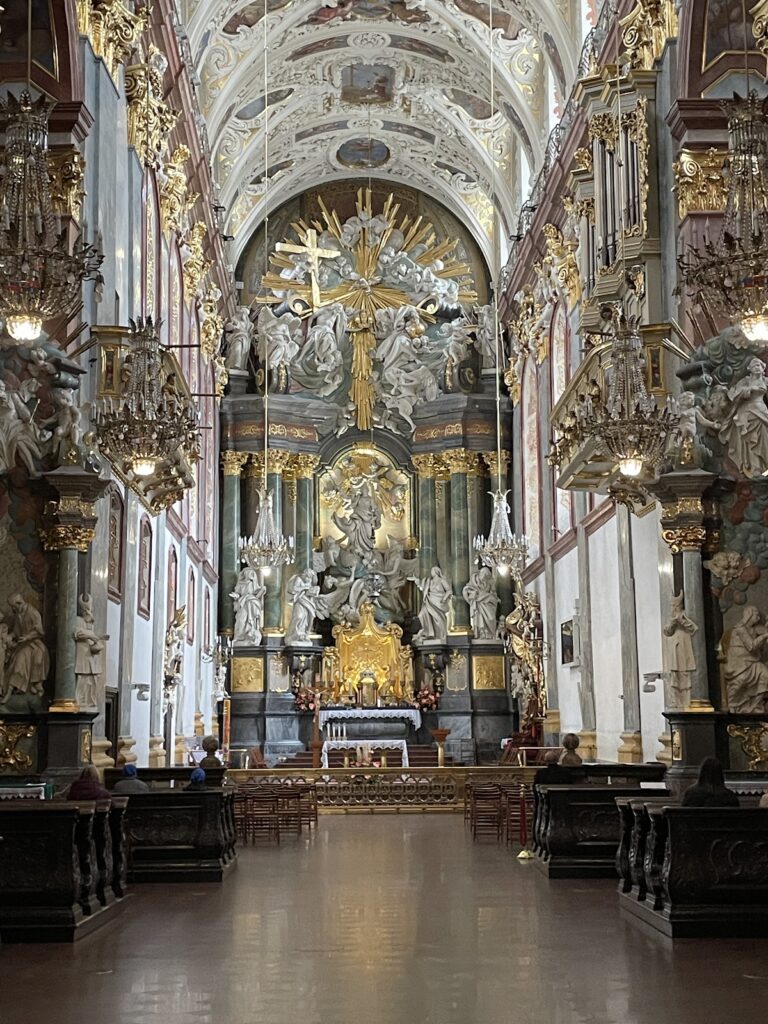
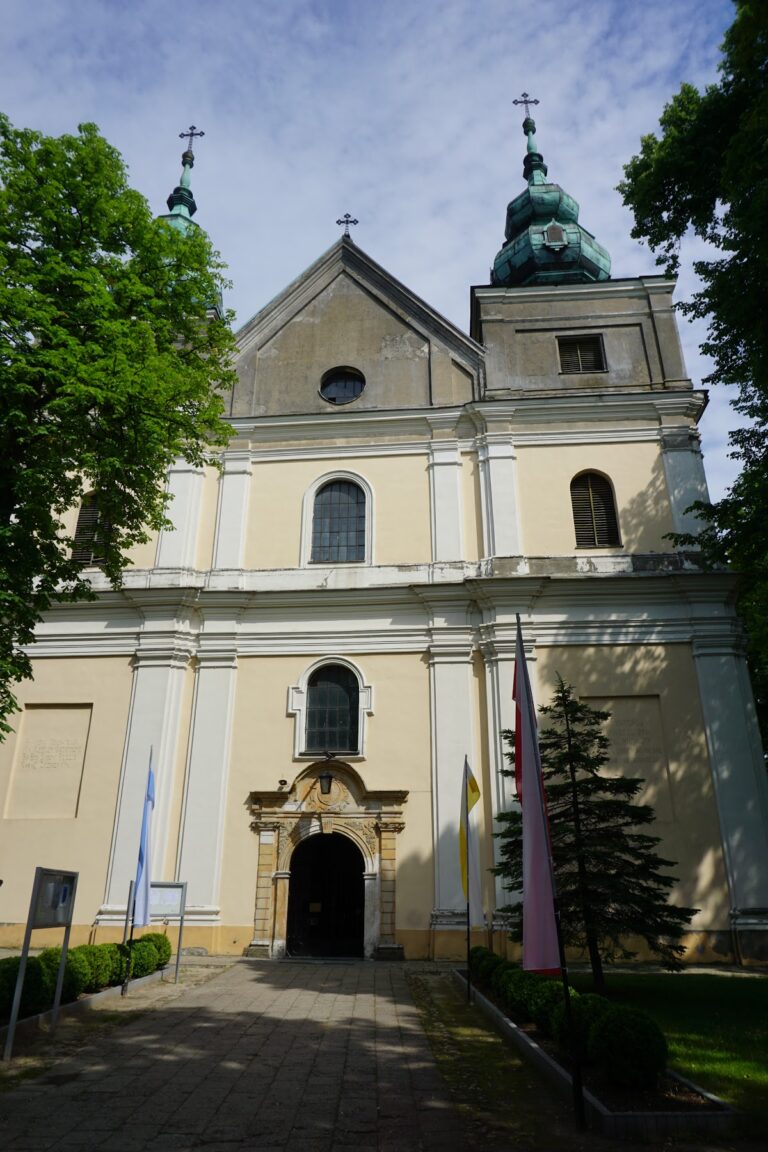
The Basilica of the Holy Cross and the Nativity of the Virgin Mary, formerly the Church of the Holy Cross and the Nativity of the Virgin Mary, has held the rank of minor basilica since 1906. A minor basilica is a church granted a special papal designation recognizing its religious and historical importance without making it a bishop’s seat. The oldest part is the fifteenth-century Gothic presbytery. After a fire on 16 July 1690, the church was rebuilt at the turn of the seventeenth and eighteenth centuries as a three-nave Baroque basilica.
The basilica is approximately 46 metres long, 21 metres wide, and 29 metres high. Its interior was restored in 1692–1695, 1706, and 1728. Karl Dankwart decorated the presbytery and main nave vaults in 1695, while Giacomo Buzzini made the principal altar in 1728. Side chapels include those of Saint Paul of Thebes, the Sacred Heart of Jesus, and Saint Anthony of Padua.
Chapel of the Black Madonna
The Chapel of the Black Madonna, also called the Chapel of the Miraculous Image or Chapel of Our Lady of Jasna Góra, lies north of the basilica and east of the service courtyard. Its original chapel predates the seventeenth century, while the three-nave section completed in 1644 now forms the presbytery. Five altars and votive offerings cover the chapel’s interior, and a 1929 extension forms part of the present complex.
The Marian image rests on a blackwood-and-silver altar donated by Chancellor Ossoliński in 1650, with a silver protective panel dating from 1673. The image is a fourteenth-century work by an unknown Italian artist. Twentieth-century examination established that the facial scars were painted as part of the image and were not solely later damage. Its attribution to Saint Luke the Evangelist, who was traditionally said to have painted it on a table in Jerusalem, is a devotional legend rather than an established artistic attribution. The ashes of Prior Augustyn Kordecki are interred in the chapel’s left wall.
Other Chapels
The Chapel of the Holy Sacrament of Saint Pius X faces the entrance to the Cenacle courtyard. Its facade bears a relief of the Triumph of the Blessed Sacrament, with angels around an oval window and a figure of Christ above. The Cenacle was formerly used by pilgrims awaiting confession and for distributing Communion during crowded summer pilgrimages. A black statue of Christ the King, crowned in gold, was installed above its entrance in 2000.
A former Marian Hall built in the 1920s was adapted as the Chapel of the Sacrament of Penance and consecrated in 2007. It contains an altar, a figure of Christ on the Cross, a copy of the Marian image, nine confessional boxes, and benches. The Chapel of Saint John Paul II was consecrated on 24 November 2021. Its features include an altar, ambo, a reliquary with the pope’s blood, a replica of his pastoral cross, and a large painting by Stanisław Rudziński. Limestone faces the walls, while the Stations of the Cross are based on those around the monastery ramparts.
Monastery Buildings and Collections
Courtyards and Representative Rooms
The main quadrilateral courtyard contains the domed vestibule of the basilica, the seventeenth-century Royal Rooms, the former pharmacy, and routes to the Marian chapel and tower. The Potocki Gate, bearing the Pilawa arms, closes the eastern side and leads to the cloistered Cenacle courtyard. The Hall of Knights was built in 1647–1649 in the southern wing as a representative room. Its barrel vault has transverse arches and lunettes, and its decoration includes Corinthian pilasters, an entablature, a monastic portal, an eighteenth-century altar of Saint John the Evangelist, a polychrome crucifix, and a relief of Our Lady of Sorrows.
Nine seventeenth-century paintings in the lunettes show episodes from Jasna Góra’s history, including its foundation, the 1430 attack, and the 1655 Swedish siege. The Royal Rooms form a two-storey, L-shaped building with an attic, built in 1644 between the basilica and the service area. Their ground floor contained a pharmacy by the first half of the seventeenth century and later provided services for pilgrims. The Musicians’ Houses, a seventeenth-century one-storey building beside the service courtyard, originally housed choir singers and later members of the instrumental-vocal ensemble.
Library, Archive, and Refectory
The Pauline library is documented by 1585, when it held approximately 200 volumes. Its representative old library was established in 1733–1739. The Baroque room has a mirror vault with stucco and painted decoration, carved and intarsia bookcases made in 1739, and two large inlaid tables. The collection contains incunabula, manuscripts, old Polish and foreign prints, and more than 13,000 books.
The monastery archive originated with the foundation of 9 August 1382. It preserves privileges, chapter records, visitation orders, profession lists, foundation registers, property descriptions, and church inventories. Its holdings include the 21-volume Acts of the Polish Province, begun in 1632, and the four-volume Acts of the Jasna Góra Convent, begun by Augustyn Kordecki in 1657. Nearly 7,000 archival units occupy approximately 113 linear metres of shelving.
The Refectory was built in the 1660s and completed on 12 August 1669. This Baroque rectangular hall has a barrel vault, seven windows in deep niches, and a sandstone portal dated 1670. Its decoration includes stucco, emblems, allegories, a late seventeenth-century crucifix, and paintings by Karol Dankwart. A ceiling painting from 1679 commemorates the wedding feast of King Michał Korybut Wiśniowiecki and Archduchess Eleonora in 1670.
Treasury, Arsenal, and Museums
The Treasury was built above the sacristy in 1649–1651 and entered from the eastern ramparts. It contains goldsmiths’ work, crosses, chalices, votive plaques, liturgical garments, rosaries, clocks, and relic objects. Among the displayed works are an ebony and silver Augsburg altar from 1624, a reliquary of the True Cross donated by August III and Maria Józefa, and a copy of the Marian image. The collection also includes dresses for the image, papal gifts, Polish and foreign paintings, royal and noble donations, and liturgical vessels.
The Arsenal was built in 1660–1680 to store weapons and military equipment and remained in use until 1812. After the fortress was dissolved, it became a warehouse and was partly rebuilt in the nineteenth century. Its ground floor was restored between 1967 and 1981 and became a museum display area. The building was adapted in 2025 as a Chapel of Adoration of the Blessed Sacrament, retaining its eighteenth-century stucco relief of an eagle on military panoplies.
The Museum of the Six Hundredth Anniversary opened in 1982 in the former printing-house building. Its displays include the 1383 foundation document of Władysław Opolczyk, Władysław Jagiełło’s 1393 foundation document, Pauline and Marian paintings, musical instruments, silver votive offerings, liturgical vessels, historical books, and objects associated with John Paul II. The Bastion of Saint Roch houses the National Memory Treasury, a permanent exhibition established in 2006. Nearly 500 objects there include weapons, military uniforms, documents, banners, religious objects, paintings, and mementoes of the Second World War, the Solidarity movement, John Paul II, Stefan Wyszyński, and the Smolensk disaster.
Tower and Memorial Features
Bell Tower
The bell tower stands west of the basilica on the axis of its main nave. It was erected over a medieval well in 1617–1625 and repeatedly damaged and rebuilt. After a fire caused by fireworks on the night of 14–15 August 1900, its wooden upper structure was replaced with stone and steel between 1901 and 1906. The tower was raised by 17 metres to 106.30 metres. Its late Renaissance and Baroque forms include a Renaissance-style arcaded gallery, a Baroque cupola, sandstone facing, granite details, and statues of saints. A clock carillon with 34 bells was installed in 1906. Two viewing galleries are reached by circular metal stairs, and the tower contains 519 steps and 36 levels. Research in 1988 established that its shaft leans approximately 78 centimetres from the vertical.
National Memory Chapel and Monuments
The Chapel of National Memory was consecrated on 3 May 1989 in a seventeenth-century belfry near the monument to Augustyn Kordecki. It contains urns with ashes and earth connected with Polish military and political martyrdom, including the Legions, concentration camps, Westerplatte, the Warsaw Uprising, Katyn, the Home Army, the 1970 coastal protests, and the Wujek mine. Four stained-glass images of Marian icons and enlarged replicas of military decorations, including the Virtuti Militari, complete the interior.
The four-metre-high Smolensk memorial plaque and epitaph was installed on 3 May 2012. It commemorates the 96 victims of the 10 April 2010 Tu-154 crash near Smolensk, including President Lech Kaczyński. Other memorials include the bronze monuments to Cardinal Stefan Wyszyński, Augustyn Kordecki, and Saint John Paul II, as well as the monument to Emilia and Karol Wojtyła. Near the main entrance stand sandstone statues of Saint Procopius of Sázava and Saint John of Nepomuk.
The complex also contains Jasna Góra Golgotha, an eighteen-painting cycle by Jerzy Duda-Gracz created in 2000–2001 for the upper entrance level of the Marian chapel. It depicts the fourteen Stations of the Cross and four additional scenes, with the largest painting, the Crucifixion, including thirty Polish saints.