Schloss Sitzenthal: A Historic Castle Estate in Austria
Site at a Glance
- Rating
- 3.4
- Popularity
- Very Low
- Country
- Austria
- Primary era
- Early Modern
- Eras represented
- Early Modern, Modern
- Civilizations
- Habsburg, Holy Roman Empire
- Site type
- Domestic
- Remains
- Castle
On this page8 sections
History
Schloss Sitzenthal is a historic castle estate in Austria, located near Loosdorf on the Pielach. Its medieval origins are reflected in the first documentary reference of 1287, while later rebuilding gave the complex much of its present historical character.
Medieval estate and changing ownership
The name Sitzenthal is associated with Count Sighard of Schalla, who held the place as a feudal tenant in the twelfth century. The shortened form “Sizo” was transferred to the later foundation. In 1287, Otto of Scheuernberg sold his estate at Sitzenthal to Hartwig of Wasen. Ownership then changed frequently over the following centuries.
Sixteenth- and nineteenth-century transformations
The castle was remodeled during the sixteenth century and underwent another major alteration in 1835. In 1843, Anton Ledóchowski, an Imperial-Royal Chamberlain, became its owner. This title referred to a court official in the Habsburg monarchy. The former residential tower probably disappeared during the alterations associated with Count Ledóchowski.
Ledóchowski’s family also gave the estate a religious association. His daughter Theresia was later beatified, meaning that the Catholic Church authorized her local veneration, while another daughter, Julia Ursula, was canonized and formally declared a saint.
The estate and the surrounding settlement
After the Ledóchowski period, the estate passed through the Counts Falkenhayn to Baron Helge Hammerstein-Equord. Helge’s son, Hans von Hammerstein-Equord, who became known during the interwar period, was born at Schloss Sitzenthal. Following Helge’s early death, his widow sold the property in 1897 to the family of the Counts Braida, which continues to own the estate.
The settlement around the castle initially consisted of only a few houses for servants. The estate owners controlled the surrounding land, using it for arable farming and livestock raising to supply the estate. A local tradition holds that prisoners released during the reign of Maria Theresa were settled at Sitzenthal and employed in the castle farmyard as part of a rehabilitation scheme. Houses were built for them, and employees received narrow cultivated plots known as Bifänge.
This development created a small linear village that extended up the slope. A second row of houses was added later. Some residents worked in the estate farmyard or followed other settled occupations, while about ten families adopted itinerant trades such as rag collecting, scissors grinding, umbrella making, and peddling. These occupations required registration and were monitored by the gendarmerie, a uniformed rural police force. Families travelled annually by wagon along prescribed routes to designated stopping places.
Community memory and present ownership
The poor reputation historically attached to Sitzenthal’s residents was linked to their being equated with Roma and Sinti, who were feared by much of the surrounding population. Some residents also adopted Jenisch, a historical language associated with itinerant communities in Central Europe. It was incorrectly equated with Rotwelsch, a stigmatizing term for argots associated with marginal or itinerant groups. Since the 1950s and 1960s, these conditions have survived mainly in local recollections, while residents have taken up varied occupations and rebuilt, enlarged, or replaced their houses.
Remains
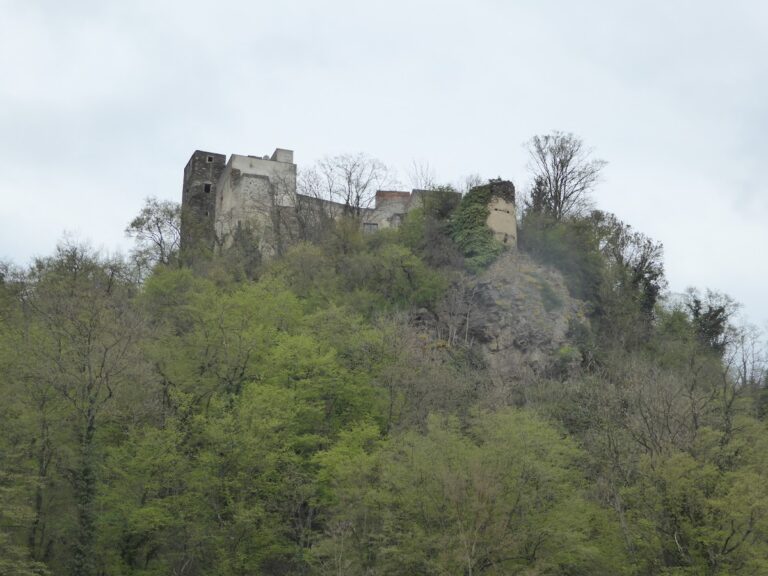
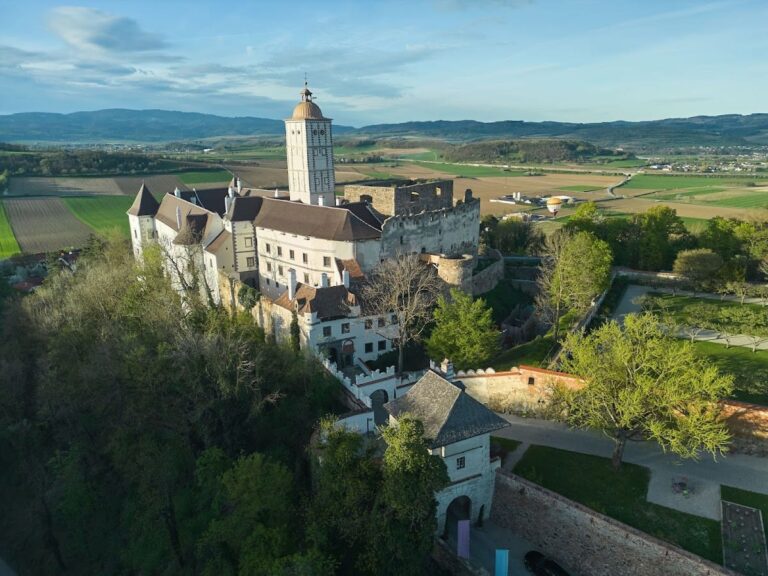
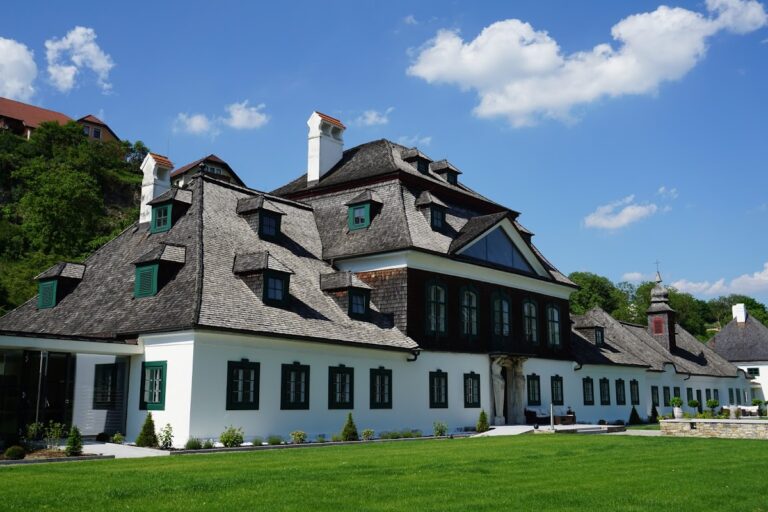
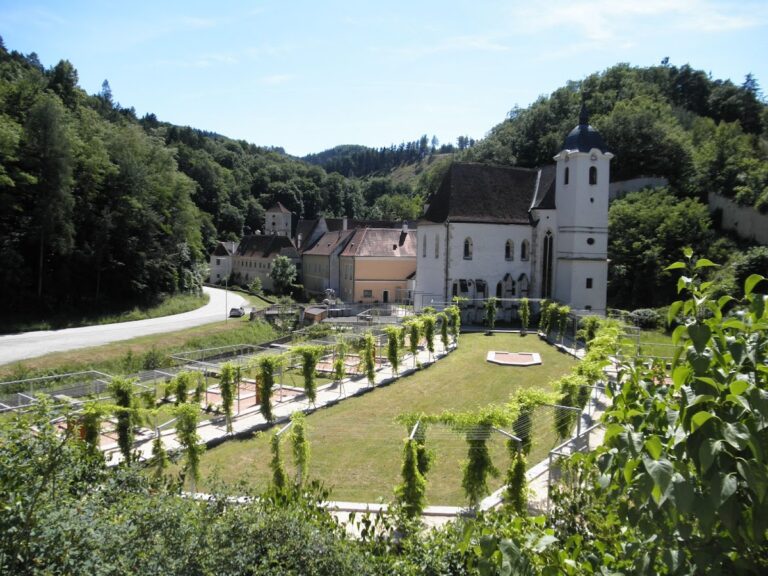
Schloss Sitzenthal forms part of a castle estate with surviving historic interiors, a remnant of a large farmyard, a nineteenth-century chapel, and an extensive park reaching the Pielach. The castle and farm buildings are in a condition greatly in need of improvement.
Castle interiors and chapel
Several interior rooms contain groin vaults, formed by the intersection of two barrel vaults. On the first floor, a six-bay hall has cross vaulting, with the intersecting curved surfaces carried by columns and resting on round arches. The hall was built around the transition from the sixteenth to the seventeenth century. Schloss Sitzenthal was also noted for the quality of its interior furnishings.
The castle chapel, dedicated to Saint Joseph, was installed in 1869 and furnished in the style of that period. Its creation belongs to the nineteenth-century phase of the estate’s development and remains part of the castle’s interior arrangement.
Farmyard and park
A very large, hook-shaped farmyard once accompanied the castle. It was constructed in the first half of the seventeenth century. Only its single-storey wing on the mountain side survives from the original farmyard. Later additions expanded this remnant into a four-sided complex.
An extensive English-style park surrounds Schloss Sitzenthal and reaches the Pielach. The park forms part of the estate landscape alongside the castle and its agricultural buildings.
Nearby sites