Schloss Hüffe: A Late Baroque Manor Estate in Germany


Site at a Glance
- Rating
- 3.2
- Popularity
- Very Low
- Country
- Germany
- Primary era
- Early Modern
- Eras represented
- Early Modern
- Civilizations
- Holy Roman Empire, Kingdom of Prussia
- Site type
- Domestic
- Remains
- Manor House
On this page9 sections
History
Schloss Hüffe is a moated manor estate in Germany, in Lashorst, now a district of Preußisch Oldendorf. The site reaches back at least to the fifteenth century, while its present manor house was built between 1774 and 1782 in the style of late Baroque classicism. Together with nearby Schloss Hollwinkel, Hüffe served as a western outpost of the Prince-Bishopric of Minden, a territory ruled by a prince who held both religious and secular authority.
Medieval and early modern estate
A document from 1229 mentions a family called “von Huffe,” although its connection with the Hüffe estate remains uncertain. The estate itself is securely recorded from 1439. The von Schloen family, also known as Gehle, originally held Hüffe and Schloss Hollwinkel. The boundary between the County of Ravensberg and the Prince-Bishopric of Minden ran through lands associated with the estate, and disputes over territory and inheritance continued until the eighteenth century.
Hüffe was a knightly estate in the County of Ravensberg. Its owner therefore held recognized political rights and could be represented in the territorial assembly. Christoph von Wrisberg, who owned the estate from 1554 to 1580 and commanded mercenary troops, became deeply involved in violent disputes with the owners of Schloss Hollwinkel. A later conflict reached the Imperial Chamber Court in 1609. This supreme court of the Holy Roman Empire dealt in part with disputes between territorial rulers and estates.
The Cornberg dispute
Philipp Wilhelm von Cornberg bought Schloss Hüffe in 1593. His renewed conflict with the von Schloen, or Gehle, family was eventually decided in his favor with help from the Landgrave of Hesse. The family’s appeal to the Prince-Bishopric of Minden brought Hesse-Kassel close to war with Minden. After extended litigation and settlement negotiations, von Cornberg secured the estate for himself and his descendants shortly before his death.
Eighteenth-century rebuilding
Friedrich Christian Arnold von Jungkenn, a Hessian general and minister of war, acquired the deteriorated estate in 1773 in exchange for Gut Lübrassen near Bielefeld. Schloss Hüffe and its park were then created in their present form between 1775 and 1784. Von Jungkenn died without children and was buried on a burial island in the park. His niece Frederike von Romberg inherited the estate, followed by her only son, Friedrich von Vely-Jungkenn.
From 1871 to 1886, Wilhelm Hohoff served as chaplain at Schloss Hüffe under Baron von Vely-Jungkenn. A chaplain provided religious services for a particular household, institution, or community. The von Jungkenn family retained ownership until 1947.
Twentieth-century changes
In 1947, Baroness von Vittinghoff-Schell, a niece of the von Jungkenn family, transferred the castle to the Westphalia-Lippe regional association of the German Red Cross. The family initially retained the surrounding lands. The Red Cross operated the complex as a convalescent home for people returning from war and later used its buildings as an old-age and nursing home until 1977.
Hartmut Krukemeyer acquired the estate in 1977 and invested several million Deutsche Mark in restoring the castle, park, and surrounding buildings. He had founded a clinic near Osnabrück in 1970, which developed into the private Paracelsus Clinics hospital group. Krukemeyer received the Grand Cross of the Order of Merit of the Federal Republic of Germany in 1990 and died in 1994. His widow, Katharina Countess von Schwerin-Krukemeyer, then owned and occupied the castle until her death in 2015. The heirs named in her will rejected the inheritance.
A merchant from the Emsland acquired the castle, ancillary buildings, and lands in March 2019. At the end of that year, the castle and park were sold again without most of the lands. The property is privately owned.
Changes to the estate district
In the 1840s, the Hüffe estate district was separated from the municipality of Alswede within the Alswede administrative office of the Lübbecke district. The estate district was dissolved on 1 October 1928 and incorporated into the then municipality of Lashorst.
Remains
Manor house and moated island
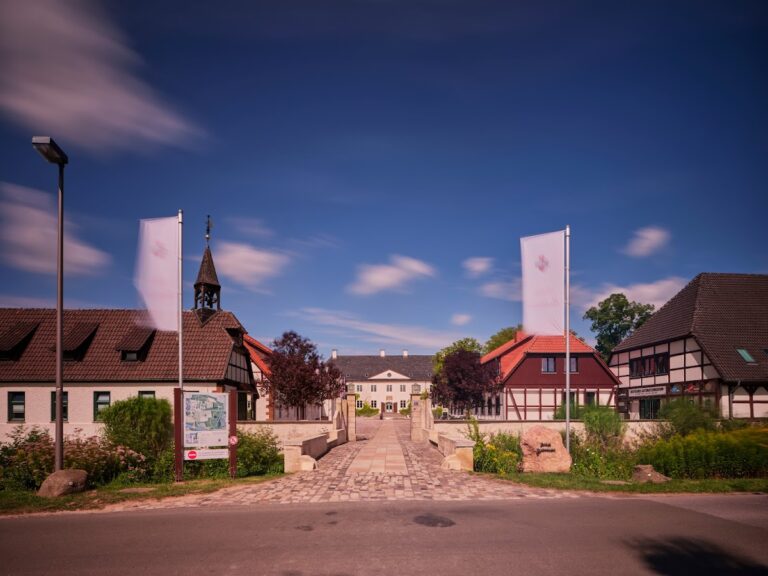
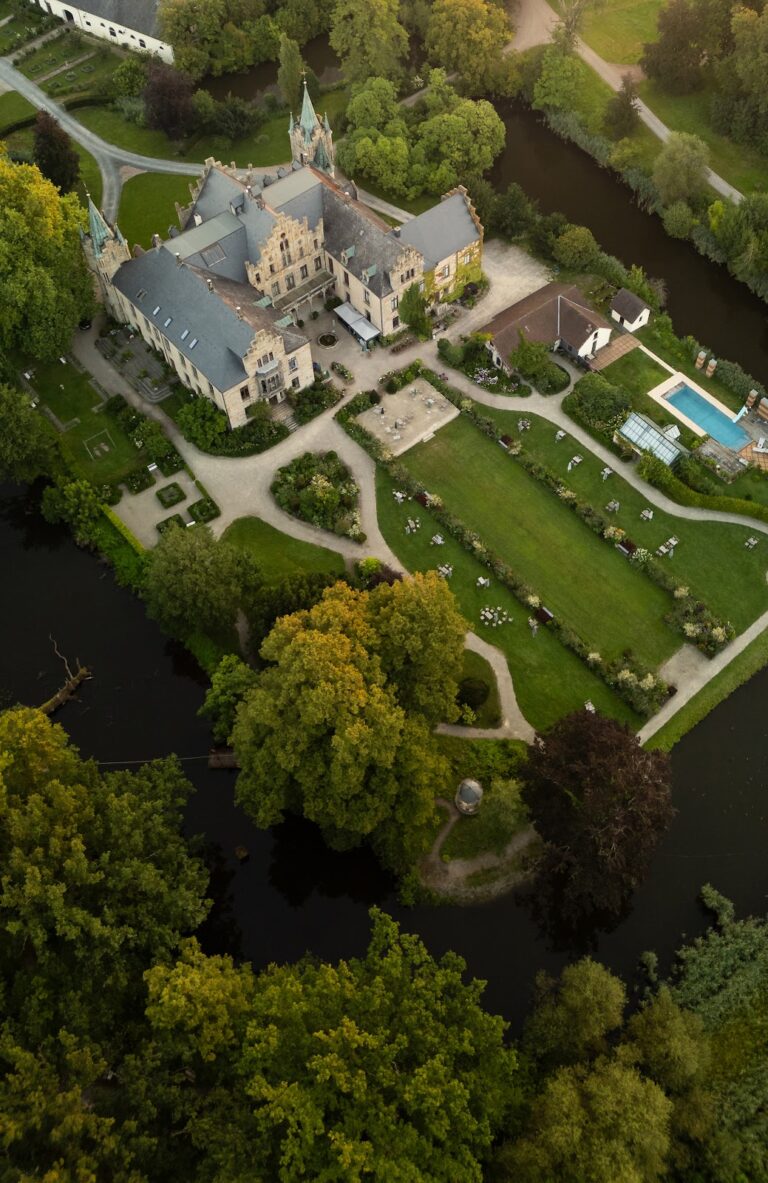
The complex covers approximately 13.5 hectares in the Alsweder lowland, south of the Mittelland Canal. The present manor house stands on an island surrounded by moats. It was built from 1774 to 1782 after an earlier building had been demolished. Its design is probably attributable to Simon Louis du Ry, an architect and senior building official active in Kassel.
Schloss Hüffe is described as the only structure in the wider surrounding area built in the style of late Baroque classicism, which combines Baroque decoration with the more restrained and formally ordered language of classicism. The exterior is restrained, while the interior contains abundant stucco decoration. The central section includes the Mirror Hall, a particularly notable interior space.
Park and burial island
Court gardener Pierre Bourguignon began laying out the park in 1775. Associated with Kassel’s courtly garden design, he created a long sightline through the grounds toward the Wiehen Hills. The park also contains the burial island where Friedrich Christian Arnold von Jungkenn was buried.
Nearby sites