Kotuliński Palace in Czechowice-Dziedzice: A Rococo Aristocratic Residence


Site at a Glance
- Rating
- 4.4
- Popularity
- Very Low
- Country
- Poland
- Primary era
- Early Modern
- Eras represented
- Early Modern, Modern
- Civilizations
- Habsburg, Holy Roman Empire
- Site type
- Domestic
- Remains
- Elite Residence
On this page6 sections
History
Kotuliński Palace is a Rococo residence in Poland, built in the 1730s for the Kotuliński family in Czechowice-Dziedzice. Czechowice was acquired in 1675 by Fryderyk Aleksander, Baron Kotuliński of Kotulin. His son and successor, Franciszek Karol Kotuliński, held the offices of archchancellor of Lower and Upper Silesia, a senior chancellery position, and starosta of the Duchy of Głogów, a high-ranking administrative office. Around 1730, he decided to build a residence suited to his position.
The Kotuliński and Renard Families
Count Andrzej Renard purchased Czechowice, the palace, and the associated estate in 1765 for 62,000 Rhine guilders, a historical currency used in the Rhineland and parts of Central Europe. The Renard family retained the property until 1856 and improved both the palace and its grounds during that period.
Later owners included Baron Bernhard Heldreich, Joseph Heiser, and the Ödenburger Allgemeine Bank of Sopron in Hungary. Heiser transferred the palace as a dowry to his daughter Paulina, who later married Baron Edward Raaben. Before nationalization, the property was owned by the Zipser family, factory owners from nearby Bielsko.
Nationalization and Restoration
The palace was nationalized in 1945 and subsequently housed an agricultural school. Ownership passed to the city of Czechowice-Dziedzice in the early 1990s, after which the building operated as a professional development center.
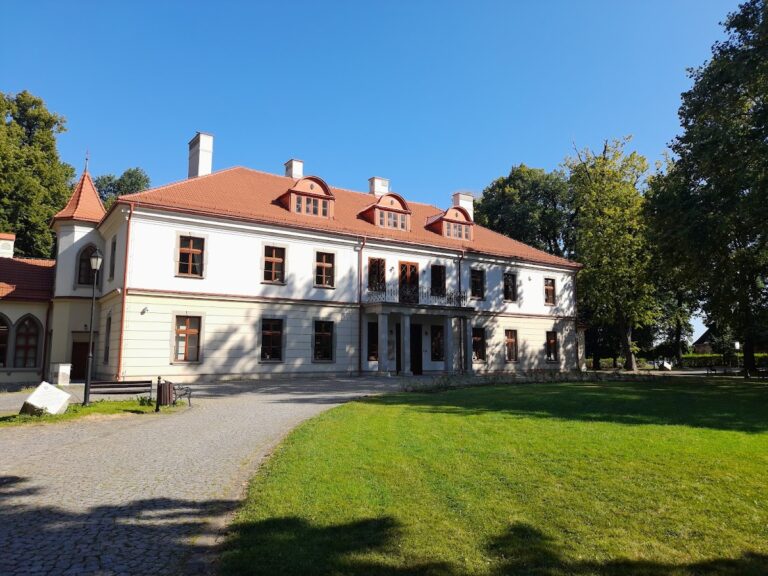
Pascal Polska purchased the palace in 2001 with plans to convert it into a luxury hotel, but financial difficulties prevented completion. Polplast acquired the property in October 2006 and carried out measures to protect it from further deterioration. The Rococo palace was then thoroughly restored, its interiors and park were returned to their historic appearance, and the building was converted into a four-star hotel. The renovation received co-financing from the Provincial Conservator of Monuments in Katowice.
On 4 September 2017, the District Court in Bielsko-Biała declared Polplast bankrupt. The palace was offered for sale, with a starting price of 5.2 million zloty at the first auction. After that auction attracted no interest, historic furnishings were excluded from the second sale. The palace was subsequently acquired by the private entrepreneur Piotr Londzin. It had been entered in the register of monuments on 24 February 1960 under registration number 28/60.
Remains
The Palace
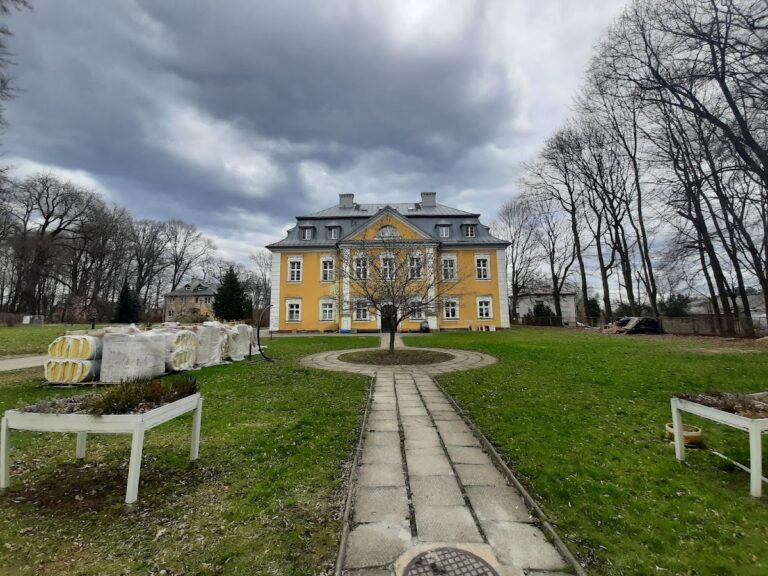
The surviving building is a Rococo residence at Zamkowa Street 2. Its facade is crowned by an avant-corps, a section projecting from the main wall. The triangular tympanum, the framed field beneath a gable, carries the Renard family coat of arms, supported by two lions. This feature reflects the period when the Renards owned and improved the estate.
Garden, Orchard, and Veranda
The grounds include a park associated with the palace, whose historic appearance was restored during the renovation after 2006. During the Renard family’s ownership, the estate was expanded with a flower garden, a fruit orchard, and a gardener’s house.
At the beginning of the twentieth century, a three-sided glazed veranda was added to the rear of the palace at ground-floor level. The veranda housed a winter garden and forms a later addition to the 18th-century residence.
Nearby sites