Schloss Oberweis: A Historic Castle and Landscape Estate in Austria

Site at a Glance
- Rating
- 3.4
- Popularity
- Very Low
- Country
- Austria
- Primary era
- Modern
- Eras represented
- Medieval, Modern
- Civilizations
- Habsburg, Holy Roman Empire
- Site type
- Domestic
- Remains
- Castle
On this page8 sections
History
Schloss Oberweis is a historic castle in Austria, located in Laakirchen. It was first recorded in 1383 as a fief, meaning property held from a superior lord in return for obligations or service, held by Ulrich Aboltinger of Abolting, also identified as Ainwalding, under the Lordship of Ort. The estate later became a princely fief held directly from the territorial ruler, and its long history reflects repeated transfers through inheritance, marriage, and purchase.
Medieval and early modern ownership
The Aboltinger family held the knightly fief until 1446, when it passed to the Geymann family, whose ownership was entered in the Ort land register. Such a register, known as an Urbar, recorded estates, rights, and related obligations. In 1484, Magdalena Geymann brought Oberweis to her husband, Walter Hauser, as a marriage portion. Because the estate had by then become a fief held directly from the territorial prince, Emperor Frederick III, the fifteenth-century Holy Roman Emperor, enfeoffed Hauser with it.
Oberweis subsequently passed by inheritance to the Greisenegger family. Erasmus Greisenegger sold the castle to Benedikt Pirchinger in 1512, and Pirchinger sold it to Wolfgang Jörger in 1514. Later that year, Oberweis passed to Ulrich Perkheimer. In 1519, Perkheimer transferred the castle and estate to his daughter, who was married to Michael Weichselpaumer, as her marriage portion.
Marriage continued to shape the estate’s ownership. Oberweis passed to Veit Traint in 1566, Michael Weinzierl in 1580, and Daniel Hofmandl in 1610. Johann Spindler of Hofegg purchased it in 1626 and was enfeoffed with it by the emperor in the same year. In 1671, the estate passed through a purchase to Ritter von Sparr. Baron Karl Quintin Josef von Grienthal acquired Oberweis in 1695 and remained associated with it until his death in 1724.
Nineteenth-century renewal
After von Grienthal’s widow remarried, Oberweis passed to her daughter, Maria Elisabeth Theresia, and her husband, Baron Johann Georg Emanuel von Hoheneck. The Hoheneck family sold the estate to Baron Ferdinand von Imsland in 1799. Alois Haselmayr of Fernstein became its owner in 1808.
Haselmayr’s son, Alois, served as an imperial-royal postmaster in Lambach. In 1843, he completely renewed Oberweis and gave the castle its present appearance. He also arranged the grounds as a landscape park, creating the setting that remains associated with the estate.
Ownership changed again during the later nineteenth century. Ignaz Mayr, a shipmaster from Linz, acquired Oberweis in 1864, followed by Anton Haase of Buchstein in 1871 and First Lieutenant Hans Ohn in 1890. Gustav and Maria Clemm owned it in 1910. The Weller family held the estate after 1911, when Bruno Heisig, the municipal master builder of Gmunden, remodelled Oberweis.
Schloss Oberweis under Nazi rule
The castle acquired a disturbing role during the Second World War. Lebensborn, an SS organization established under Nazi rule and associated with racial and population policy, purchased Schloss Oberweis on 9 April 1938. Because the building was in very poor condition, the organization initially intended to resell it. Instead, it established the Alpenland home there from 1943 under the direction of Maria Knipp-Merkel.
The home primarily served the Nazi regime’s forced Germanization of Polish children and children from the Banat and southern Styria. Germanization was the coercive removal of children from their original national and family environments to place them within German society. Three children from Lidice were also housed there. Their parents had been murdered during the Nazi reprisal operation that destroyed the Czech village of Lidice in 1942.
The Gestapo, the Nazi German secret state police, supplied the home with furnishings, sanitary equipment, and books taken from Jewish owners. These wartime uses form an essential part of Schloss Oberweis’s modern history and interpretation.
Later ownership and present status
Retired cavalry captain Karl Weller remained the owner until 1960, when Oberweis passed to Josef Swoboda. Since 2003, Carvatech Karosserie- und Kabinenbau GmbH has been based at the site, while the owners use the castle as a residential complex. Schloss Oberweis remains privately owned and is protected as a historic monument.
Remains
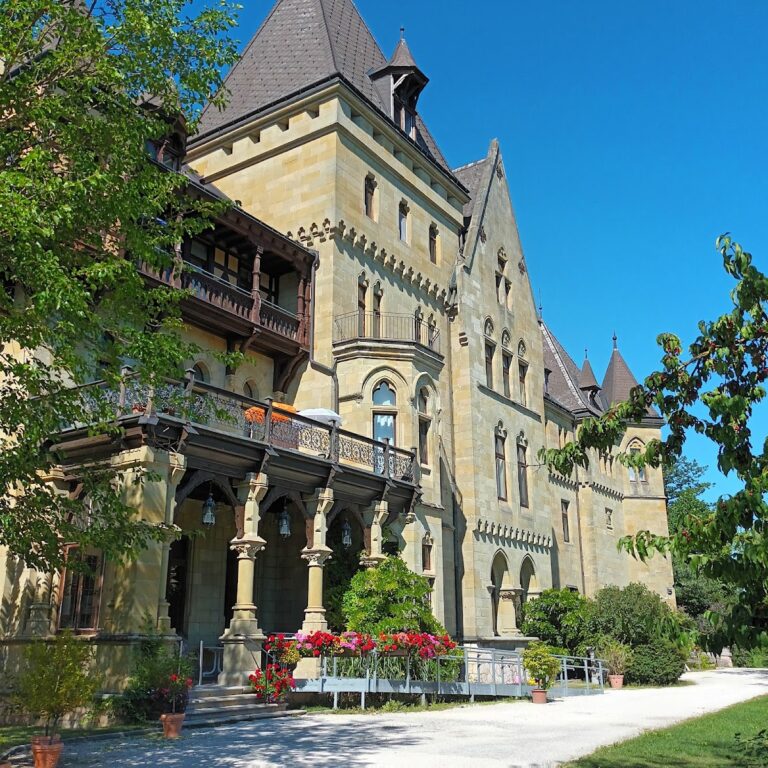
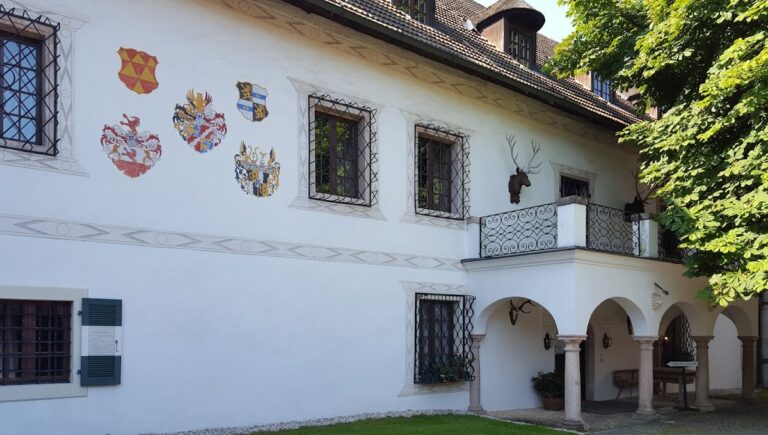
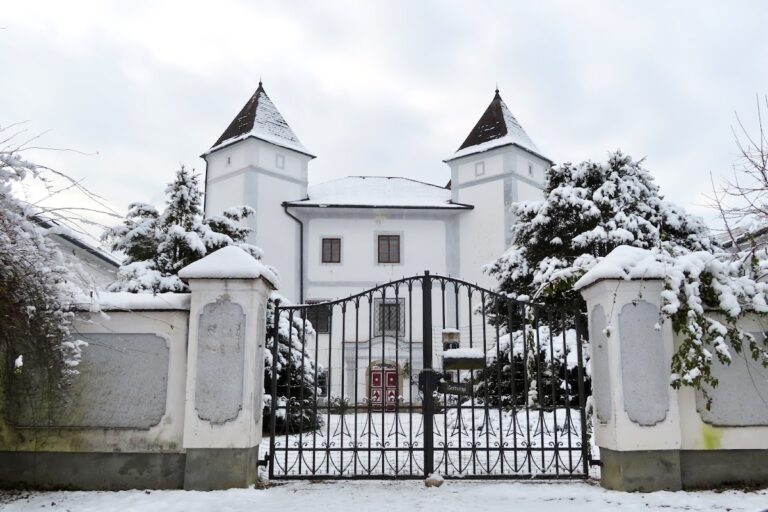
Schloss Oberweis is a three-storey, hook-shaped building with a hipped roof, set within a landscaped park. Its principal facade faces the pond complex. A continuous cornice runs across the building, while the ground floor has ashlar-style render, a finish designed to resemble regularly cut stone. On the garden side, a balcony is supported by two stone columns.
Castle building
The building’s present form dates from the comprehensive renewal of 1843, when Alois Haselmayr reshaped the castle and established its landscaped setting. The three-storey structure combines the hook-shaped plan with a hipped roof and a continuous cornice. Its garden-side balcony and stone supports form part of the surviving exterior, while the ground-floor ashlar-style render distinguishes the lower level from the rest of the facade.
Park and water features
The grounds form a connected architectural and landscaped setting around the castle. The landscape garden was laid out during the 1843 renewal. Garden figures date from the second half of the nineteenth century. A pond complex with an artificial island was added in 1966, extending the designed water features of the estate.
Nearby sites