Palazzo Primoli: A Historic Palace and Cultural Center in Rome
Site at a Glance
- Rating
- 4.9
- Popularity
- Very Low
- Country
- Italy
- Primary era
- Early Modern
- External website
- Open
- Eras represented
- Early Modern, Modern
- Civilizations
- Italian, Papal States
- Site type
- Domestic
- Remains
- Elite Residence
On this page8 sections
History
Palazzo Primoli is a sixteenth-century palace in Rome, Italy, whose present form combines historic fabric with a neo-Renaissance renovation carried out between 1904 and 1911. Its history is closely connected with the Gottifredi, Filonardi, Primoli, and Bonaparte families, and it later became the setting for museums, a library, an archive, and a cultural salon.
From the Gottifredi to the Filonardi
Around 1500, the palace belonged to the Roman Gottifredi family. Around 1600 it passed to the heirs Bruto and Francesco Gottifredi, and about a century later it came into the possession of the Filonardi family. The Filonardi retained the property until the end of the eighteenth century.
The Primoli family and the Bonaparte connection
Count Luigi Primoli acquired the first floor around 1820 and later obtained the entire building, moving there with his family. His son Pietro Primoli, Count of Foglia, married Charlotte Bonaparte in 1848. The Bonaparte family was the dynasty associated with Napoleon I and his relatives, and this marriage linked the Primoli family to that wider historical network.
Pietro lived in the palace for approximately five years before moving to Paris with Charlotte and their three sons in 1853. He returned to Rome in 1870. In 1901, Count Giuseppe Primoli became the palace’s sole owner. A descendant of the Bonaparte family, he formed the Napoleonic collection that later became the Museo Napoleonico and recorded the relationship between Rome and the Bonaparte family. He was also a dedicated photographer and made the palace an important literary and cultural salon in Rome.
Early twentieth-century transformation
Giuseppe Primoli expanded the property by purchasing two adjoining buildings and commissioned the Roman architect Raffaello Ojetti to renovate and partly modernize the complex. The work, undertaken from 1904 to 1911, followed the opening of Via Zanardelli, the construction of Ponte Umberto I, and embankment works along the Tiber. During the 1920s, the palace temporarily housed the Embassy of France to the Holy See while Jean Doulcet was serving as its representative.
Bequest and later cultural uses
Giuseppe Primoli died in 1927 and left the palace and his collections to the City of Rome. The property is now held by the Fondazione Primoli and the City of Rome. His bequest established the basis of the Museo Napoleonico, which occupies approximately ten rooms on the ground floor. The palace also houses the Fondazione Primoli, its library, and Primoli’s photographic archive.
Mario Praz, an Italian scholar, writer, and collector known for his work on art and cultural history, moved into the third floor in 1969 and lived there until his death in 1982. The Museo Mario Praz was established in June 1995 after several years of legal procedures in his former apartment. The museum now belongs to the National Gallery of Modern and Contemporary Art. Thousands of volumes from Praz’s library were transferred to the Fondazione Primoli, and the palace continues to accommodate the foundation, both museums, the library, the photographic archive, and other collections.
Remains
Exterior and architectural ensemble
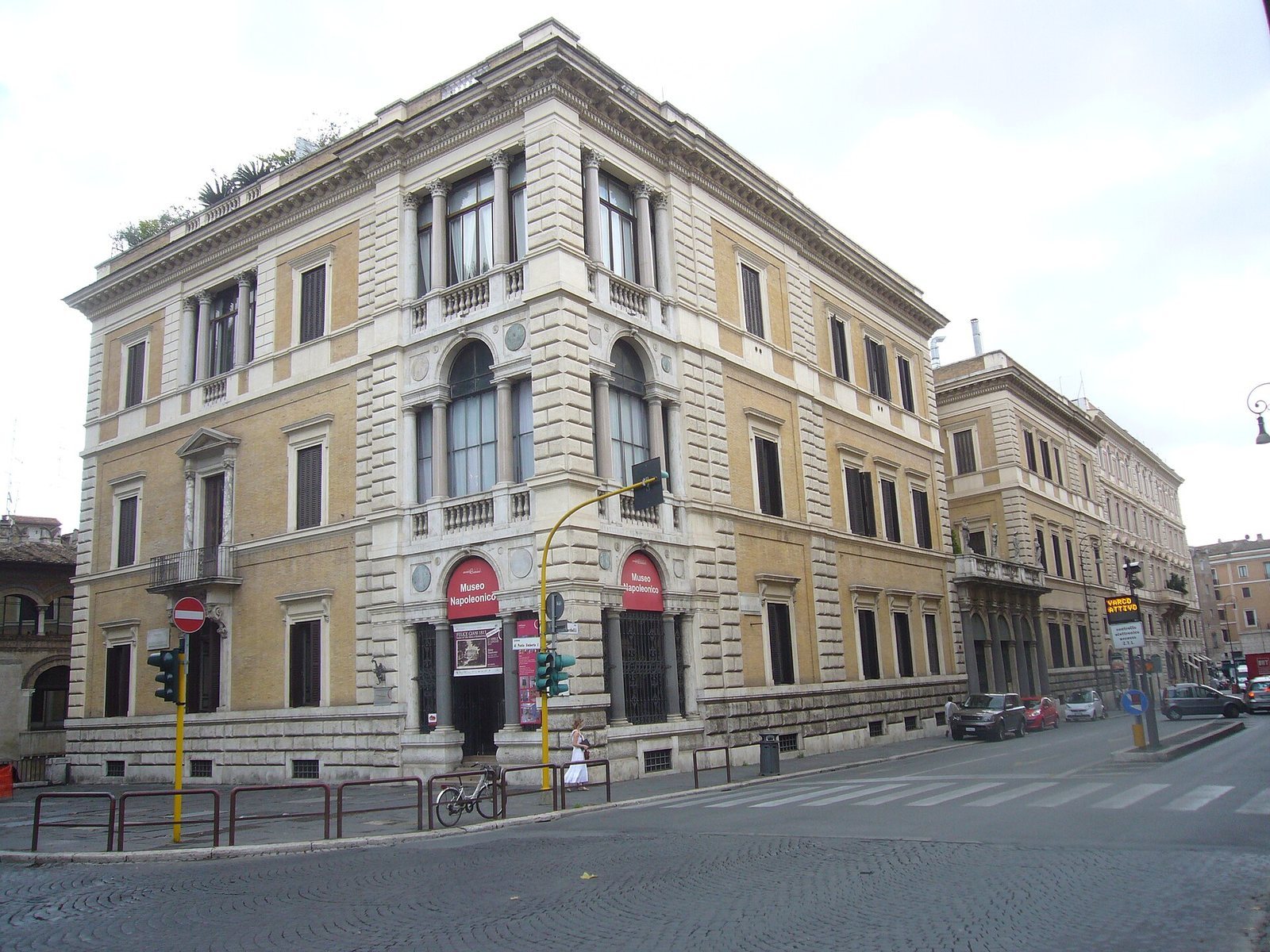
Palazzo Primoli stands at Via Giuseppe Zanardelli 1, at the corner of Piazza di Ponte Umberto, beside the Tiber in Rome’s Ponte district. The original palace was a relatively small building bounded by Vicolo Altemps, Piazzetta dell’Orso, and Vicolo della Fontana Secca. During the renovation of 1904 to 1911, the façade facing Piazzetta dell’Orso was demolished and replaced by a new building at the corner of Via Zanardelli. Ojetti incorporated the earlier palace into a unified complex with a neo-Renaissance appearance, a monumental entrance, and a new façade facing Piazza di Ponte Umberto. The ensemble combines brick, travertine, a porous limestone widely used in Roman construction, and polychrome marble in several colors.
Decorative features and museum interiors
Friezes in rooms III and V show the Primoli lion and the Bonaparte eagle. They were created in connection with the 1848 marriage of Pietro Primoli and Charlotte Bonaparte. In 1909, Marchesa Chigi-Zondadari commissioned the painter Arturo Viligiardi to create a canvas of Flora as a ceiling decoration for one of the rooms.
The Museo Napoleonico occupies the ground floor, while the Museo Mario Praz occupies the third floor and preserves the former arrangement of Praz’s apartment. When the museum was recreated, its furniture, paintings, and objects were placed in their exact former positions. The Fondazione Primoli’s library contains more than 30,000 volumes on literature, history, and art, and the palace also preserves Primoli’s photographic archive. The building remains active and continues to be used for these cultural collections and institutions.