Palácio Belmonte: A Historic Palace in Lisbon, Portugal

Site at a Glance
- Rating
- 4.5
- Popularity
- Very Low
- Country
- Portugal
- Primary era
- Early Modern
- Eras represented
- Classical, Medieval, Early Modern, Modern
- Civilizations
- Portuguese, Roman
- Site type
- Domestic
- Remains
- Elite Residence
On this page11 sections
History
Palácio Belmonte is one of Lisbon’s oldest palaces, built in Portugal over Roman and Moorish remains during the medieval period. Its first construction dates to 1449, when Brás Afonso Correia, an official at the court of King Manuel I and Lisbon’s inspector-general, began developing the site near the ancient alcáçova, a fortified citadel or palace.
Medieval Foundations and Early Palace
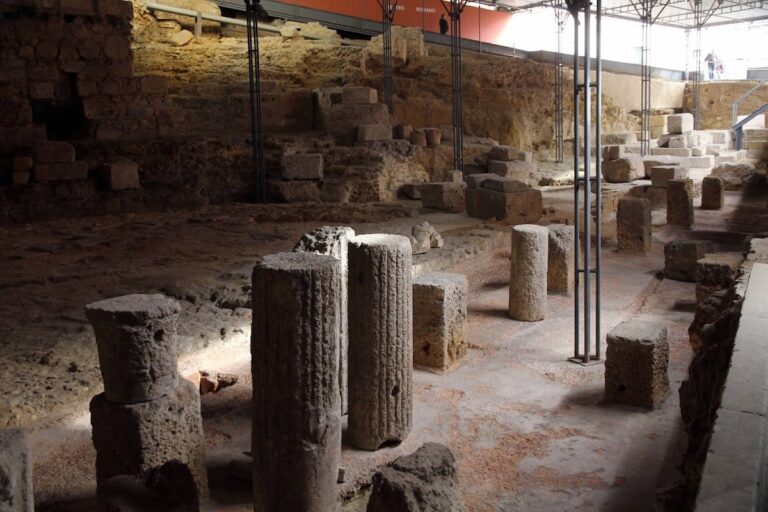
The palace stands above Roman and Moorish ruins associated with the old citadel and the Cerca moura, Lisbon’s medieval Moorish defensive wall. These earlier walls were regarded as approximately 1,500 years old when the palace was built. Riu de Figueiredo later brought together land, older houses, a yard, and a stable to form a larger manor-house complex.
In 1503, Pedro Álvares Cabral built the first part of the present palace after leading the 1500 expedition traditionally credited with the European arrival in Brazil. The building’s setting in Alfama, the primitive nucleus of Lisbon, placed it within a neighborhood connected to major national events. Vasco da Gama was received at the palace after returning from India, Gil Vicente presented his first play there, and the chronicler Fernão Lopes wrote his chronicles within its walls.
Seventeenth- and Eighteenth-Century Development
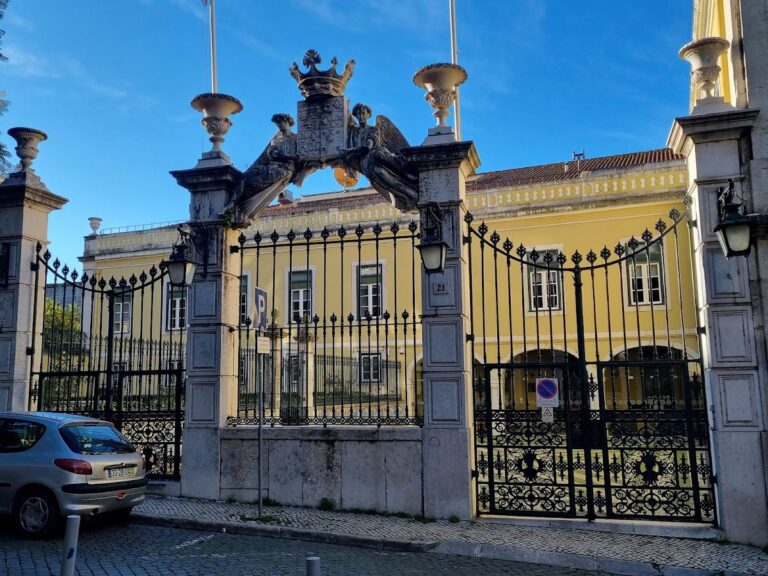
The palace underwent its most substantial restoration in 1640. This phase enlarged the complex with the area now called the Terrace Suites and added five classical-style façades. Those façades form much of the palace’s visible appearance today.
Between 1720 and 1730, the Portuguese tile masters Manuel Santos and Valentim de Almeida contributed to a collection of 59 panels containing more than 30,000 tiles. Their subjects include episodes from Christianity and scenes from the Portuguese court of the period. Together with the eighteenth-century fireplace and the garden, the tile collection contributed to the palace’s recognition as a National Heritage site, a formal designation for places valued for their cultural or historical importance.
Restoration and Contemporary Use
Frederic Coustouls purchased and restored Palácio Belmonte in 1994 with assistance from the city of Lisbon and the European Union. The work reshaped the interiors into intimate spaces and rooms with distinctive character. It also introduced measures intended to support sustainable design, including heavy insulation, large windows, and natural ventilation.
After the restoration, the palace operated as a luxury hotel with ten suites. Several suites bear the names of figures from Portuguese history, including Fernão Magalhães, Egas Moniz, Fernão Mendes Pinto, Gil Vicente, and Bartolomeu de Gusmão. The Belmonte Cultural Club also operates within the palace as an exhibition space and live-music venue, curated and managed by the museum WOA, or Way Of Arts.
Remains
Fortifications and Historic Fabric
Medieval Keep and Defensive Walls
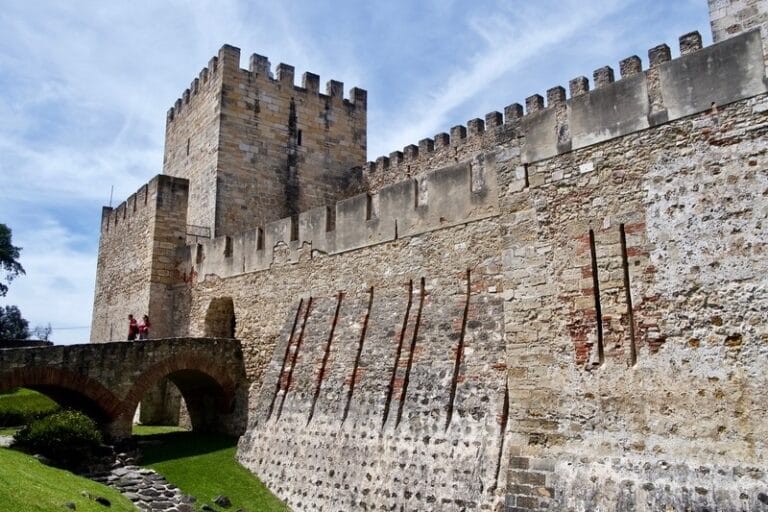
The oldest surviving elements include a medieval keep and fortifications raised on Roman and Moorish foundations. Their construction incorporates architectural influences from both earlier traditions. The historic complex also included surrounding walls, a doorway known as D. Fradique, a turret, and two towers dating from the fifteenth and sixteenth centuries.
Palace Structure and Interiors
Within the palace, vaulted ceilings, arched doorways, and painted frescoes preserve aspects of its historic architectural character. The main door carries the arms of the Figueiredo family, showing five fig leaves, together with the inscription “Pro Deo Pro Patria PN AM.” The restored rooms retain an intimate arrangement and individually distinctive character, while heavy insulation, large windows, and natural ventilation form part of the later intervention.
Decorative Features and Garden
Tile Panels
The palace’s collection of 59 tile panels contains more than 30,000 tiles. The panels portray Christian episodes and scenes from the Portuguese court of the eighteenth century, linking the decorative program to the palace’s period of artistic development between 1720 and 1730.
Fireplace and Garden
An eighteenth-century fireplace forms another notable interior feature. The palace garden provides views over Alfama, the monastery and church complex of São Vicente de Fora, and the Tagus River.
Nearby sites