Rânes Castle: A Historic Aristocratic Residence in France


Site at a Glance
- Rating
- 4.6
- Popularity
- Very Low
- Country
- France
- Primary era
- Medieval
- External website
- Open
- Eras represented
- Medieval, Early Modern
- Civilizations
- French
- Site type
- Domestic
- Remains
- Castle
On this page10 sections
History
Rânes Castle is a former aristocratic residence in Rânes, France, built during the fourteenth and fifteenth centuries and reconstructed in the eighteenth century. First recorded in 1372, it changed hands between French and English control during the Hundred Years’ War, before later becoming a municipal center and public heritage site.
Medieval Ownership and the Hundred Years’ War
For nearly nine centuries, the château remained within the same lineage through male succession and marriage. Its ownership passed through the families of Beaumont, Méheudin, Saint-Germain, Harcourt, Pont-Bellenger, Argouges, Montreuil, Broglie, and Berghes-Saint-Winock.
During the Hundred Years’ War, a prolonged conflict between England and France, the château moved from French to English control and then returned to France. From 1419 to 1450, Henry V of England, whose reign formed part of England’s military and political expansion in France, confiscated it from Samson II de Saint-Germain, a supporter of the French king. He granted the property to Gérard Huyn, also recorded as Guérard Hungh, an aide to Talbot, the governor of Falaise Castle.
From Barony to Marquisate
In 1550, Renée du Pont-Bellenger brought the barony of Rânes to Jean d’Argouges. In 1670, Louis XIV, king of France from 1643 to 1715, raised the barony of Ranne to a marquisate for Henri d’Argouges. A marquisate was a hereditary territorial rank associated with a marquis.
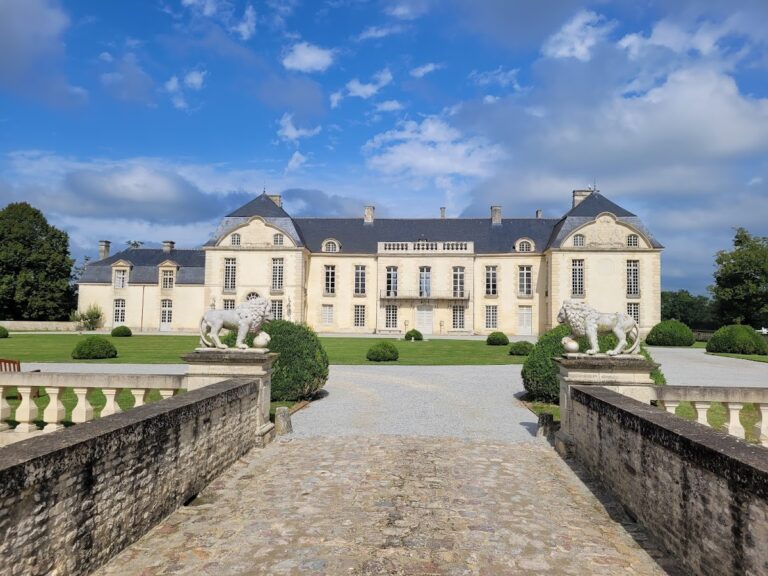
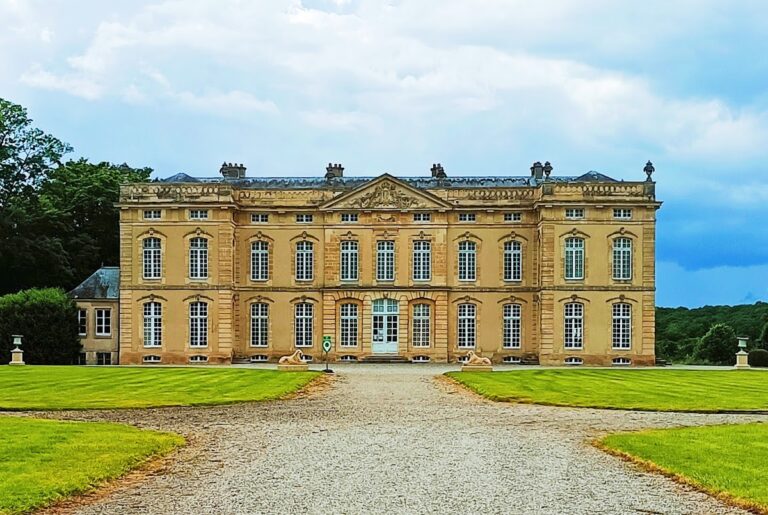
A major fire devastated the château in 1719. Louis d’Argouges, Marquis of Rannes and a field marshal in the king’s army, rebuilt and enlarged the residence. The reconstructed eighteenth-century form became the principal expression of the château’s later history.
Revolution, Sale, and Municipal Transformation
During the French Revolution, the château largely escaped the destruction that affected many aristocratic residences. Only part of its archives was burned, on 25 July 1789, when the property belonged to Prince Victor-Amédée de Broglie.
The nineteenth century brought few major changes. Pierre de Berghes, the elder of the château’s owners, died in 1871 from the consequences of the Battle of Sedan, and the park was redesigned in the English style. After Ghislain de Berghes died without issue in 1907, the château ceased to function as an aristocratic residence. It was sold on 3 June 1908 to Richard and Bernard, described as non-noble owners, one an officer and the other a chevalier of the Legion of Honour. Commander Charles Richard and later his son Claude owned it for about forty years.
During the fighting of the Liberation in August 1944, the château narrowly escaped severe bombardment. Bombs, shells, and fires devastated part of Rânes and killed about fifty inhabitants, including people in the château’s outbuildings.
The commune of Rânes acquired the château in 1947. Its buildings were adapted for municipal offices, a gendarmerie barracks, a post office, a tax office, a community hall, housing, and other uses. A gendarmerie barracks housed personnel of the French national police force with military status. These changes made the château the civic center of Rânes.
Heritage and Museum Use
The château has also been used as a museum. In 2020, the public could enter a prehistory museum through the main courtyard, including the château’s keep, and visit the landscaped park. The facades and roofs were listed as historic monuments by an order dated 5 May 1975.
Remains
Keep and Main Buildings
Fortified Keep
The principal surviving form combines a square residential keep with chamfered corners and a central facade dating from the seventeenth and eighteenth centuries. Built in granite at the beginning of the fifteenth century by Guillaume de Méheudin, the keep has a ground floor, two upper stories, crenellations, and machicolations. A keep was the principal fortified tower of a castle and often served as both stronghold and residence. Its machicolations are projecting defensive structures with openings through which defenders could discharge missiles onto attackers below.
Late Medieval Pavilions
Two pavilions dating from the late fifteenth century flank the main facade. They were altered in the seventeenth century, forming part of the château’s combination of medieval fabric and later residential design. The château stands opposite the Church of Notre-Dame-de-l’Assomption in the town of Rânes.
Park and Water Features
The present park is a surviving portion of a former 120-hectare estate. It was laid out according to a seventeenth-century tradition attributed to André Le Nôtre, the leading French landscape designer associated with the formal gardens of Versailles.
On the La Ferté-Macé side, a ha-ha, or concealed sunken ditch, is cut into the park’s outer wall. It was sometimes incorrectly identified as part of the moat of the fifteenth-century feudal château. Instead, it was created with the new park to extend the western view while restricting intrusion across its boundary.
The park’s large pond was later adapted as a bathing area, becoming the swimming pool of the 1950s. In the period of municipal ownership, the wider park was organized as a multipurpose public garden containing a municipal stadium, a swimming area, a racecourse, and a campsite.
Nearby sites