Palais archiépiscopal de Lyon: Medieval Episcopal Residence in France


Site at a Glance
- Rating
- 4.1
- Popularity
- Very Low
- Country
- France
- Primary era
- Medieval
- Eras represented
- Medieval, Early Modern
- Civilizations
- French, Holy Roman Empire
- Site type
- Religious
- Remains
- Palace
On this page8 sections
History
The Palais archiépiscopal de Lyon, also known as the Palais Saint-Jean, is a medieval-origin palace in France that served as the residence of Lyon’s bishops and archbishops for many centuries. An earlier episcopal building, called the domus ecclesiae by Gregory of Tours, a sixth-century bishop and historian, and by Leidrade, an early ninth-century archbishop of Lyon, has not been located, and excavations have not established whether it stood on this site.
Medieval establishment
The present palace was formally established under Bishop Humbert, who commissioned a complex with a northern and a southern tower. Archbishop Hugues de Die later added an atrium, an entrance court or forecourt, and decorated the palace chapel. His successor, Josserand, completed the chapel paintings and added an upper gallery in 1118.
About twenty years later, Archbishop Pierre I added a second storey and renovated the lower levels. In 1200, Archbishop Jean Belles-mains commissioned a kitchen. After Archbishop Renaud de Forez built the Château de Pierre Scize, the Palais Saint-Jean ceased to serve as an episcopal residence for several centuries.
Renaissance reoccupation
During the Renaissance, the palace returned to episcopal use after the Château de Pierre Scize was permanently requisitioned by the king of France. Archbishop Charles de Bourbon, a fifteenth-century French archbishop and member of the Bourbon dynasty, ordered major renovations around 1466, although he remained in Lyon only briefly.
Revolutionary and modern uses
The palace was confiscated during the French Revolution. From 1974, it was used to store Lyon’s municipal archives. It has been registered as a French historic monument since 17 April 1952, with protection covering its façades, roofs, and eighteenth-century woodwork in the large and small salons. The building now accommodates the Académie des sciences, belles-lettres et arts de Lyon, a learned institution devoted to scientific, literary, and artistic scholarship, and the library serving Lyon’s Fifth Arrondissement within the municipal library system.
Remains
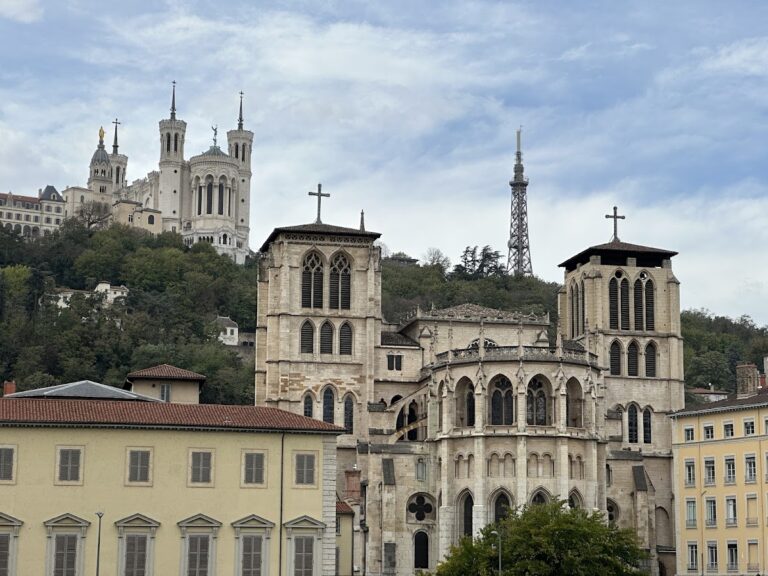
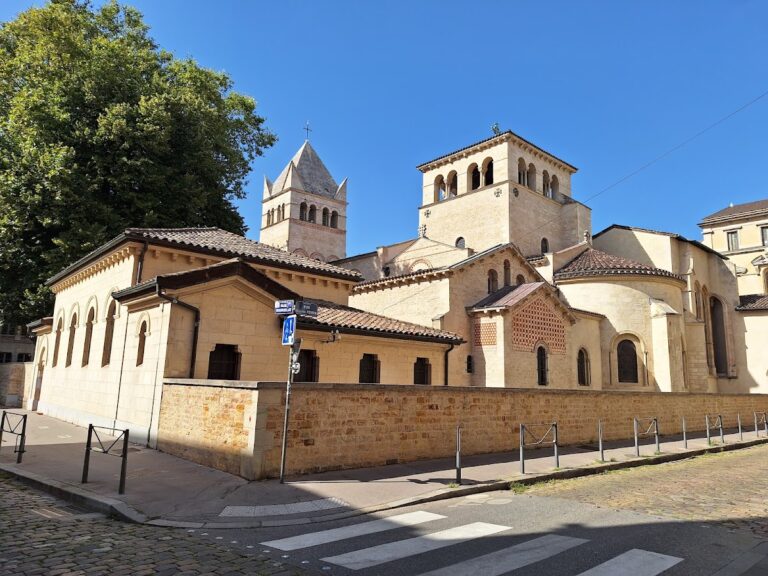
The Palais Saint-Jean stands in Lyon’s Fifth Arrondissement near the Primatial Church of Saint John. Its surviving fabric brings together a medieval towered complex, Renaissance additions, and protected eighteenth-century interiors. Later alterations changed the medieval structures, but both original towers remain part of the building.
Medieval complex
The medieval palace was organized around a northern tower and a southern tower. Both survive, although the southern tower has been truncated, while the northern tower still rises above the later building. The chapel retains the history of its medieval decoration, begun under Hugues de Die and completed under Josserand, together with the upper gallery added in 1118. The second storey and the renovated lower levels belong to the subsequent medieval enlargement, while the kitchen commissioned in 1200 forms another surviving element of the complex.
Renaissance additions
Renaissance work reshaped the palace with a large building range along the Saône. A chapel was built against the cathedral’s eastern end, or chevet, and a terrace covered the Rue des Estrées. The river-facing façade received a small sentry box, while a monumental gate was constructed on the northwestern side, opening toward the Rue de l’Archevêché.
Eighteenth-century interiors
Inside the palace, protected eighteenth-century woodwork survives in the large and small salons. These interiors form part of the monument’s legally protected fabric alongside its façades and roofs.
Nearby sites