Palazzo Nerucci: A Historic Palace and Art Collection in Castel del Piano


Site at a Glance
- Rating
- 4.2
- Popularity
- Very Low
- Country
- Italy
- Primary era
- Early Modern
- External website
- Open
- Eras represented
- Early Modern
- Civilizations
- Republic of Siena
- Site type
- Civic
- Remains
- Palace
On this page10 sections
History
Construction and civic use
Palazzo Nerucci is a historic palace in Castel del Piano, Italy, constructed in 1564 at the request of Domenico Nerucci. An important figure in the Vatican courts, Nerucci served as auditor to Cardinal Fornelli, fiscal auditor at Rome’s Campidoglio civic complex under Pope Gregory XIII, and appellate judge under Pope Sixtus V.
The palace’s design reflects Nerucci’s connections with Rome. It was inspired by the Farnesina, a sixteenth-century Roman villa designed by Baldassarre Peruzzi whose architecture and decoration influenced Renaissance palace design. Palazzo Nerucci later housed Castel del Piano’s municipal government until the offices moved to Palazzo Ginanneschi in 1937. From 1964, the building also accommodated a local secondary school.
Formation of the art collection
The palace’s art collection was established on its principal upper floor, known as the piano nobile, in 2005. It began with nine works donated by the family of Giuseppe Vegni to the Castel del Piano hospital in 1883. The collection remains owned by ASL 9 Grosseto, the local public health authority, and is loaned to the municipality. Its definitive inauguration took place on 1 July 2006.
The collection grew through the donation of Edo Cei’s youthful works, produced between 1952 and 1978, and through the later addition of wood sculptures by Piero Bonacina of Montegiovi. In July 2012, Bernard Le Huche’s painting The Fox entered the collection after the artist donated it to the Amiata Grossetano Museum System. The municipality also purchased further works, including an Annunciation from the workshop of Antonio Nasini and The Death of Saint Joseph by Francesco Nasini, both painters associated with an established Tuscan artistic family.
Remains
Palace layout and historic features
Plan and courtyard
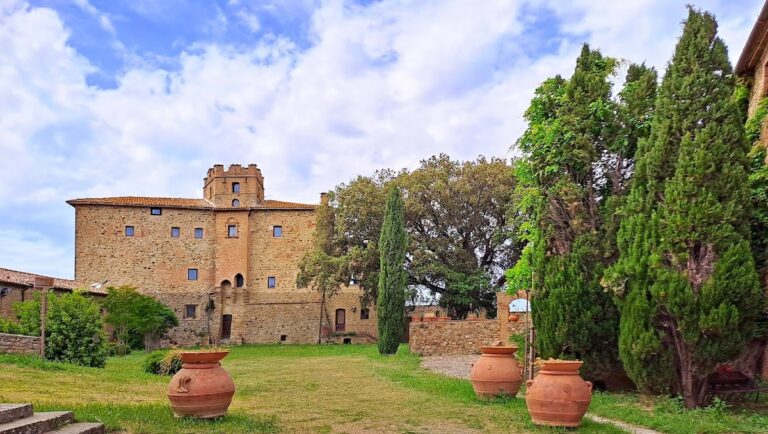
Palazzo Nerucci stands in Castel del Piano’s historic centre, with its principal facade facing Piazza Colonna and its rear extending toward Corso Nasini. The building has a C-shaped plan arranged around a courtyard. This organization reflects the influence of Roman architecture and the Farnesina, linking the palace’s physical form to Domenico Nerucci’s Roman associations.
Loggia della Mercanzia and Chapel of the Conception
At the northwestern corner is the Loggia della Mercanzia, an open-sided architectural gallery dated to 1554. The loggia incorporates the Chapel of the Conception, whose interior is finely frescoed. Its date places this feature before the construction of the palace requested by Nerucci in 1564.
Art collection rooms
Vegni works
The collection occupies the piano nobile, the principal upper floor traditionally used for reception rooms and important residential spaces. The route begins in a room containing the ticket office and bookshop. Four rooms on the left serve temporary exhibitions, while a conference room and four additional rooms hold the permanent collection.
The first permanent-collection room contains the original group of nine works associated with the Vegni family. Five nineteenth-century paintings show rural or everyday subjects, including The Washerwoman and At the Spring, made by an anonymous Italian painter of the Roman school, together with a landscape by the Florentine painter Emilio Donnini. The group also includes an embroidered portrait of Cosimo III de’ Medici, Grand Duke of Tuscany, on silk and dating from the second half of the eighteenth century; a Self-Portrait by Rosalba Carriera; a nineteenth-century heraldic coat of arms in tempera on paper; and a floral still life in oil on canvas. The still life was discovered during restoration of the embroidered portrait.
Edo Cei rooms
The Edo Cei collection occupies three rooms and includes four wood sculptures by Piero Bonacina. Its first two sections contain twenty caricatures made with techniques including ink and pencil, six advertising posters painted in tempera on white wrapping paper, and seven oil paintings on canvas. The caricatures portray people and social types from Castel del Piano in the 1950s. The posters reflect the influence of cinema, comics, and the changing culture of that period.
Seven sketches show views and settings in Castel del Piano, Arcidosso, and Seggiano. The final Cei room contains eight paintings dated from 1965 to 1978. These works express early existential and metaphysical themes, using psychological, philosophical, and dreamlike imagery rather than straightforward representation. Two of the paintings are Old Open-Air Cinema from 1966 and Leaving on a Feast Day from 1978. The latter is dedicated to Danilo Pioli, who died on 7 September 1978, on the eve of Castel del Piano’s Palio delle contrade, a traditional competitive festival between local districts.