Trauttmannsdorfský palác: A Neoclassical Palace in Prague


Site at a Glance
- Rating
- 4.7
- Popularity
- Very Low
- Country
- Czechia
- Primary era
- Early Modern
- External website
- Open
- Eras represented
- Medieval, Early Modern
- Civilizations
- Habsburg, Holy Roman Empire, Kingdom of Bohemia
- Site type
- Domestic
- Remains
- Elite Residence
On this page7 sections
History
Gothic and Renaissance origins
Trauttmannsdorfský palác is a Neoclassical palace in Prague, Czechia, whose major transformation took place through successive reconstructions from the Gothic period onward. A Gothic building occupied the site by 1400, and it later provided the basis for a Renaissance reconstruction.
Baroque reconstruction
A major rebuilding campaign took place in the late seventeenth or early eighteenth century, probably to a design by Jan Blažej Santini-Aichel, a Bohemian architect known for combining Baroque design with Gothic forms. This phase gave the palace important Baroque elements that remain part of its character.
Classicist enlargement and later changes
The building was later reconstructed and enlarged in the Classicist style by the architect Alexander Helmlich. In 1894, it was converted into a rental apartment building. The facade of the entire building was altered in 2012, along with other minor modifications. Trauttmannsdorfský palác is protected as a cultural monument of the Czech Republic.
Remains
Layout and exterior
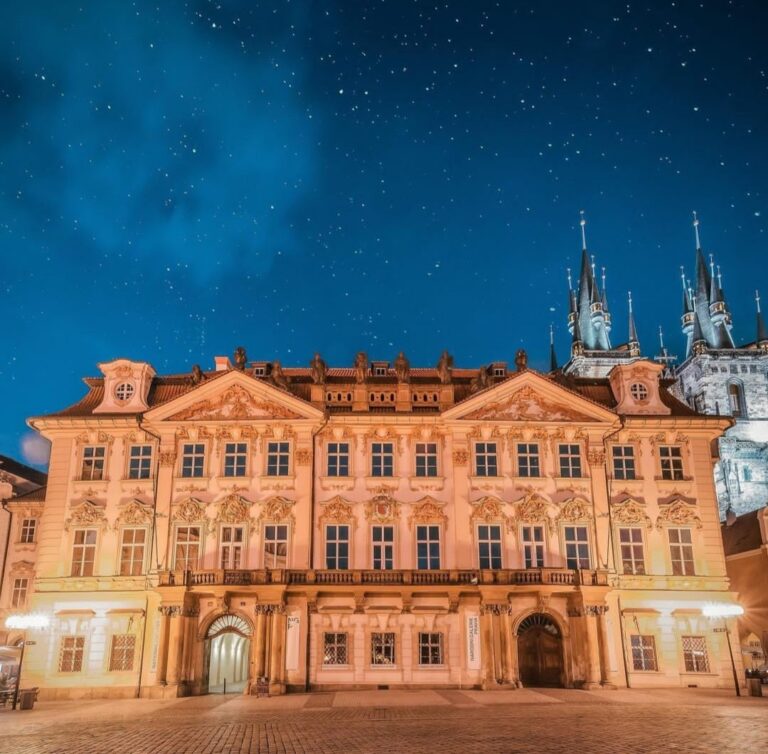
The palace is an irregularly planned Neoclassical building in central Prague’s Old Town. Its plan follows the alignment of Mariánské náměstí, Husova, and Seminářská. The main entrance faces Mariánské náměstí and is framed by a Baroque aedicule portal, an architectural surround resembling a small shrine or miniature temple. The portal bears the Trauttmannsdorf family coat of arms from the seventeenth century.
Baroque detailing survives in the gate within the main portal, the courtyard windows, and the portals around the courtyard doors. The galleries are in the Classicist style and have stone rafters, preserving evidence of the palace’s later architectural transformation.
Gothic cellars
Cellars from the Gothic predecessor survive beneath the palace. They preserve part of the earlier building that occupied the site before the Renaissance reconstruction and the later Baroque and Classicist changes.