Schloss Alfter: A Historic Secular Castle in Germany


Site at a Glance
- Rating
- 4.7
- Popularity
- Very Low
- Country
- Germany
- Primary era
- Early Modern
- Eras represented
- Medieval, Early Modern, Modern
- Civilizations
- Holy Roman Empire
- Site type
- Domestic
- Remains
- Castle
On this page15 sections
History
Schloss Alfter is a historic secular castle in Germany, rebuilt in 1721 as an early eighteenth-century noble residence. Its origins reach back to the lords of Halechtre, later called the Knights of Alfter, who are first recorded in 1117. From 1188, Alfter Castle was connected with the hereditary marshal’s office of Electoral Cologne, the ecclesiastical principality ruled by the archbishops and electors of Cologne. The marshal’s office was a high-ranking court position whose rights could pass through a noble family.
Medieval lordship and destruction
The succession of the Alfter lordship changed through marriage. In 1418, the Alfterer heiress Ricarda married Wilhelm II of Wevelinghoven. Their daughter Irmgard married Count Johann VI of Salm-Reifferscheidt-Dyck in 1433. In 1461, the lordship of Alfter and the hereditary marshal’s office passed to him.
A fire destroyed the castle in 1468, but it had been rebuilt by 1481, the year of the peace treaty that refers to the restored complex. Another fire followed at the beginning of the sixteenth century, after which the castle was rebuilt again. The cause of this second fire is unknown. In 1583, during the Truchsessian War, a late-sixteenth-century conflict over control of the Electorate of Cologne, Alfter, its castle, and the adjacent Anna convent were attacked and completely destroyed.
The eighteenth-century rebuilding
Count Wilhelm of Salm built the present castle in 1721. The manor house and service courtyard belong to this rebuilding phase, as does the castle park. The complex therefore represents the reconstruction of the Alfter residence after the repeated medieval and early modern destructions.
Residence and cultural center
From 1930 to 1961, Schloss Alfter was the residence of the family of Franz Josef, Prince of Salm-Reifferscheidt-Krautheim and Dyck. After his death, the family’s permanent residence moved to Schloss Dyck. Since 2008, Schloss Alfter has been owned by his grandson, Simeon Reichsgraf Wolff Metternich zur Gracht.
At the invitation of Prince Salm, the Thursday Society met at the castle from 1947 to 1950. This postwar artistic circle brought together artists and people interested in art, and its gatherings made Schloss Alfter and Alfter an important setting for the revival of artistic and cultural life after the Second World War. A 2019 exhibition later revisited the society’s history and its role in that cultural revival.
Institutional uses since the 1960s
Between September 1962 and October 1965, the castle housed the Bundeswehr’s Psychological Warfare Training Group. The Bundeswehr is Germany’s federal armed forces, while psychological warfare used communication and propaganda methods in military operations. The group was a predecessor of the later Operational Communication Force. The Social-Scientific Research Institute of the Konrad Adenauer Foundation subsequently used rooms in the castle.
Parts of Alanus University occupied Schloss Alfter from 1977 to 2009. Since 1991, the castle gallery has displayed works including drawings and paintings by Renier Roidkin, an eighteenth-century painter and draughtsman known for depicting castles, gardens, and other buildings in the Rhineland.
Recent community uses and protection
After Alanus University moved out, the castle was largely unused. In October 2015, the municipality of Alfter rented it as emergency accommodation for refugees, with 150 places for initial reception. This facility closed on 31 December 2016. The gatehouse was partly rented as a dwelling, and a Waldorf kindergarten occupied another ancillary building.
In December 2021, Alfter’s municipal council decided to rent the castle for twenty years for places in the open all-day program of the Anna Primary School. This type of program provides supervised education and care beyond regular classroom hours. After Russia’s invasion of Ukraine began on 24 February 2022, the municipality also arranged accommodation for Ukrainian refugees in the complex. Since 2023, the open all-day program has used the ground floor and outdoor grounds, while refugees have been housed in the gatehouse and first floor. Schloss Alfter is protected as a historic secular building under monument legislation.
Remains
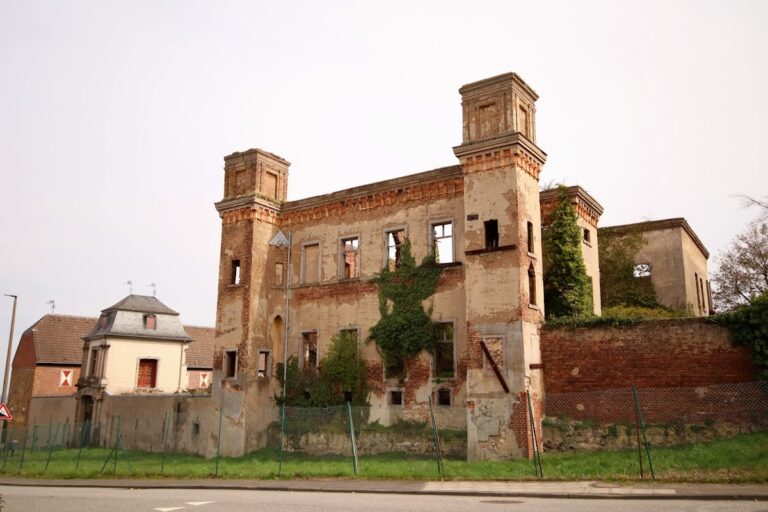
Schloss Alfter forms an irregularly enclosed rectangular complex composed of a horseshoe-shaped manor house and a service courtyard. Both parts date from the 1721 rebuilding, although the courtyard has undergone substantial later alteration. The castle park, covering 1.3 hectares, retains the basic structure established during the same major phase despite repeated changes in the use of the complex.
Castle buildings
Manor house
The manor house is a two-storey rendered building with hipped roofs and tower-like projections at the corners. Its exterior was originally painted to imitate red ashlar masonry. The walls are now painted yellow. The second floor is unsuitable for occupation because of fire-safety requirements, while the ground floor forms part of the present educational use of the complex.
Service courtyard
The service courtyard completes the enclosed castle complex. Although it belongs to the 1721 construction phase, its fabric and arrangement have been substantially changed since then. The gatehouse remains part of the complex and has partly been used as a dwelling.
Medieval masonry
In the basement of the northwestern corner building, columnar basalt masonry survives from around 1200. This early fabric provides a physical link with the medieval castle associated with the lords of Halechtre and the Knights of Alfter before the later rebuilding phases.
Castle park
Terrace and water gardens
The park was redesigned in the 1930s by Hermann Mattern, a German landscape architect associated with modern garden design, at Potsdam-Bornim. Mattern conceived it as an expanded living environment for the castle’s residents and divided it into separate garden “rooms.” Directly in front of the castle, the terrace garden was used by the on-site Waldorf kindergarten until 2023.
Across from it lies the sink garden, which was designed to retain rainwater and made more useful as a garden through perennial planting. A rose garden with a small basin adjoins the sink garden. Rudimentary remains of the rose garden survive.
Hedge theatre
The hedge theatre is an outdoor performance space formed by clipped hedges. It served as a stage for children’s charades and was later used by the Alfter open-air touring theatre during its first seasons. The park is privately owned and is not open to the public.
Gallery collection
The castle gallery contains works by Renier Roidkin, who was born in Spa and lived from 1684 to 1741. Drawings and paintings by Roidkin have been shown there since 1991, adding an artistic collection to the complex’s architectural and landscape remains.