Barzyna Palace: A Historic Estate in Poland
Site at a Glance
- Rating
- 4
- Popularity
- Very Low
- Country
- Poland
- Primary era
- Early Modern
- External website
- Open
- Eras represented
- Early Modern, Modern
- Civilizations
- Duchy of Prussia, Kingdom of Prussia
- Site type
- Domestic
- Remains
- Manor House
On this page12 sections
History
Barzyna Palace is a historic palace in Poland, associated with the Prussian noble von Bodeck family and shaped by Baroque and Neo-Gothic alterations. The palace was probably first built in 1693, although the family’s exact date of settlement at the estate is unknown. Its surviving form reflects repeated extensions and reconstructions carried out over several centuries.
Barzyna and the von Bodeck estate
Barzyna was originally known by the Prussian name Wisen. The village was recorded in 1310, and in 1374 Grand Master Konrad III Zöllner von Rotenstein granted its estates to three Prussian brothers. He was the head of the Teutonic Order, a medieval religious and military institution that controlled extensive territories around the eastern Baltic.
The von Bodeck family was connected with the estate from 1560 to 1829. Its origins are associated either with Frankfurt am Main or with Kassel, but the family’s precise place of origin remains uncertain. A heritage-register description from 1968 gives 1693 as the date of the palace, probably referring to the construction of the original building. Later additions transformed that first residence into the irregular complex that survives today.
Changes of ownership
After Albrecht Heinrich Christoph, the last von Bodeck representative at Barzyna, died without a male heir on 27 August 1829, the palace and estate passed to Kazimierz von Hülsen, a major in the Prussian Landwehr. The Landwehr was the Prussian state’s territorial reserve and militia, and a major was a senior military rank.
The estate later came to Baron Bernhard von Sanden, whose family had held baronial status since 1840. He was married to Ulrika von Bodeck, the daughter of Albrecht Christoph, the last von Bodeck representative named in this succession. Paul and Otto Frankenstein owned the estate from 1868 to 1910. Before the First World War, ownership passed to the siblings Gerd and Maria von der Groeben.
Before the war, the von der Groeben estate covered 850 hectares and included a further 100 hectares of woodland. Its agricultural holdings comprised approximately 110 horses, 80 cattle, 60 pigs, and more than 500 Merino sheep. The family also kept numerous inherited works of art in the palace, including a self-portrait by the Dutch painter Rembrandt known as The Laughing Rembrandt, which had come to them from the Prussian von Carstanjen family.
War, state use, and decline
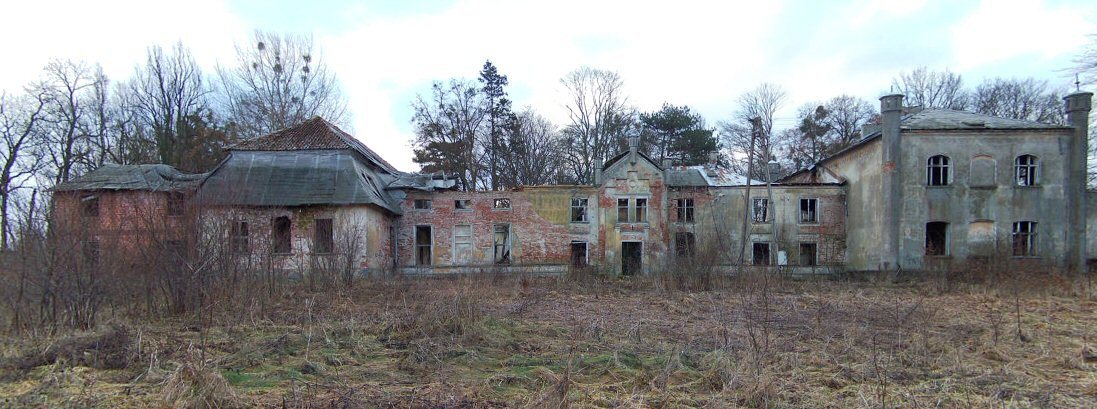
During the Soviet offensive in East Prussia in January 1945, Gerd von der Groeben shot himself. After the Second World War, the palace and estate became part of a state agricultural farm, a government-run enterprise managing land and agricultural production. The palace was converted into a kindergarten and also housed farm workers and offices.
Later, the building was left without regular repair or conservation and deteriorated into ruin. Stanisław Duch, a private individual from nearby Kwitajny, arranged the removal of numerous historic interior elements and their transfer to the well-preserved Dönhoff family palace there. Barzyna Palace is now privately owned, but the building and estate remain unrepaired and continue to deteriorate. The palace entered Poland’s register of immovable monuments as number 651/68 on 27 February 1968.
Remains
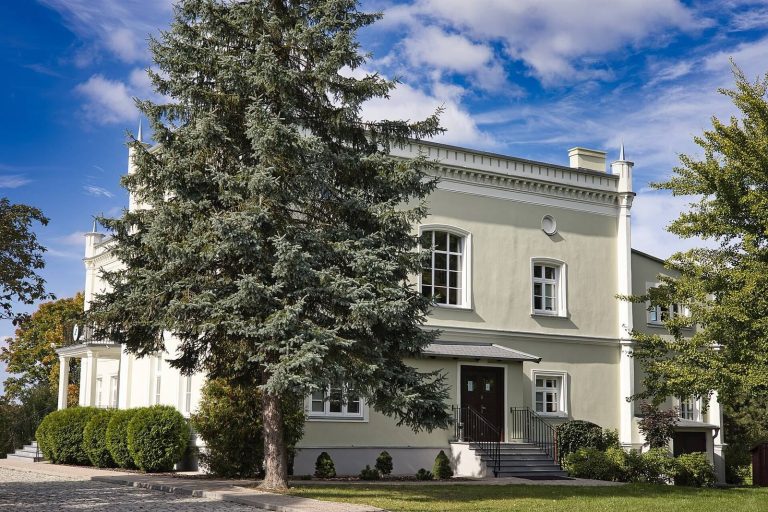
The palace belongs to an estate complex with a small surrounding park. The building has a rectangular plan, while its principal mass is irregular because of successive additions. A small projecting entrance section occupies the centre of the main body and contains the principal entrance. Large extensions stand on opposite sides. The left-hand addition has a mansard roof, whose lower slopes are steeper than the upper ones. The right-hand extension is Neo-Gothic, with towers at its corners and an almost completely flat roof.
Palace building and park
Baroque entrance
A Baroque portal remains barely visible on the palace. Its frame has ear-shaped ornaments, consisting of projecting curled or bracket-like forms. The frieze formerly carried the von Bodeck family arms on both sides and an inscription naming Johanna Florentina von Bodeck and Bonaventura Dominicius von Bodeck, with the date 1724.
Estate park
The surrounding park has been repeatedly altered along with the estate. Its former qualities have been lost, and the grounds are now wild and overgrown.
Rescued interior elements
Tiled stoves
Two tiled stoves removed from the palace date from 1933. Their plinths bear the von der Groeben family coat of arms. One was produced at Walter Wendel’s ceramic works in Braniewo. Both stoves were transferred to the Dönhoff family palace at Kwitajny.
Cast-iron firebacks
Two richly decorated cast-iron firebacks from the seventeenth century represent Renaissance-style work. One depicts Judith holding the head of Holofernes, while the other shows Salome with the head of Saint John. They were among the interior elements moved from Barzyna to Kwitajny.
Heraldic plaque
A cast-iron plaque bears the arms of the von Hülsen family and the related von Wallenrodt family. It was probably made around the transition from the seventeenth to the eighteenth century. Its inscription refers to J. S. von Hülsen as a colonel of the Brandenburg elector’s cavalry and to C. von Wallerode as his wife, and gives the date 1696. The plaque was also transferred to the Dönhoff palace at Kwitajny.