Château Ducru-Beaucaillou: A Historic Bordeaux Wine Estate


Site at a Glance
- Rating
- 4.6
- Popularity
- Very Low
- Country
- France
- Primary era
- Modern
- External website
- Open
- Eras represented
- Early Modern, Modern
- Civilizations
- French
- Site type
- Economic
- Remains
- Production Complex
On this page12 sections
History
Château Ducru-Beaucaillou is a historic wine-estate complex in France, at Saint-Julien-Beychevelle in Gironde. Its earliest traces may reach back to the thirteenth century, and the estate later became known for a principal wine classified as a Deuxième Grand Cru Classé, or Second Growth, in the Bordeaux Wine Official Classification of 1855. This category is the second-highest red-wine rank in that classification.
Early ownership and the Ducru transformation
The estate originated through the division of the Barony of Beychevelle. The Bergeron family held it for several centuries, until 1720. Bertrand Ducru acquired the property in 1795, giving it the Ducru name and beginning a major transformation of both the château and its wine-producing facilities. New wine cellars formed part of these alterations, which were carried out with the assistance of the architect Paul Abadie.
The wine’s 1855 classification placed it among the fifteen Second Growths of Bordeaux. A tradition claims that Ducru-Beaucaillou was frequently served during the classification committee’s sessions and that this helped secure the result. This explanation remains an allegation rather than an established account of the classification.
The Johnston and Borie families
In March 1866, Lucie-Caroline Dassier, the wife of Bordeaux wine merchant and faience manufacturer Nathaniel Johnston, purchased the château. Faience is glazed earthenware. Johnston commissioned Louis Garros to transform the buildings, creating a further architectural phase after Ducru’s nineteenth-century work.
The financial crisis of 1929 led the Johnston family to sell the estate to the Desbarats family, who were wine merchants. Francis Borie acquired it in 1941, and ownership has remained with the Borie family. The estate lies within the Saint-Julien appellation of Bordeaux, a legally defined wine-producing area governed by regional conditions and rules, near the Beychevelle estate and the Gironde. Its wider holdings cover approximately 105 hectares.
Modern production and management
A new underground cellar was created in the late 1990s for fermentation and maturation. In 2001, Alain Triaud and Luc Arsène-Henry designed a new wine-production building north of the château. During the mid-1980s, TCA contamination affected the cellars and damaged several vintages, including those of 1988, 1989, and 1990. The problem was later corrected.
On 3 January 2003, Bruno-Eugène Borie, Francis Borie’s grandson, became head of Ducru-Beaucaillou. Under his management, the estate introduced integrated agricultural practices, created a research and development unit led by two engineers, and installed a new vat room for managing individual vineyard parcels. Stricter grape selection also reduced the yield of the estate’s principal wine, known in Bordeaux terminology as the grand vin.
The Borie family remains the owner. The wine has retained its Second Growth status since 1855, and in 2011 La Revue du vin de France described it as a “super second.” The estate reorganized its wine range in 2018. La Croix de Beaucaillou, made as the second wine since 1995, remained paired with the grand vin, while Le Petit Ducru replaced Lalande Borie as the third wine. Produced since 2019, Le Petit Ducru de Ducru-Beaucaillou comprises the former Château Lalande-Borie.
Remains
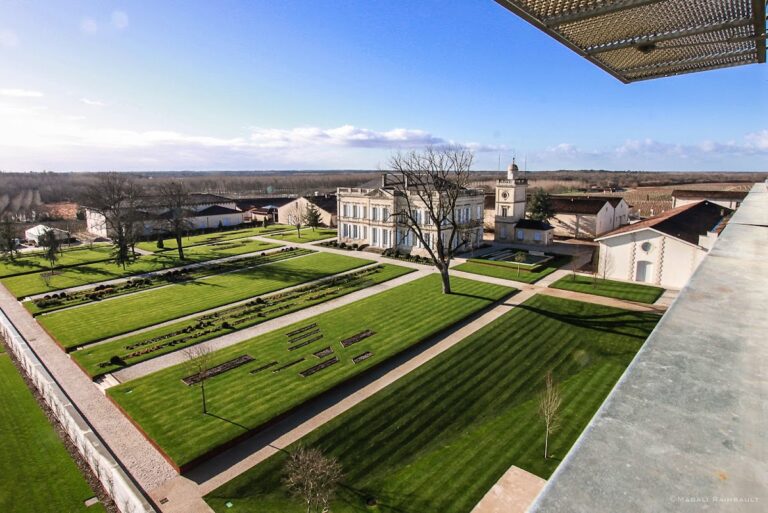
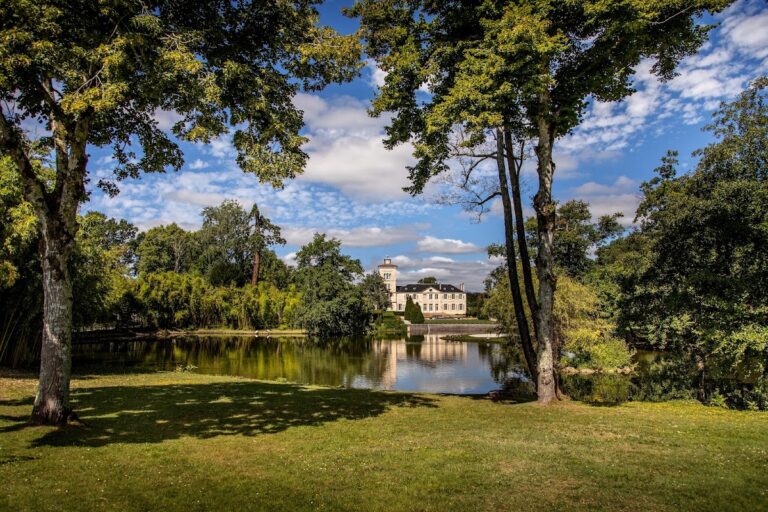
The surviving estate is organized around the château, wine-production buildings and cellars, gravel vineyards, and a five-hectare park. The buildings represent successive phases of alteration, while the surrounding land preserves the physical setting of the estate’s viticulture and wine production.
Château and production buildings
Château and historic cellars
The château was substantially altered under Bertrand Ducru, with Paul Abadie involved in the work, and was transformed again for Nathaniel Johnston by Louis Garros. The associated wine-production facilities include the new cellars constructed during Ducru’s alterations. Together, these buildings express the estate’s long development from an established property into a more extensively organized wine-producing complex.
Modern production facilities
The estate’s later production buildings include an underground cellar created in the late 1990s for fermentation and maturation and a wine-production building constructed north of the château in 2001. A newer vat room supports management of micro-parcels, allowing production to follow the estate’s separate vineyard units more closely.
Vineyards and park
Gravel vineyards
Approximately 50 to 52 hectares of the larger property are planted with vines. The vineyards occupy well-drained gravel containing stones up to about 2.5 inches in diameter. The name Beaucaillou refers partly to these large, attractive stones, which are said to release heat stored during the day into the evening. In this setting, terroir means the combined influence of soil, terrain, and climate on viticulture.
The vines are planted at a density of approximately 10,000 per hectare and average about 35 to 40 years of age. Current plantings comprise approximately 70 percent Cabernet Sauvignon and 30 percent Merlot. Earlier plantings of Cabernet Franc and Petit Verdot were uprooted.
Park and statuary
A five-hectare park forms part of the property. It contains ginkgo biloba, blue cedars, and centuries-old sequoias, as well as statues of Diana, Bacchus, and Demeter. Diana is a Roman goddess associated with hunting and nature, Bacchus is the Roman god of wine, and Demeter is the Greek goddess associated with agriculture and grain.
Wine maturation
The estate’s wines mature for approximately eighteen months in barrels containing between 50 and 80 percent new oak, with the proportion depending on the richness of the vintage. They are fined with egg whites, lightly filtered, and bottled. These processes form part of the continuing production system housed within the estate’s buildings and cellars.