Schloss Wolfsegg: A Historic Palace in Austria


Site at a Glance
- Rating
- 4.5
- Popularity
- Very Low
- Country
- Austria
- Primary era
- Early Modern
- External website
- Open
- Eras represented
- Early Modern
- Civilizations
- Habsburg, Holy Roman Empire
- Site type
- Domestic
- Remains
- Elite Residence
On this page10 sections
History
Schloss Wolfsegg is a historic palace in Austria, in the municipality of Wolfsegg in the Hausruck region. The present building succeeded an earlier castle and took its palace form during the sixteenth or seventeenth century. The site developed through medieval feudal divisions, Habsburg rule, noble ownership, military destruction, and later literary association.
Medieval Lords and Divided Ownership
Wolfsegg was formerly called Hausruck, a name derived from the Hausrucker family. Hadmar I of Hausruck appears in records from 1120, while his son Heinrich de Husrucke is recorded in 1135. The Wolfsecker family later held the site. Its early members included Aribo, Chunradus de Wolvesekke, Helwiga, Adelhaid, Hadmar II, Christina, Otto, Ortlof, and Christian. Chunradus was recorded in 1191 as a ministeriale, a medieval administrative and military official who could hold land while serving a territorial lord. Members of the family appear in records between 1185 and 1277.
Christian of Wolfsegg, the last male-line member of the family, died in 1321. He had sold his share of the property to Duke Albert I of Austria in 1291. Ownership was already divided at that time. One half belonged to Christian’s sister and entered her marriage with Albero of Pollheim as a dowry. The Weißenberg family later received this share as a fief, meaning property held from a superior lord under specified obligations. The other half belonged to the Archdiocese of Salzburg, an ecclesiastical principality whose archbishops exercised both religious and territorial authority, and was granted to the Schaunberg family in 1321.
Dietrich of Weißenberg sold his share to Duke Frederick the Fair in 1326. The disputed share had been surrendered to the archbishop of Salzburg in 1321 and then returned as a Schaunberg fief. An arbitration court settled the conflict in 1328. Wolfsegg came permanently under Habsburg rule in 1369. The Habsburgs were the dynasty that ruled Austria and acquired the property at that time. When Wolfsegg was not pledged, custodians administered it on behalf of its superior lord. It was pledged to Reinprecht II of Walsee from 1405 to 1410, an arrangement that transferred control as security for an obligation without necessarily granting full ownership.
Custodians, Pledges, and Noble Owners
King Ladislaus enfeoffed Jörg Perkheimer with Wolfsegg in 1455, and Duke Albert VI changed the grant into a Perkheimer pledge. In 1488, Emperor Frederick III ordered Kaspar Perkheim to suppress extensive salt smuggling. When Kaspar did not adequately carry out the order, the emperor dissolved his pledge and appointed Hilprand Jörger as custodian.
Emperor Maximilian I pledged Wolfsegg to Caspar of Retschan in 1500. Retschan died in 1545, and Johann of Senftenau later succeeded him. Cosmas Gienger of and at Grienpichel acquired the castle as a pledged holding in 1566, and it subsequently became his property. After Hans Adam Gienger of Wolfseck died in 1621 or 1623, his daughter Ursula inherited Wolfsegg.
War, Conversion, and Later Estate History
On 19 November 1626, General Pappenheim stormed Wolfsegg after peasants had occupied the castle. Pappenheim was a military commander. The castle was stormed again and badly damaged in 1632 during the Upper Austrian Peasant Revolts, a series of uprisings by peasants in Upper Austria. Christoph of Khevenhüller, an Austrian nobleman and military commander, expelled the peasants.
By the time of the Gienger family, the former castle had already been converted into a palace. Ursula Gienger brought the property into her marriage with Josef Pfliegl, also called Pflügl, of and at Goldenstein. He was an Electoral Bavarian chamber councillor and vice-dominus, an administrative deputy of a territorial or ecclesiastical authority. Through the marriage of Eleonore Isabella Anna, the daughter of Johann Baptist Pfliegl, Wolfsegg passed to Mathias Castner of Sigmundslust.
After Mathias Castner died, his widow married Count Karl of Tige in 1721. His administration left the estate in such poor condition that bankruptcy proceedings began after his death. State Minister Thaddäus Adam of Reischach acquired the Lordship of Wolfsegg in 1797. Ehrenreich, Knight of Schinnern, owned it in 1818, and in 1819 it passed to the eleven Querer siblings. Their division damaged the palace and estate, which were then placed under compulsory administration. Franz of Saint Julien purchased the lordship in 1835, and the Saint Julien-Wallsee family has held the property since then.
Wolfsegg in the Work of Thomas Bernhard
Schloss Wolfsegg appears repeatedly in the work of Thomas Bernhard, an Austrian novelist, playwright, and poet whose writing often examined memory, society, and history through Austrian places and institutions. Bernhard first mentioned the palace in 1953 while working as a journalist, initially because of his interest in the origin of the name Wolfsegg. In his 1963 novel Frost, he placed a war crime there without naming the location, continuing a murder plot from Hans Lebert’s The Wolf’s Skin. About a decade later, Bernhard’s screenplay The Italian was filmed at the palace with details based on Wolfsegg’s topography. The palace also became an important setting in his final novel, Extinction.
Remains
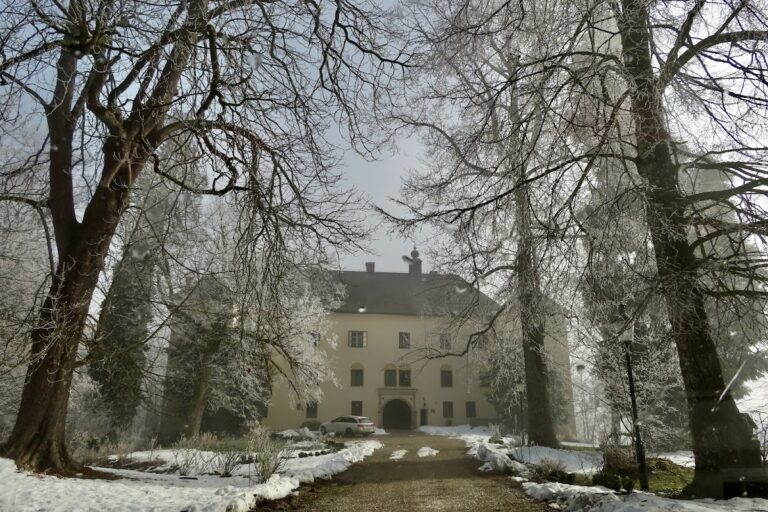
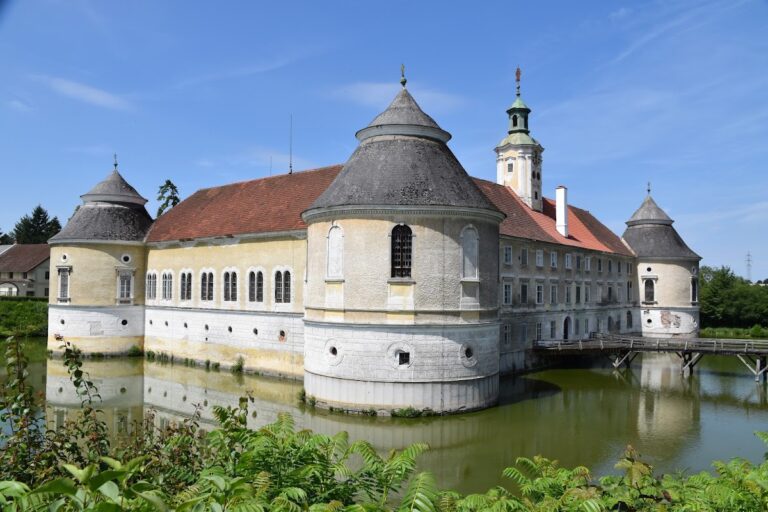
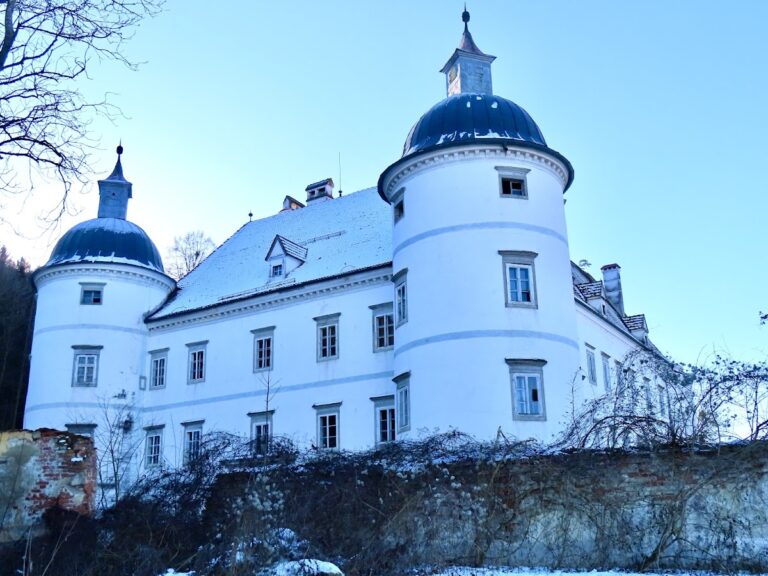
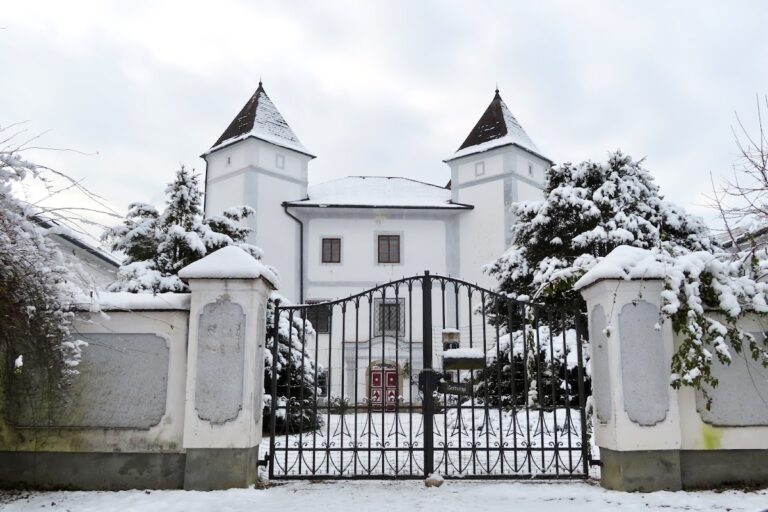
The surviving complex combines the irregular palace with rear wings, an enclosed courtyard, a chapel, a separate farmyard, and landscaped grounds. It incorporates elements of the earlier castle and retains traces of the defensive arrangement that preceded the present palace.
Palace Complex
Main Wing and Courtyard Wings
The present palace is a successor building of the sixteenth or seventeenth century, erected on the site of the earlier castle. Its three-storey main wing forms an irregular quadrangular building and incorporates remnants of the old castle wall. The Knights’ Hall contains an elaborate six-column door frame dating from the end of the seventeenth century. Two two-storey corridor wings extend from the rear of the main wing and join a parallel wing of three storeys. Together, these sections enclose an inner courtyard.
Palace Chapel
The palace chapel was built in 1746. Its interior has barrel vaults and stucco decoration, and the chapel is dedicated to Saint Anne. The altarpiece, also dating from 1746, was painted by Bartolomeo Altomonte.
Defensive Features and Grounds
Two deep outer ditches once separated the castle from the area in front of it. Their former lines survive as broad depressions. Opposite the palace stands a horseshoe-shaped farmyard. The palace is enclosed by a park and a simple wall. The park was laid out or described in 1721 and includes a glasshouse, or palm house, dating from the early nineteenth century.
Nearby sites