Château de la Briantais: A Second Empire Estate in Saint-Malo


Site at a Glance
- Rating
- 4.4
- Popularity
- Very Low
- Country
- France
- Primary era
- Modern
- Eras represented
- Early Modern, Modern
- Civilizations
- French
- Site type
- Domestic
- Remains
- Castle
On this page9 sections
History
Château de la Briantais is a nineteenth-century estate in Saint-Malo, France, built by Eugène Sully-Brunet in the Second Empire period to replace an earlier manor. The estate occupies the territory of the former commune of Saint-Servan, now incorporated into Saint-Malo, in Brittany.
The Pointel and Picot families
The Pointel family, a prosperous Saint-Malo shipowning family, acquired the Briantais estate in the seventeenth century. Its position allowed the family to monitor its commercial fleet and shipping traffic in Saint-Malo Bay. Jacques Pointel commissioned a manor house on the estate in 1666.
In 1770, the estate was sold to Michel Picot de Prémesnil, Baron du Guildo. It later passed to his son, Jean Picot de Plédran, Viscount of Plédran. The grounds were developed as an English landscape park during the eighteenth century. This type of designed garden used informal planting, curving paths, lawns, viewpoints, and ornamental structures rather than a rigid geometric plan.
Revolutionary confiscation and nineteenth-century rebuilding
During the French Revolution, a period of political upheaval that ended the old monarchy and transformed France, the estate was confiscated. Pierre Collar purchased it in 1803. Ownership then passed to the shipowner Hervé Fontan and, in 1818, to Joseph Périer de Hauterive. After Joseph’s death, his son Hyppolite Périer de Hauterive inherited the property.
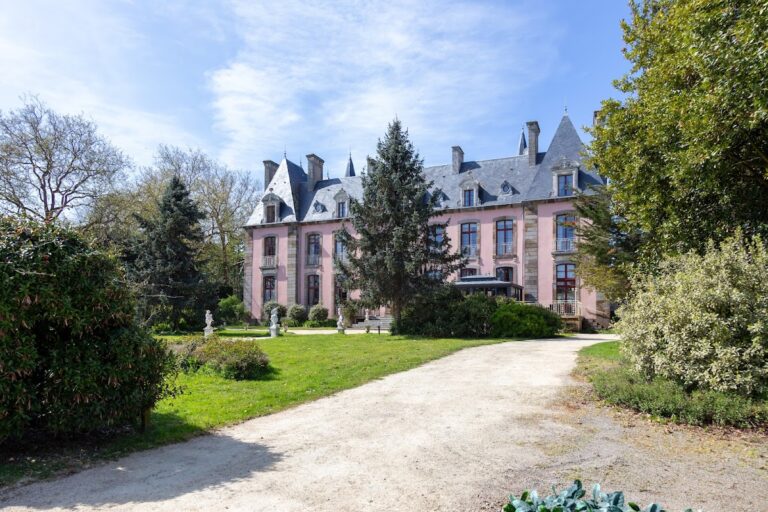
The deaths of the Périer de Hauterive heirs in 1838, combined with their inability to agree on the estate’s future, led to its sale. Eugène Sully-Brunet acquired the property in 1850 and commissioned the present château, which was constructed between 1850 and 1864. It replaced the seventeenth-century manor, although the new building was positioned nearby rather than directly on the earlier structure’s site.
The La Chambre family and public ownership
Charles La Chambre purchased the château in 1888. His family commissioned two lateral wings shortly before 1900. Ownership subsequently passed to his son Charles La Chambre and then to his grandson Guy La Chambre, a former French minister and mayor of Saint-Malo.
Guy La Chambre died without an heir in 1975 and donated the estate to the Archdiocese of Rennes, Dol and Saint-Malo, which inherited it in 1978. The property was later used as a cultural and spiritual centre. After the archdiocese’s twenty-year commitment ended, the cost of maintaining the estate led the diocesan authorities to dispose of it.
The City of Saint-Malo purchased the estate in 1999. The château is used for exhibitions and events, while the grounds serve as a public leisure park. An order dated 12 September 2022 listed the château as a historic monument.
Remains
The château and earlier manor
The present château is a Second Empire building dating from 1864. The Second Empire was the period of Napoleon III’s rule in France, from 1852 to 1870, and its architecture often combined historical references with elaborate nineteenth-century forms. Château de la Briantais retains much of its original interior decoration. A small bell turret crowns the building, recalling the turret of Saint-Malo’s town hall and serving as an observation point over the Rance estuary. Two lateral wings, added shortly before 1900, complete the principal building.
Ruins of the 1666 manor remain visible near the château. They mark the earlier centre of the estate, while the present building occupies a nearby but different position.
The landscape park and associated structures
The estate includes a 27-hectare English landscape park laid out in the eighteenth century on elevated ground above the Rance estuary. Its designed landscape contains numerous statues, several garden structures, and ancillary buildings. From the park’s heights, views extend toward Saint-Malo, Dinard, and the Rance tidal power station, a hydroelectric installation that produces electricity from the rise and fall of the tide in the estuary.
Chapel and ornamental structures
Among the park’s associated structures are a chapel dated 1778 and a Temple of Love. These elements form part of the ornamental and religious setting developed around the estate.
Service buildings
The grounds also contain neo-Norman service buildings constructed during the final quarter of the nineteenth century. Their style forms part of the later architectural additions made to the estate.