Hof van Watervliet: A Historic Town House in Bruges

Site at a Glance
- Rating
- 4.2
- Popularity
- Very Low
- Country
- Belgium
- Primary era
- Medieval
- External website
- Open
- Eras represented
- Medieval, Early Modern
- Civilizations
- County of Flanders, Duchy of Burgundy, Habsburg
- Site type
- Domestic
- Remains
- Elite Residence
On this page11 sections
History
Hof van Watervliet is a protected monument in Bruges, Belgium, built in 1454 by the Bruges nobleman and knight Jan III de Baenst and his wife, Margareta de Fever. Originally called Hof van Sint-Joris, the house formed part of the city’s established medieval residential quarter around Oude Burg. Its surviving history reflects the changing fortunes of noble families, officeholders, merchants, and civic figures, while its restoration has preserved evidence of domestic life from the fifteenth to the eighteenth century.
The medieval quarter and the De Baenst foundation
The area around Oude Burg had become a residential district by about the thirteenth century. South of Oude Burg, near the Dijver, the ground was originally sloping and was raised between the eleventh and approximately the thirteenth century. Occupation followed this transformation, and by 1279 at least eight houses stood in the narrow Winterstraatje, which led toward the Dijver. During the medieval period, numerous small streets crossed a densely built urban district.
Building activity in the wider area had begun by the late twelfth or early thirteenth century. A wall found in Sint-Niklaasstraat was built mainly from tuff brought from the Eifel region, on a foundation of fieldstone. Before Hof van Sint-Joris was erected, houses around Oude Burg were held largely by cloth merchants and mercers, particularly around 1400 and during the first half of the fifteenth century. Jan III de Baenst and Margareta de Fever owned the property and were the first residents of the new house. Beam supports bearing the De Baenst coat of arms, found there in 1982, are original structural elements associated with its construction.
The Lauweryn family and the name Watervliet
The De Baenst family retained the Hof until 1541, when Francoise Rauffault, widow of Matthias Lauweryn, and her children acquired it. The family held the property until 1611. The Lauweryns were lords of Watervliet, a territorial estate whose lord exercised specified jurisdictional and economic rights, and their connection with that lordship gave the house its enduring name.
Hiëronymus Lauweryn, the family patriarch, advanced from a lower-ranking official to a senior financial officer and confidant of Philip the Fair. With the prince’s support, he drained and opened more than 4,000 hectares of polder land and founded Watervliet in East Flanders. His son Matthias became lord of Watervliet and married Francoise Rauffault.
After Francoise died in 1565, the family possessions were divided among her three sons. Marcus Lauweryn inherited both the lordships of Watervliet and the Bruges Hof, which he made his permanent residence. He developed a library, coin cabinet, and art collection in the house. During the Calvinist Republic, the Calvinist-led regime that governed Bruges from 1578 to 1584 during the Dutch Revolt, Marcus fled to Calais, where he later died. The Hof then passed to his brother Guido, who died in Lille in 1588, and subsequently to their brother Marc and Marc’s daughter. She sold the property to Pieter Boddens in 1611.
The Boddens and de la Coste periods
Pieter Boddens was a nobleman from Tielt who settled in Bruges as master of the Great Toll. He was married to Anne de Piermont and had previously followed a military career. Between 1651 and 1661, the Hof was rented to Anthone Preston, Lord of Sint-Joris. This title referred to a territorial lordship rather than an occupation based at the house. King Charles II of England spent the first two weeks of his exile in Bruges at the Hof.
Jan de la Coste purchased the property on 14 December 1699, and his son, Jan Baptiste de la Coste, later inherited it. Jan Baptiste served as a councillor in the Bruges magistracy and temporarily held the office of mayor. He also governed the girls’ orphan school known as the Sint-Elisabethschool and took part in Bruges associations. After his death in 1772, his children sold the Hof to Petrus d’Herbe.
The d’Herbe family and nineteenth-century inheritance
Petrus d’Herbe, who lived from 1725 to 1794, was a merchant, rentier, and trained surveyor who had worked with the Austrian army. He made major alterations to the house. In 1793, amid the political upheavals and regime changes affecting Bruges, he became a neighborhood warden, a local official with administrative or supervisory duties in a district, and was assigned six soldiers to billet.
D’Herbe had sheltered a French nobleman who had fled to Holland and kept in contact with him by correspondence. He was arrested on 23 September 1794 for alleged antirevolutionary activity, sentenced to death on 10 October, and executed by firing squad six hours later. His property was confiscated, but his daughter Maria d’Herbe had the confiscation annulled within a year. His widow and children were consequently able to remain at the Hof.
On 6 April 1812, d’Herbe’s youngest daughter Anna married Philippe Verhulst, a wealthy rentier and son of the lawyer Charles Verhulst. Philippe served as a Bruges alderman and municipal councillor, chaired the churchwardens’ board of the Onze-Lieve-Vrouwe parish, and owned the chapel of Vivenkapelle. Their daughter Elisa lived alone at the Hof after her parents’ deaths until her own death on 15 August 1903.
Twentieth-century ownership and restoration
Constantia de Hertoghe inherited the property in 1904 and transferred it by inheritance to the candidate notary Edgard Muylle in 1917. Muylle sold it to the Vermeyen family in 1919. The family retained the house for more than fifty-five years. In 1976, the children of Benedictus Vermeyen and his wife sold the property to the Volkswelzijn non-profit association.
Extensive restoration followed in the early 1980s. Work carried out between 1982 and 1983 and between 1986 and 1987 responded to modernization and new safety regulations while keeping demolition of the original fabric to a minimum. The gatehouse, garden house, and deep house were restored, and in 1983 the Christian Mutualities and Vereniging Volkswelzijn placed the complex in use as an open meeting and welfare centre. Since then, the Bruges branch of the Christian Mutuality, a Belgian mutual-aid and health-insurance organization, has used the Hof as a sociocultural and welfare meeting house for activities including yoga, a games club, and self-help groups.
Remains
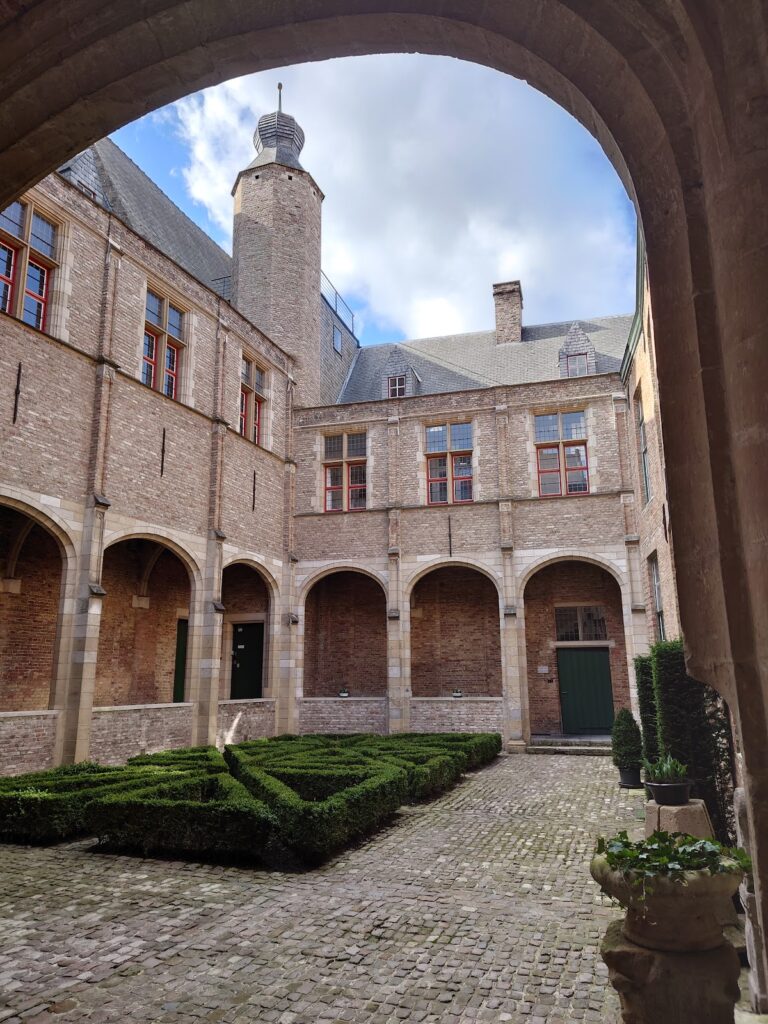
The courtyard complex
Hof van Watervliet consists of a gatehouse, a garden house, and a deep house arranged around an inner courtyard. A deep house is a narrow urban building extending substantially backward from the street frontage, a common form in historic Flemish towns. Together, these buildings form the principal surviving arrangement of the complex. The former kitchen was replaced during the 1982 to 1987 restoration by a new wing containing stairs, lifts, and technical installations, while the gatehouse, garden house, and deep house retained the focus of the historic layout.
Fifteenth-century structural evidence
Beam supports carrying the coat of arms of the De Baenst family were found at the property in 1982. They are original structural elements linked to the house built in 1454 by Jan III de Baenst and Margareta de Fever. Their survival provides a direct physical connection between the present complex and the couple who established Hof van Sint-Joris in the fifteenth century.
Eighteenth-century alterations
The house was altered in the eighteenth century, when changes were made to the windows on both the ground and upper floors. A door with a bay window above it was also added in the Louis XVI style, a late eighteenth-century design associated with an orderly return to classical forms. These changes remain part of the building’s architectural development before the later restoration.
Archaeological evidence from the courtyard
Investigation of the inner courtyard’s cesspit on 26 September 1982 produced material from the seventeenth and eighteenth centuries. A cesspit was a below-ground chamber for collecting household waste, and its contents provide evidence about possessions, crafts, and living conditions. The material probably belonged to the period when the de la Coste family occupied the house.
The finds include ceramics and other craft products made in Bruges, along with stoneware associated with England or Germany, clay pipes from Gouda in the Netherlands, and Chinese porcelain. The assemblage also includes objects connected with pottery, glassmaking, footwear production, and turned wood. Together, these materials reflect both local manufacture and goods brought from outside the region, while retaining evidence of the household economy and material culture associated with the Hof’s early modern residents.
Nearby sites