Finca Moratalla: A Historic Palace and Garden Estate in Spain


Site at a Glance
- Rating
- 3.9
- Popularity
- Low
- Country
- Spain
- Primary era
- Modern
- External website
- Open
- Eras represented
- Medieval, Modern
- Civilizations
- Almohad, Crown of Castile, Spanish
- Site type
- Domestic
- Remains
- Elite Residence
On this page7 sections
History
Finca Moratalla is a historic palace and garden estate in Spain, near Hornachuelos in Córdoba, developed from a medieval fortress whose origins date to the twelfth century. The site had already been inhabited during the Roman period because of its strategic position at the meeting point of the Bembézar and Guadalquivir rivers. Its later palace and gardens became the physical core of an estate sometimes known as the “Cordoban Versailles.”
Medieval origins and Christian rule
The name Moratalla derives from the Arabic term Murad. In the twelfth century, the geographer al-Idrisi described the place as part of the northern route along the Guadalquivir toward Seville. Ferdinand III of Castile, a thirteenth-century king whose reign expanded Christian rule in the Iberian Peninsula, conquered the settlement in 1240. It was subsequently recorded under several forms of its name and described as a community with a church, which later acquired the status of a town.
Approximately three decades after the conquest, the fortress was owned by Gondruenda Ruiz de León. Luis Venegas de Figueroa held it between 1492 and 1504, after which the lords of Belmonte acquired the property and enlarged it into a small rural settlement.
The noble estate and palace
In 1681, Charles II, the Spanish monarch who ruled from 1665 to 1700, sold the property to Francisco Luis Fernández de Córdoba. This acquisition established the Marquisate of Moratalla, a territory associated with the marquis, a high-ranking hereditary nobleman. The estate later passed to the Cabrera family, whose coat of arms was placed above the principal entrance portal.
The Marquis of Villaseca commissioned the first garden in front of the palace in 1850. At the beginning of the twentieth century, the second Marquis of Viana, José de Saavedra y Salamanca, enlarged both the palace and the garden, and the estate lost its earlier rural character. Between 1908 and 1930, King Alfonso XIII made more than thirteen documented visits because of his friendship with the second Marquis of Viana. He stayed at the palace, played polo, and hunted with the marquis.
On 12 December 1927, the palace hosted the wedding of the third Marquis of Viana, Fausto de Saavedra, and Sofía Amelia of Lancaster. The estate was also visited by Francisco Franco, the Spanish military dictator who ruled for much of the period from 1939 to 1975, and by King Juan Carlos I, who reigned from 1975 to 2014.
Protection, ownership, and recent history
Finca Moratalla was declared an Asset of Cultural Interest on 1 July 1983, in the category of Historic-Artistic Garden. At the end of the twentieth century, Ignacio Medina y Fernández de Córdoba, nineteenth Duke of Segorbe, acquired the property and unsuccessfully attempted to convert it into a hotel. The project was hindered by the economic crisis of 2008.
On 21 August 2012, approximately 200 people occupied the palace in a symbolic action organized by the Andalusian Workers’ Union and led by Juan Manuel Sánchez Gordillo. The occupants demanded public ownership of the property and payment for workers. The Ministry of the Interior accused the aristocratic owner of acting permissively toward them. In October 2017, Palacio de Moratalla S.L. entered insolvency proceedings. The building then passed to Banco Popular and Banco Santander, which carried out improvement works before placing it on the market at the end of 2019. The Magtel business group acquired the palace in December 2022 and announced plans to convert it into a five-star hotel.
Remains
The surviving estate is organized around a palace complex that developed from the twelfth-century fortress. The palace and its formal gardens form the principal physical group. The garden occupies the area in front of the palace and includes fountains, channels, and sculptures. Its layout was designed in 1914 by Jean-Claude Nicolas Forestier, a French landscape architect known for formal gardens and urban parks, who also designed Seville’s María Luisa Park for the Ibero-American Exposition of 1929.
Palace and entrance
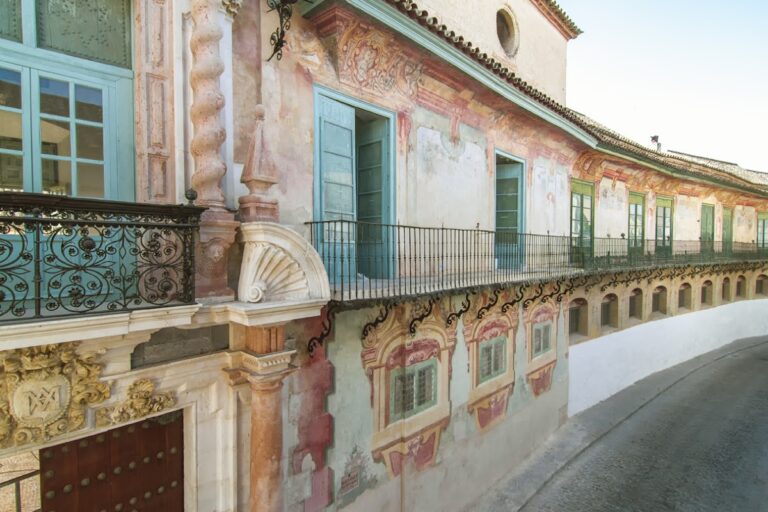
The palace was enlarged along with the garden at the beginning of the twentieth century, and its principal façade was documented around 1914. The main entrance portal carries the coat of arms of the Cabrera family, linking the surviving architectural fabric to the family’s period of ownership.
River junction and surrounding archaeology
Finca Moratalla stands at the junction of the Bembézar and Guadalquivir rivers, a setting that helps explain the site’s early strategic value. The surrounding archaeological landscape includes Umbría de Moratalla and Llanos del Roldán. Roman mosaics were found at these archaeological sites and are now visitable at the Palace of Viana rather than being identified as housed at Finca Moratalla itself.
Nearby sites