Schloss Henneckenrode: A Weser Renaissance Castle and Former Orphanage in Germany


Site at a Glance
- Rating
- 4.3
- Popularity
- Low
- Country
- Germany
- Primary era
- Early Modern
- External website
- Open
- Eras represented
- Early Modern, Modern
- Civilizations
- German, Holy Roman Empire
- Site type
- Domestic
- Remains
- Castle
On this page9 sections
History
Schloss Henneckenrode is a castle in Germany, in Henneckenrode within the municipality of Holle, Lower Saxony. It was built between 1579 and 1580 in the Weser Renaissance style, a regional form of late Renaissance architecture associated with northern Germany and the Weser River area. The site began as a knightly estate connected with the Counts of Wohldenberg from the early thirteenth century.
Medieval Estate and Feudal Ownership
In 1293, Siegfried II, Bishop of Hildesheim, acquired the estate for the Diocese of Hildesheim and granted it as a fief to the von Heere family. A feudal holder possessed land from a superior lord in return for obligations, while ultimate authority remained with the granting lord or institution. After the von Heere family became extinct, Burchhard von Saldern received the fief in 1567.
Construction and Noble Possession
Burchhard’s son Heinrich von Saldern built the castle in 1579 and 1580. A fire damaged it in 1588 and prompted rebuilding, although the extent of the damage and the nature of the reconstruction are not known. In 1684, Adam Arnold Freiherr von Bocholtz acquired Schloss Henneckenrode from Aschwin von Saldern.
The property changed hands again in 1820, when Friedrich Blum, the land rentmaster of Hildesheim, acquired it. A land rentmaster managed revenues and financial administration connected with landed estates or territorial government. In his will of 1831, Blum directed that the castle should become an orphanage administered by a foundation. After his death in 1832, the Blum Orphanage Foundation was established, with the Bishop of Hildesheim placed in charge on the instructions of the King of Hanover.
Orphanage and Welfare Institution
After alterations to the building, the orphanage opened at the castle in 1838. The Sisters of Mercy, a Catholic congregation whose members combined religious life with charitable and social care, worked there from 1856 until 1946. The Franciscan Sisters of the Poor then cared for the children until 2007.
During the Second World War, from 1942 to 1945, Schloss Henneckenrode served as a Wehrmacht military hospital. The Wehrmacht was Nazi Germany’s armed forces, and its military hospitals treated service personnel. After the war, the site returned to child care. Until 2017, the Caritas Association of the Diocese of Hildesheim operated a child and youth welfare institution in the castle, housing approximately 30 children and young people. The agricultural operation of the former estate was leased out and supplied income to the Blum Orphanage Foundation.
Closure, Protection, and Conservation
At the end of 2014, the Diocese of Hildesheim, the castle’s indirect owner, announced that the foundation’s institutions would leave the site and move elsewhere. Necessary building work costing more than two million euros was cited as the reason, since the expense exceeded the foundation’s assets. Former residents, staff members, and local residents formed an initiative opposing the closure of the children’s home. The castle was offered for sale in 2019, although the diocese postponed the sale in 2020.
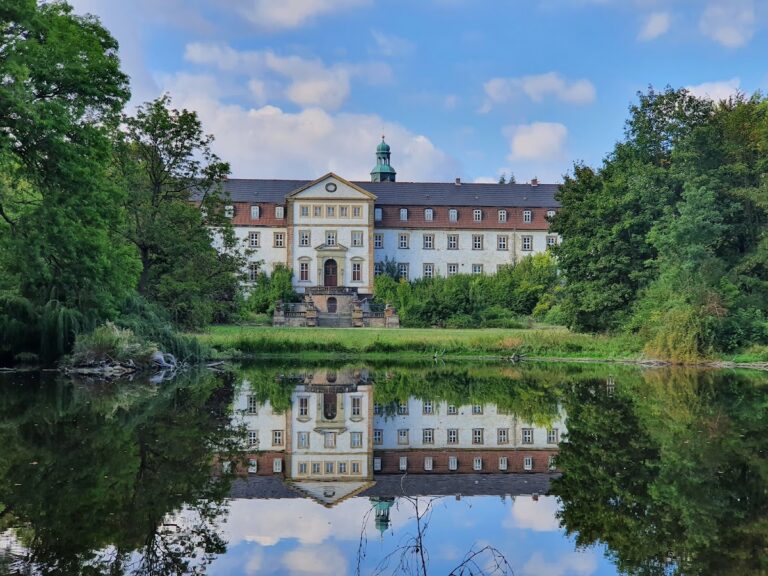
Schloss Henneckenrode and its grounds have been protected as a historic monument since 1988. The protected ensemble comprises the castle, two pavilions, the farm courtyard, the former castle church, and the landscape park with its pond. Part of the garden was reconstructed in 1999 and 2000 as a heritage-conservation measure. In 2012 and 2013, the silted-up pond was restored and the castle façades were repaired.
Remains
Castle and Estate Buildings
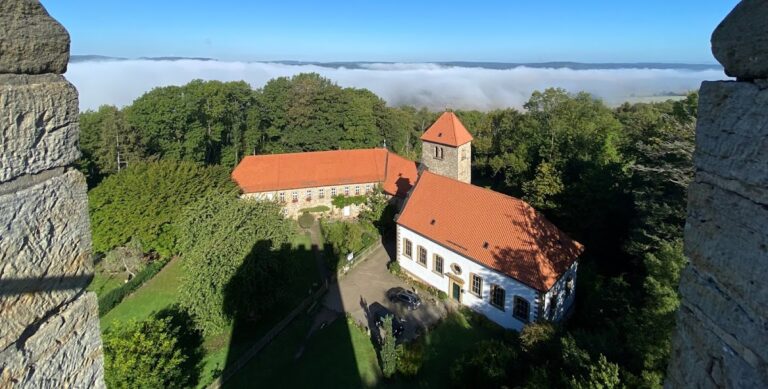
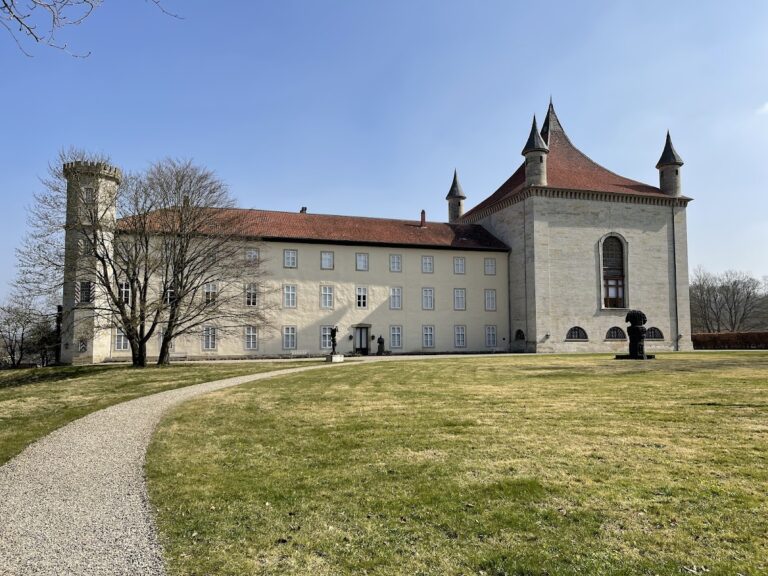
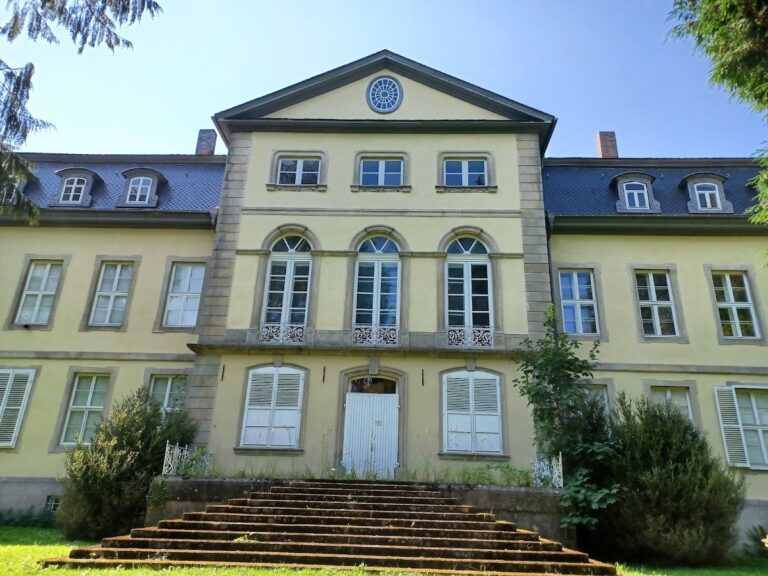
The castle’s west-facing front is arranged around a central projecting section called an avant-corps, with elaborate elements characteristic of the Weser Renaissance. Its rear is strengthened by massive, tall buttresses. Together with the three-sided farm courtyard, the building forms a four-wing complex enclosing a large inner courtyard.
Garden and Landscape Park
The castle garden was laid out around 1580 in connection with the construction of the residence. It was a formal Renaissance garden, probably influenced by Italian models, and was planned as a geometric square whose terraces formed a unified composition with the house. Earlier views show a parterre, or formal ornamental garden, divided into four equal sections. Boxwood edging defined the sections, while cross-shaped paths divided them.
Pergolas bordered the parterre beside the water areas, and a circular space occupied the center of the garden. The arrangement provided views toward the water, the Nette valley, the surrounding uplands, and Wohldenberg Castle. The garden’s basic structure survives, although the four-part division of the parterre has been removed. The landscape park includes a pond of approximately 2.6 hectares, fed by the Nette River.
Religious Buildings and Chapels
St. Joseph Church stands within the estate and was built as the castle church by Burchard von Saldern in 1597. It now belongs to the Catholic parish of St. Hubertus Wohldenberg. A house chapel inside the castle was documented in 1910, and a separate chapel was installed in the children’s home in 1970. Bishop Heinrich Maria Janssen consecrated that chapel on 8 December 1970 under the patronage of the Immaculate Conception of Mary.
Nearby sites