Schloss Schönberg (Wenzenbach): A Medieval Castle Complex in Germany


Site at a Glance
- Rating
- 4.6
- Popularity
- Low
- Country
- Germany
- Primary era
- Medieval
- External website
- Open
- Eras represented
- Medieval, Early Modern, Modern
- Civilizations
- Duchy of Bavaria, Holy Roman Empire
- Site type
- Domestic
- Remains
- Castle
On this page9 sections
History
Schloss Schönberg (Wenzenbach) is a medieval castle complex in Germany, with a core dated to 1253–1254 and later medieval expansion. It developed into a lordship whose ownership and administration passed among the bishops of Regensburg, the dukes of Bavaria, noble families, and ducal officials. The castle’s long history continued through early modern alterations, nineteenth-century jurisdictional change, and modern conservation.
Medieval lordship and ducal administration
In 1269, Schönberg belonged to the Lords of Hohenfels, ministeriales who formed a service nobility holding offices and estates for higher lords such as bishops and princes. The bishops of Regensburg and the dukes of Bavaria later held the castle. The Satelboger family possessed Schönberg from 1333, followed by the Hauzendorfer family from 1335. Konrad of Hauzendorf was still named as its holder in 1364.
During the later fourteenth and early fifteenth centuries, Schönberg was managed by a succession of ducal custodians. These included Ulrich Pudenstorfer in 1371, Eberhart Hofer, Werner Auer in 1385, Ulrich Auer, Purckhart Prachs in 1392, Lienhart Hilprant in 1393, Hanns Pfaffesanger in 1396, Niclas Schwednitz of Hohenburg in 1397, Hanns Pfaffenbanger in 1398, Konrad Haberstorffer in 1401, and Wilhelm Fraunberger in 1403. In that year, Duke Johann of Lower Bavaria pledged Schönberg to the knight Prodwitz Satelboger. After his death in 1407, Dietrich Satelboger held the castle until 1426. Oswald Krumpeckh sealed documents there in mid-1427 as judge of Schönberg, while Dietrich Mosheimer served as custodian in 1437.
The Deuerlinger family administered Schönberg between 1445 and 1460, and Erhart Muracher held it from 1462 to 1467. Jörg Haselbeck purchased the castle in 1468. Duke Albrecht bought it back at the beginning of 1498 and sold it to Wolfgang, Count of Kolberg of Neuenkolberg. Achatz Eberspeck, mentioned in 1501, and Michael Zenger subsequently served as custodians.
Capture and early modern ownership
On 12 September 1504, Maximilian I, then King of the Romans and later Holy Roman Emperor, captured Schönberg. He became Holy Roman Emperor in 1508. After the Battle of Wenzenbach, Duke Albrecht entered the castle, and in 1508 he granted it to Bernhardin of Stauff, Baron of Ehrenfels.
The lordship was sold to the Paumgartner family in 1513 and passed to the Breitenbach family in 1543. When Wilhelm of Breitenbach died in 1580, it reverted to the Wittelsbachs, the major Bavarian ruling dynasty. In 1585, they granted Schönberg to their personal physician Thomas Mermann, while excluding high justice, the authority over serious criminal cases traditionally punishable by death. Caspar Carthauser bought the property in 1589. Andreas Georg of Khürmreuth of Hörmanntorff and Hans Ludwig Trainer sealed documents there in 1591, and Trainer continued in that role until 1606.
Transformation of the estate
Through Trainer’s daughter Katharina, Schönberg passed as a marriage portion to the Lerchenfelder family. They remained resident there until 1753, when the estate was sold to Georg Karl Joseph of Stingelheim, a canon of Breslau Cathedral. The Stingelheim family retained it until 1817. A new castle building was erected in 1726, while further alterations took place from the late seventeenth to the early eighteenth century and again around 1770–1771. The roof frame bears the date 1820–1823.
In 1817, Karl Alexander of Thurn and Taxis purchased the lordship. Schönberg’s patrimonial court of first instance, a noble landholder’s court for cases heard at the initial level, also administered the patrimonial courts of Bernhardswald and Wiesent. These remaining forms of noble jurisdiction were abolished during the Revolution of 1848.
Modern ownership and conservation
The castle passed to the Vilsmeier family in 1927, and a tavern opened in the service buildings in 1928. The Fichtl family acquired the estate in 1957. The current owner, physician Hans-Hermann Klünemann, initiated renovation of the complex with assistance from the German Foundation for Monument Protection. Most of the renovation was completed in 2010. Schönberg is protected as an architectural monument, while archaeological remains in the castle area, on the site of the former medieval complex, are protected as an archaeological monument. The castle remains privately owned.
Remains
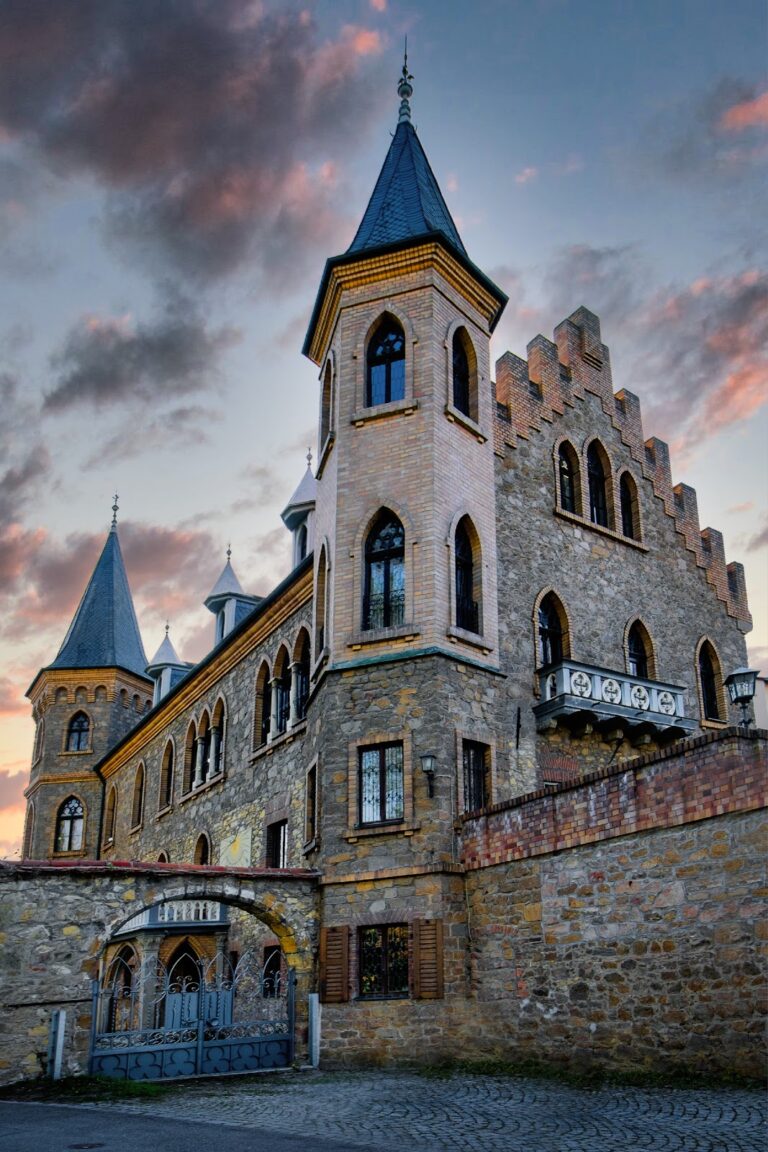
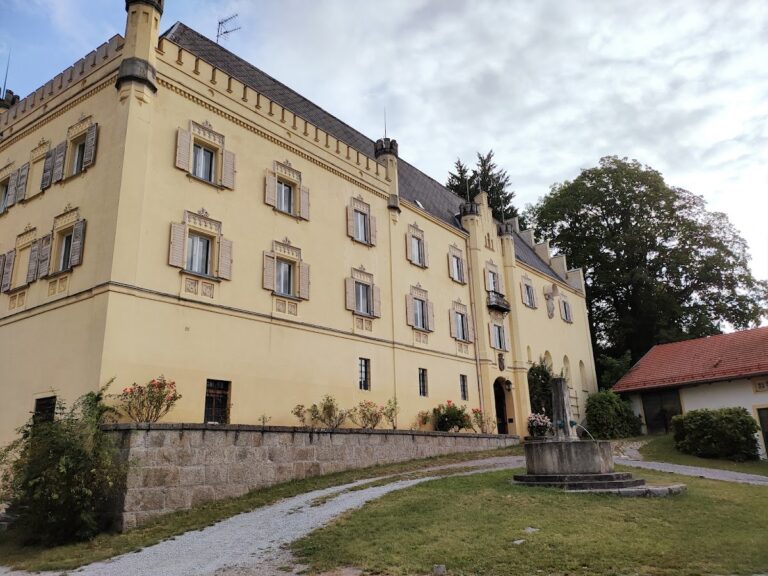
The surviving complex combines a three-storey castle building with fragments of the medieval fortifications and remains of ancillary structures. The present building has an irregular plan broken toward the south, a bay window, and a hipped roof that slopes down on all sides rather than ending in vertical gables. Its fabric incorporates the medieval core dated to 1253–1254, a later medieval extension, and subsequent alterations.
Castle building and chapel
The main castle is a three-storey structure whose medieval substance remains integrated into the later building. A Baroque chapel dedicated to Saint Joseph forms part of the complex. The building’s later appearance reflects the new castle construction of 1726, alterations from the late seventeenth and early eighteenth centuries, changes made around 1770–1771, and the roof frame dated 1820–1823. Renovation carried out mainly before 2010 affected the surviving complex.
Ancillary building remains
Part of a former ancillary building survives as two parallel cellars. They are built of rubble stone and covered by barrel vaults, continuous tunnel-shaped masonry vaults. These cellars probably date from the second half of the sixteenth century and preserve a fragment of the service structures associated with the castle.
Fortifications and former ditch
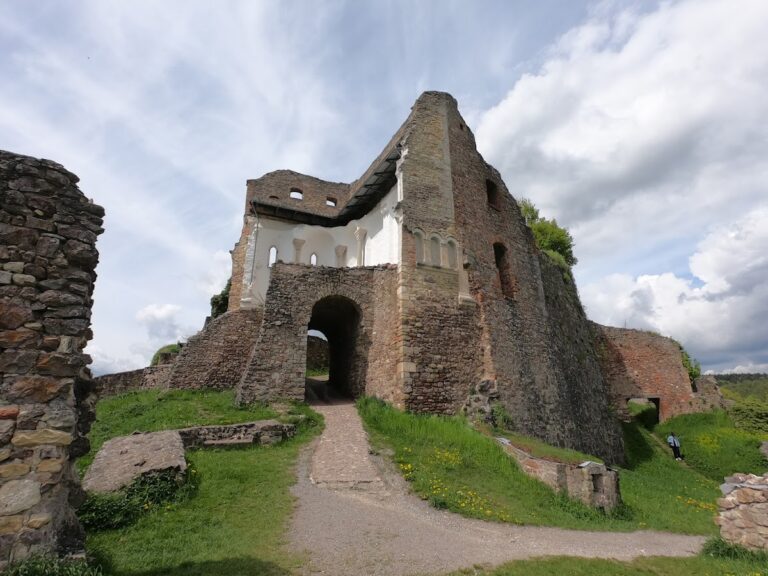
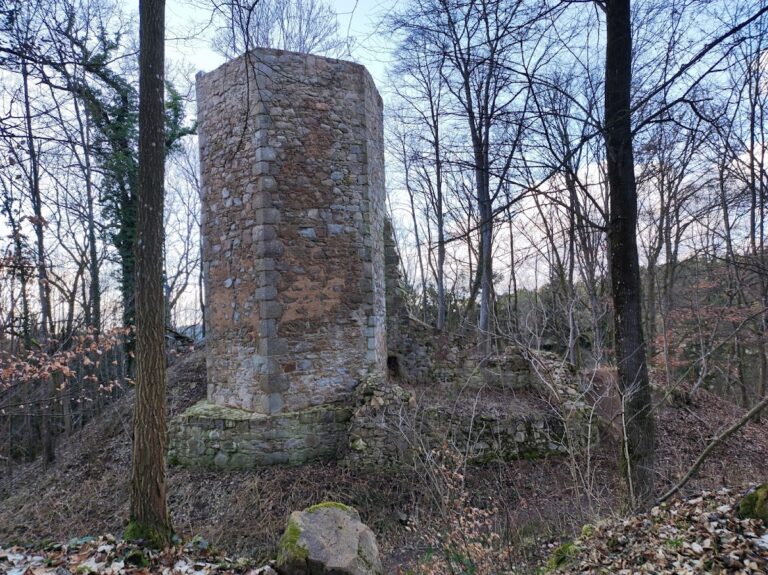
Fragments of the enceinte, or enclosing fortification, include sections of curtain wall and shell towers, defensive towers partly open toward the enclosure behind them. A probably late-medieval outer defensive wall survives with the ditch. This outer wall is built of granite rubble and formed a zwinger, an outer defensive enclosure between the main fortification and an external wall or ditch.
The former castle ditch has been filled in and is now used as a garden. Little of the original complex survives, but traces remain at the south-west corner, where a stretch of wall is preserved. The section of the present street called Am Schloss extending as far as house number 9 marks the line of the former ditch.
Nearby sites