Jalesne Castle: A Historic Estate in Vernantes, France


Site at a Glance
- Rating
- 4.3
- Popularity
- Low
- Country
- France
- Primary era
- Early Modern
- External website
- Open
- Eras represented
- Early Modern, Modern
- Civilizations
- French
- Site type
- Domestic
- Remains
- Castle
On this page8 sections
History
Jalesne Castle is an early seventeenth-century château in Vernantes, France, built during the early modern period and later extensively enlarged. The property developed from the former Jalesne fief, an eleventh-century feudal estate whose name was adopted by a knightly family.
From fief to marquisate
The medieval feudal castle associated with the Jalesne fief has disappeared. In the seventeenth century, the family that held the estate became extinct, but the fief continued to gain status. Louis XIII, king of France from 1610 to 1643, raised it to a marquisate in 1634. A marquisate was a noble territorial jurisdiction governed by a marquis, and the elevation recognized the loyalty of the Jalesne lords.
The last Marquis de Jalesne died in 1642, and his wife, Éléonore de Maillé, died in 1659. Their two daughters inherited the estate, which passed through marriage to the Maillé de la Tour-Landry family. A cenotaph commemorating the couple survives in the chapel of Vernantes’ town hall and church. The monument includes two white-marble busts, while its epitaph was left unfinished after the marquise’s death.
Revolutionary upheaval and nineteenth-century expansion
During the French Revolution, Charles Henri François de la Tour-Landry, who used the name Maillé and described himself as a timber merchant, purchased nationalized property. On 10 March 1791, he acquired Louroux Abbey for 60,000 livres. Seals were placed on Jalesne Castle in 1792, and the property was looted in December 1793.
The château was transformed and enlarged during the nineteenth century, with new construction added in 1862. Its large scale, tree-lined avenue, enclosed park, and deep moats preserved an aristocratic character even as the estate changed. In 1879, its owners received the Spanish Infante Dom Carlos for a month. Dom Carlos was a Spanish Bourbon claimant to the throne and an infante of Spain, a royal title used by members of the Spanish royal family who were not the sovereign’s heir.
The visit brought elaborate preparations, entertainments, and receptions for the nobility and local villagers. It was followed by financial difficulties and the gradual decline of the estate’s former lavish way of life. After the marquis died, the property had fewer resources available for its upkeep.
New owners and changing uses
In 1886, the wealthy Saumur merchant Mr Ackerman bought and restored the property. After his death in 1914, his daughters inherited it. One entered the Carmelite order, a Catholic religious order associated with contemplative life, and the sisters later transferred the château to an educational organization.
The Oblates of the Assumption, a Catholic religious congregation, established themselves in Anjou in 1916 and converted the château into the Saint-Louis Institution. In 1940, during the Second World War, the building became the headquarters of General Feldt, commander of the First German Cavalry Division. A medical post was also installed there to evacuate German dead.
In 1965, Dr Frétigny opened a nursery at the château for children with encephalopathy. The center later expanded its work to include children and adults with disabilities. The property is now listed as private.
Remains
The château and estate
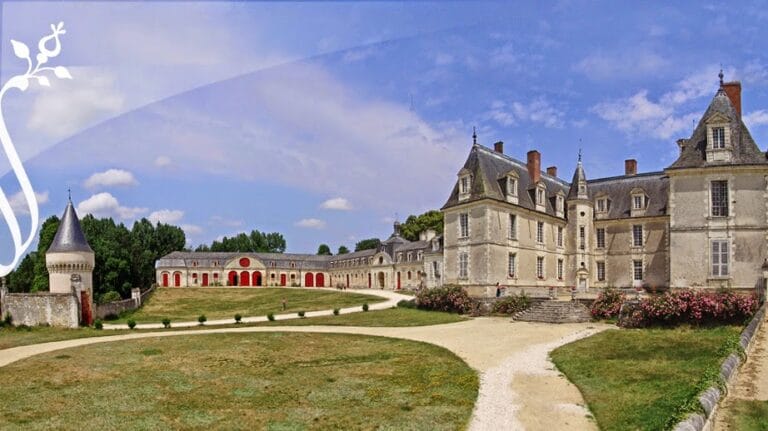
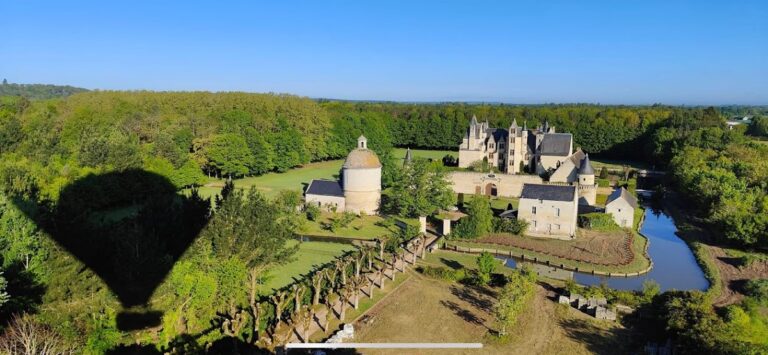
The surviving building is the early seventeenth-century château, substantially remodeled and enlarged during the nineteenth century. Its setting included a magnificent avenue lined with tall, old trees, a large enclosed park, and deep moats. These features formed the principal estate around the later château, rather than the vanished medieval castle.
Service buildings and parkland
Partly demolished service buildings once supported the estate’s agricultural and domestic operations. They accommodated livestock, thirty-six horses, and a kennel for sixty dogs. The park was used to raise roe deer and a fallow deer, while the surrounding lands hosted numerous hunts with hounds.
Preparations for the 1879 visit
The arrangements for Dom Carlos’s stay altered several parts of the château temporarily or permanently. An honor staircase was constructed, and a theatre was installed in one of the rooms. Dancers from Nantes and actors from the Paris Opera performed there. The central avenue was covered with five centimeters of bran to soften the horses’ footsteps, while silver bits and horseshoes were prepared for the visiting animals.
A small opening or window overlooking the moats was associated with a story that silverware had been lowered into the water during the visit. Traces of the alleged theft were said to remain around the opening. This tradition forms part of the château’s later historical memory, alongside the surviving evidence of its early modern construction and nineteenth-century transformation.