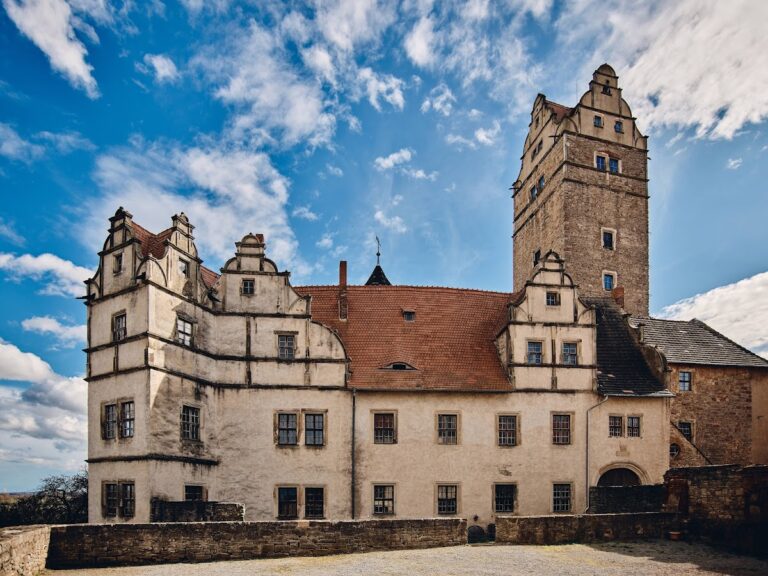
Oberwiederstedt Castle: Home of the Novalis Museum and Early Romanticism Research Center


Site at a Glance
- Rating
- 4.4
- Popularity
- Low
- Country
- Germany
- Primary era
- Early Modern
- External website
- Open
- Eras represented
- Medieval, Early Modern
- Civilizations
- Holy Roman Empire
- Site type
- Domestic
- Remains
- Castle
On this page14 sections
History
Oberwiederstedt Castle in Arnstein, Germany, is a Renaissance manor built in the sixteenth century over parts of an earlier Dominican convent complex. The estate is closely associated with Friedrich von Hardenberg, the eighteenth-century German poet known as Novalis, who was born here in 1772. Today, the castle houses the Novalis Museum, a research center for Early German Romanticism, the International Novalis Society, and the Novalis Foundation.
Medieval convent and Renaissance manor
A Dominican convent for nuns relocated from Kupferberg near Hettstedt occupied the site from 1261 until the Reformation and the associated secularization. The later manor incorporated surviving portions of this earlier complex, creating a connection between the medieval religious foundation and the estate’s Renaissance form.
The manor was repeatedly altered from the seventeenth century onward. It suffered severe damage during the Thirty Years’ War, the major seventeenth-century conflict that affected much of Europe, and was repaired afterward. From 1634, or during the seventeenth century through marriage, ownership passed to the von Hardenberg family. Although the family leased the estate for several years at the beginning of the nineteenth century and moved to other properties, Oberwiederstedt remained their family seat until their expropriation and expulsion in October 1945.
The von Hardenberg family
Friedrich von Hardenberg, who wrote under the name Novalis, was born in the manor in 1772. Novalis became one of the central figures associated with Early German Romanticism, a movement that emphasized imagination, symbolism, emotion, and the relationship between art, nature, and philosophy. The family later placed a commemorative plaque beside the entrance portal of the east wing.
Hans von Hardenberg was also born at Oberwiederstedt. He became a senior Prussian official and politician, serving as district administrator of the Mansfeld Mountain District and later as deputy government president.
War damage, decline, and preservation
In 1945, the castle was used to house refugees. During the German Democratic Republic, it became an old people’s home, but the building was declared uninhabitable and evacuated in 1981. A study commissioned in 1982 considered its possible conversion into a cultural and administrative center.
As deterioration continued, five of the eleven bays of the west wing and a Gothic corbelled latrine were demolished in 1985. The castle was removed from the list of protected historic monuments in the mid-1980s or in 1987. In 1988, citizens formed an initiative to prevent its complete demolition. Led by the craftsman Gerald Wahrlich and supported by friends and colleagues, the group began emergency preservation and partial rehabilitation through unpaid voluntary work, including provisional roof repairs.
Later assessments concluded that the manor could be saved. Resources intended for dismantling were redirected toward structural consolidation, especially at the west gable facade and east wing. The initiative also opposed demolition plans through public campaigns and pressed for new uses for the building. The Interessengemeinschaft Novalis grew out of this campaign and later helped establish the Kuratorium Novalis-Geburtshaus association.
Public cultural institution
After German reunification, donations from western Germany and public appeals supported the security and comprehensive rehabilitation of the castle and its parkland from the early 1990s onward. On 2 May 1992, the partially restored estate was transferred to the Mansfeld district for public use on the 220th anniversary of Novalis’s birth. The International Novalis Society was founded on the same day with the participation of scholars and admirers of Novalis from several countries.
The Forschungsstätte für Frühromantikforschung began work in 1993 with support from Saxony-Anhalt and the district. The Novalis Museum was included in the Blaubuch, a German national inventory of culturally significant memory institutions and memorial sites, when it was first published in 2001. Oberwiederstedt is regarded as a cultural memory site of special national importance.
Restoration later extended to the nearby church where Novalis was baptized and to parts of the former Dominican convent complex. Part of the convent has been restored, while the former convent church continues to require repair and conservation.
Remains
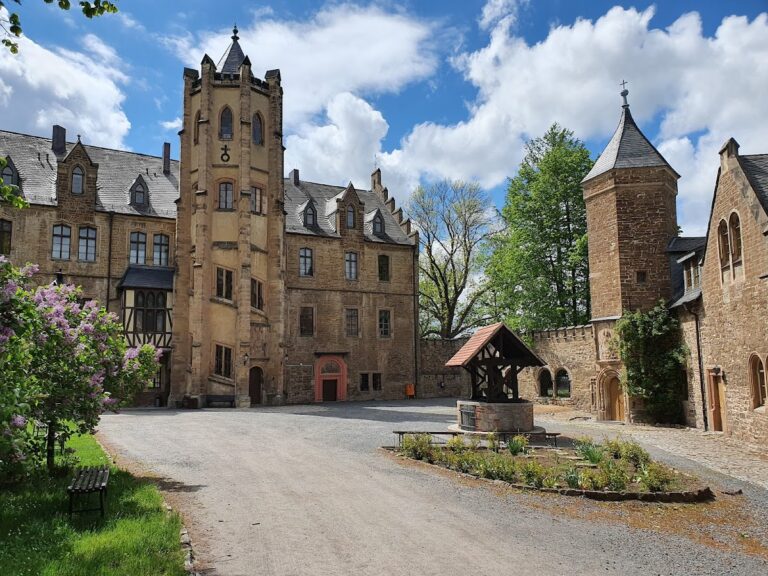
Oberwiederstedt Castle is a Renaissance manor formed by two wings set at a right angle, with a stair turret at their junction. The sixteenth-century building incorporates surviving elements of the medieval convent complex. Its later history remains visible in seventeenth-century Baroque work, nineteenth-century additions, and the physical changes made during twentieth-century emergency preservation and restoration.
The castle buildings
Renaissance wings and stair turret
The two-wing arrangement gives the manor its basic plan. A stair turret rises at the meeting point of the wings, and the building’s sixteenth-century fabric includes portions inherited from the earlier convent. During the nineteenth century, the turret was raised and stepped gables were added, reinforcing the building’s Renaissance appearance.
Portal, windows, and interior features
The seventeenth-century rebuilding introduced a Baroque entrance portal dated 1687. Cross-mullioned windows with wooden fittings belong to the same phase, while the entrance hall on the second floor contains an open-hearth fireplace. The interior door surrounds retain Renaissance features. A balcony above the entrance portal, added in 1915, was removed during restoration, along with other later additions, as the building was brought closer to its pre-1870 appearance.
West wing and restored fabric
The west wing originally contained eleven bays. Five were demolished in 1985 because of structural deterioration, and a Gothic corbelled latrine was removed at the same time. Emergency work first included provisional roof repairs, followed by structural consolidation focused on the west gable facade and the east wing. The surrounding parkland was secured and comprehensively rehabilitated from the early 1990s.
Religious buildings and archaeological remains
Baptismal church
A nearby church where Novalis was baptized forms part of the historical setting associated with the castle and the poet’s family. Its restoration was undertaken alongside later work at the estate.
Former Dominican convent
The site also includes the former convent church and remains of the Dominican convent that preceded the manor. Parts of the convent complex have been restored, while the former convent church remains a focus of further repair and conservation.
Novalis Museum collections
The permanent Novalis Museum exhibition includes historical paintings of the von Hardenberg family and artifacts relating to Novalis’s life and work. These collections complement the preserved birthplace and the research activities devoted to Early German Romanticism carried out within the castle.
Nearby sites