Schloss Walbeck: A Baroque Manor Estate in Germany


Site at a Glance
- Rating
- 4.5
- Popularity
- Very Low
- Country
- Germany
- Primary era
- Early Modern
- External website
- Open
- Eras represented
- Medieval, Early Modern, Modern
- Civilizations
- Holy Roman Empire
- Site type
- Domestic
- Remains
- Castle
On this page16 sections
History
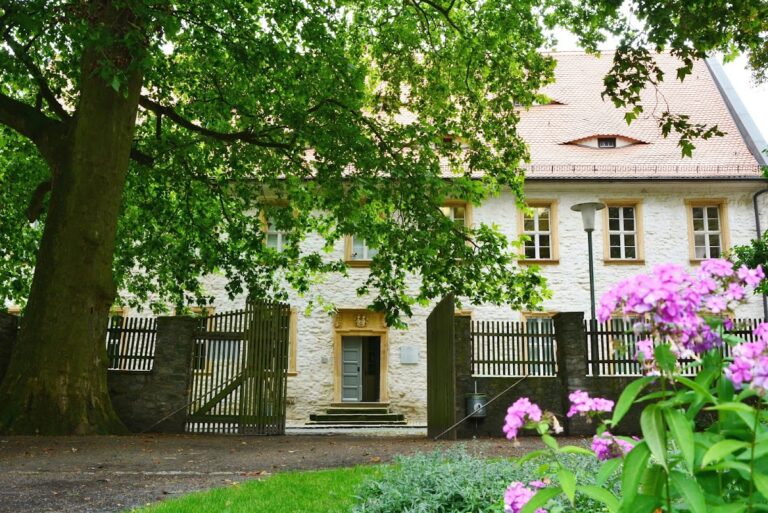
Schloss Walbeck is a Baroque castle complex in Germany, built in 1765 on the surviving foundations of a former Benedictine monastery. The estate stands at a site first recorded in 959 as Walbiki and developed from a royal residence and monastery into a manor, agricultural estate, and protected historic monument.
Royal residence and Benedictine monastery
Walbeck was described by the historian Cyriacus Spangenberg as a substantial manor farm. Kings Henry I, Otto I, Otto II, and Otto III used it as a royal residence, placing the estate within the early medieval royal landscape.
In 985, Abbess Mathilde of Quedlinburg received Walbeck from Adelaide of Burgundy, the widow of Otto I. The transfer required Mathilde to establish a Benedictine monastery there. The Benedictine Order is a Christian monastic order shaped by the Rule of Saint Benedict, with communal prayer, disciplined work, and religious observance at its centre. Bishop Arnulf of Halberstadt consecrated the monastery in 997.
Destruction, secularization, and the manor estate
The monastery complex was severely damaged during the German Peasants’ War in 1525, a widespread uprising in the German lands that challenged religious, social, and economic authority. After the monastery was secularized in 1546, meaning that its ecclesiastical institution and property were transferred into nonreligious control, the estate passed to the Counts of Mansfeld. They later pledged and sold it, beginning a succession of ownership changes.
In the 1670s, the Hanoverian chief mining official Friedrich Casimir zu Eltz acquired the estate. His son, Philipp Adam, bequeathed it in 1728 to his nephew Johann Clamer von dem Bussche-Lohe. The property was registered as a manor in 1745, and the present Schloss Walbeck was built in 1765 as the family seat. A church was constructed on the grounds at the same time.
Later estate development and agricultural use
A later member of the Bussche family redesigned the park and established an extensive orchard. The orchard was placed under the care of a Dutch officer, for whom the Planteurhaus was built. A Planteurhaus was a house intended for an orchard gardener or manager.
At the end of the nineteenth century, the district administrator Bartel acquired the property and added large barns to the estate. He was dispossessed in 1945. After the Second World War, Schloss Walbeck became a state-owned agricultural estate. In the German Democratic Republic, such an institution was known as a Volkseigenes Gut, a state-owned farm. Large stable complexes were added, and Walbeck became an agricultural training establishment associated with horse breeding. An agricultural school with a boarding facility also operated in the castle.
Privatization and conservation
After the political change of 1989, the estate was privatized by the Treuhandanstalt, the East German trust agency responsible for managing and selling state-owned property and enterprises. The property changed hands several times and accumulated a substantial renovation backlog. In 2011, a private owner installed extensive photovoltaic systems on the castle roofs. Revenue from electricity production has supported renovation of the estate and castle, which is known as the Sonnenschloss. The complex is currently used as a residence and is associated with the Endres family.
Remains
Castle and church
Baroque castle
The present castle is a Baroque complex erected in 1765 over the surviving foundations of the monastery. Its side wings have curved gables, giving the building a characteristic eighteenth-century profile. Large barns constructed at the end of the nineteenth century stand on the estate and obstruct the view of these gables. Photovoltaic installations added to the roofs in 2011 form part of the castle’s modern fabric and have helped finance the continuing renovation of the buildings.
St. Andreas Castle Church
St. Andreas Castle Church stands west of the castle. It was built at the same time as the present residence and forms part of the eighteenth-century arrangement of the estate.
Surviving monastery cloisters
The monastery’s surviving cloisters are incorporated into the castle complex. They preserve a physical connection with the Benedictine foundation consecrated in 997 and are the principal surviving element of the earlier monastic complex within the present estate.
Park and orchard
Redesigned park
The grounds include a park redesigned by a later member of the Bussche family. Its present arrangement belongs to the period when the estate was being developed as a family manor and agricultural property.
Orchard and Planteurhaus
An extensive orchard was established on the estate, together with the Planteurhaus for the Dutch officer responsible for managing it. The house and orchard form a distinct group of estate features linked to the property’s later horticultural development.
Agricultural buildings
Late nineteenth-century barns
Large barns were built after Bartel acquired the estate at the end of the nineteenth century. Their scale reflects the expansion of the property’s agricultural functions, and their position affects views toward the castle’s curved side-gable wings.
Postwar stable complexes
Large stable complexes were added after 1945, when Walbeck became a state-owned agricultural estate and training establishment. These buildings supported the estate’s horse-breeding activities and its agricultural educational role.
Nearby sites