Château de Costaérès: A Neo-Medieval Manor in Trégastel, France


Site at a Glance
- Rating
- 4.9
- Popularity
- Low
- Country
- France
- Primary era
- Modern
- Eras represented
- Modern
- Civilizations
- French
- Site type
- Domestic
- Remains
- Castle
On this page11 sections
History
Château de Costaérès is a neo-medieval manor in Trégastel, France, built in the late nineteenth century as a summer residence for Bruno Abakanowicz, a Polish-Lithuanian mathematician, electrical engineer, and inventor. Construction took place from 1892 to 1896 on the roughly one-hectare island of Costaérès, using the Historicist tradition, a nineteenth-century approach that revived forms from earlier periods. The island lies on Brittany’s Côte de Granit Rose and faces the beaches of Tourony and Saint-Guirec at Ploumanac’h.
Foundation and construction
Abakanowicz bought the island from customs officer René Le Brozec toward the end of summer 1892. He paid 0.25 French franc per square metre, or approximately 2,500 francs in total. Before the manor was built, the land was used to grow potatoes and to dry lichen and fish. The plans were prepared by the engineer Lanmoniez, while construction was directed by the Lannion contractor Pierre Le Tensorer.
Abakanowicz died in 1900 before the manor was fully finished. His daughter, Sofia Abakanowicz, later Madame Poray, inherited the property, completed the building, and added a western wing. She then moved to the island with her family.
A Polish cultural setting
At the beginning of the twentieth century, the manor became a meeting place for Polish emigrants. Henryk Sienkiewicz, a Polish novelist and close friend of Abakanowicz who received the Nobel Prize in Literature in 1905, stayed at Costaérès in 1898 and 1899. He wrote his novel Quo Vadis there.
War damage and later changes
During the Second World War, the German army requisitioned the manor and used it as a small military base. The occupation caused damage to the interior. Dieter Hallervorden bought the property in 1988 and had it fitted out as a second residence. A fire on 6 September 1990, following roofing work, partially destroyed the interior, and the damaged areas were later restored. The estate was put up for sale in early 2025.
The island’s name comes from an old Breton expression meaning “old drying place” or “old drying facility,” recalling the former practice of fishermen drying their catches there. The island is within the Natura 2000 Côte de Granit Rose–Sept-Îles protected area, part of a European network established to conserve important habitats and species. Although some descriptions administratively associate the manor with Ploumanac’h, it lies within the territory of Trégastel. The property is recorded in the French Ministry of Culture’s Mérimée heritage database.
Remains
The manor and its construction
Neo-medieval exterior
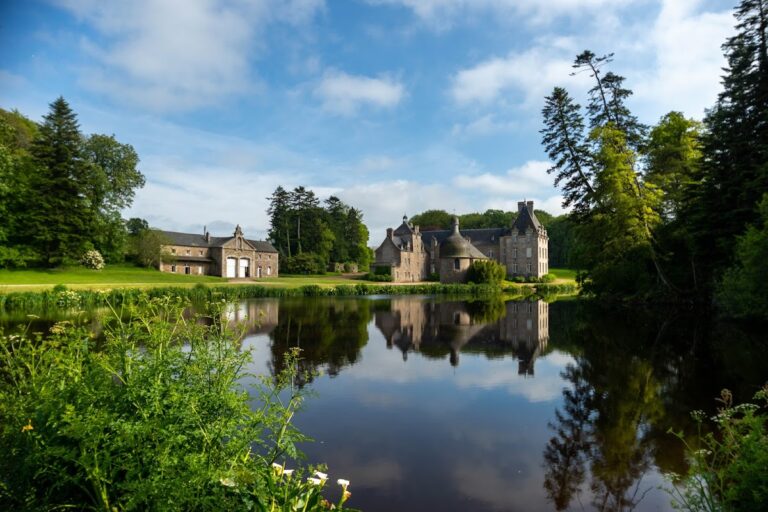
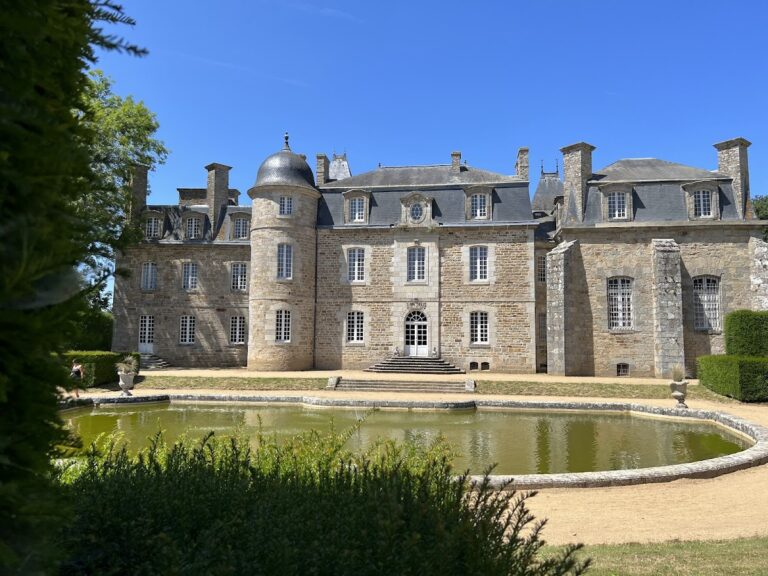
Château de Costaérès is a large Neo-Gothic and neo-medieval manor designed to resemble a medieval castle. Its complex form reflects several extensions and alterations. The walls are built from pink granite quarried at La Clarté in the Perros-Guirec area, while weather-resistant slate covers the roofs. A richly decorated masonry facade includes small round turrets, and the western wing was added to the rear facade after 1900.
Interior rooms
The principal residence rises through four floors. Surviving rooms include a knights’ hall, a panoramic salon, reception halls, and banquet halls, along with five bedrooms. Reclaimed wood from the three-masted sailing ship Maurice, which was stranded in the winter of 1896, was used in the interior design.
Island estate
Terraces and grounds
Several terraces surround the manor. The estate also contains an ornamental garden, an extensive enclosing wall, a private beach area, and a boathouse. The building was apparently renovated in 1980, when a television room, sauna, fitness room, and swimming pool were added.
Coastal setting
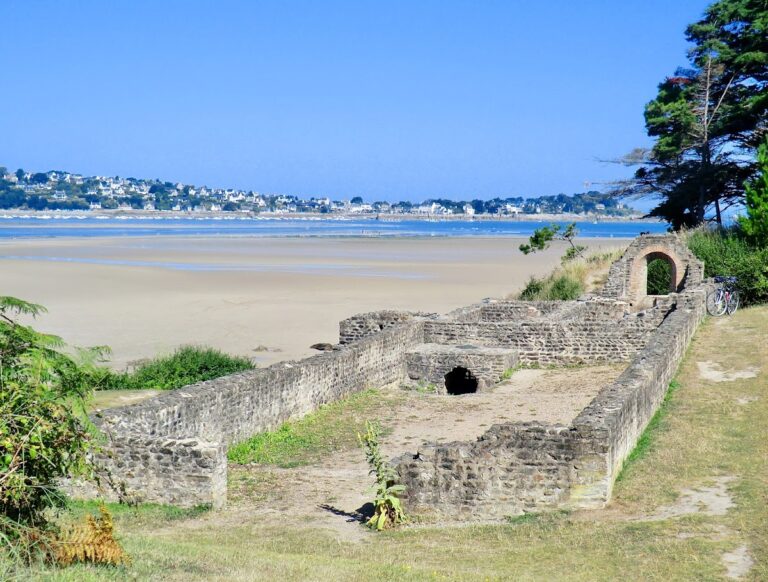
The manor stands on Costaérès island opposite the beaches of Tourony and Saint-Guirec at Ploumanac’h. The channel of the port of Ploumanac’h, formed by the Grand-Traouïero stream, separates the island from Ploumanac’h.
Nearby sites