Kergüntuil Gallery Grave: A Late Neolithic Tomb in France
Site at a Glance
- Popularity
- Low
- Country
- France
- Primary era
- Stone Age
- Eras represented
- Stone Age
- Civilizations
- Unclassified
- Site type
- Burial
- Remains
- Tomb
On this page11 sections
History
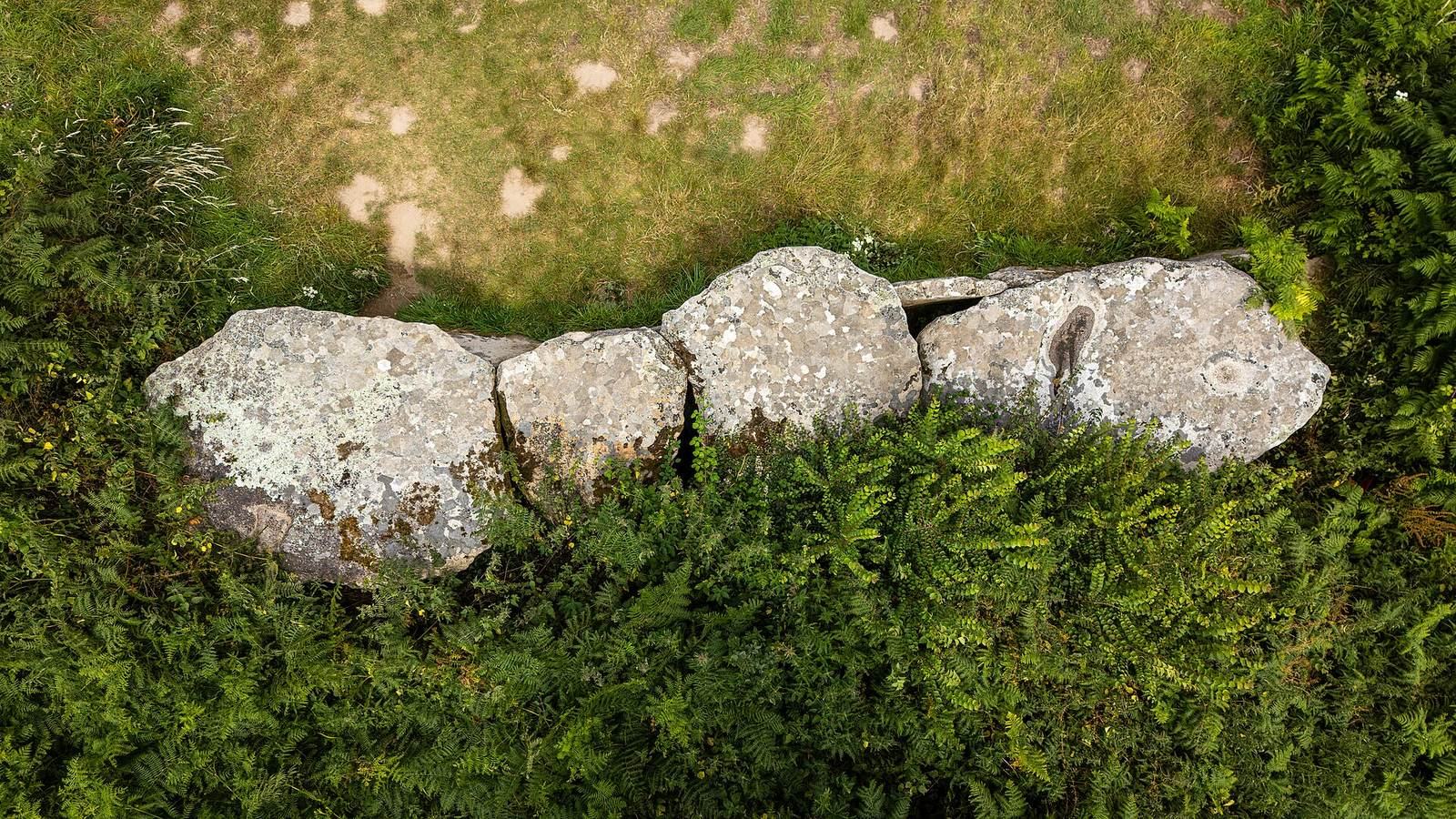
The Kergüntuil gallery grave is a late Neolithic covered-gallery tomb at Pleumeur-Bodou, France. It belongs to a regional tradition of side-entry tombs built between about 3000 and 2500 BCE. Its decoration is assigned to the final Neolithic, around 2500 BCE. A separate dolmen stands nearby.
Neolithic setting
The Neolithic was the prehistoric period when farming and settled communities developed. Communities in the area also drew on coastal resources: salt was produced along the shore, while fish, seafood, and seaweed supplemented agricultural diets.
Later use and modern history
The dolmen was later adapted as a dwelling and then used as a stable. A homeless man lived in it for an extended period and added wooden elements to make it a more practical shelter.
In 1939, the municipality of Trégastel and local helpers excavated and restored the covered gallery. The work was haphazard, and local people disturbed the monument after pottery was found. In 1948, the dolmen and gallery were jointly classified as historic monuments.
Remains
The dolmen and covered gallery are separate stone tombs about 100 metres apart. The dolmen lies slightly more than 100 metres northwest of the gallery.
The dolmen
Chamber and supports
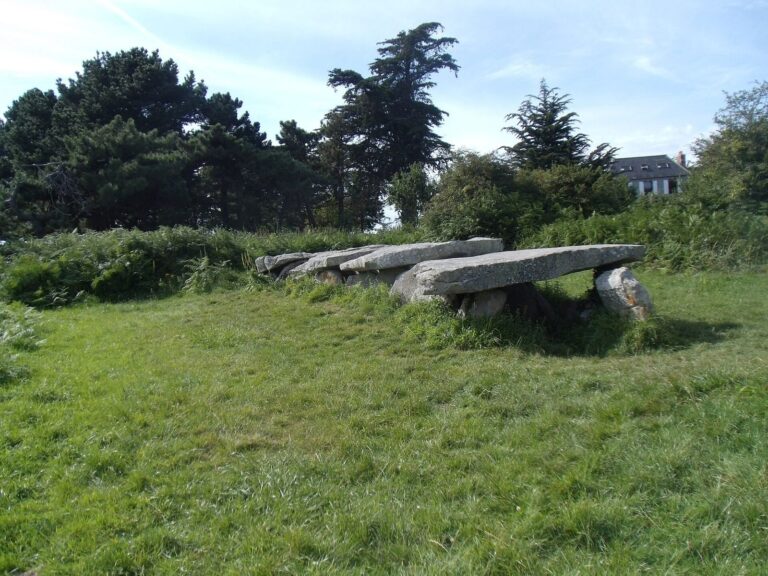
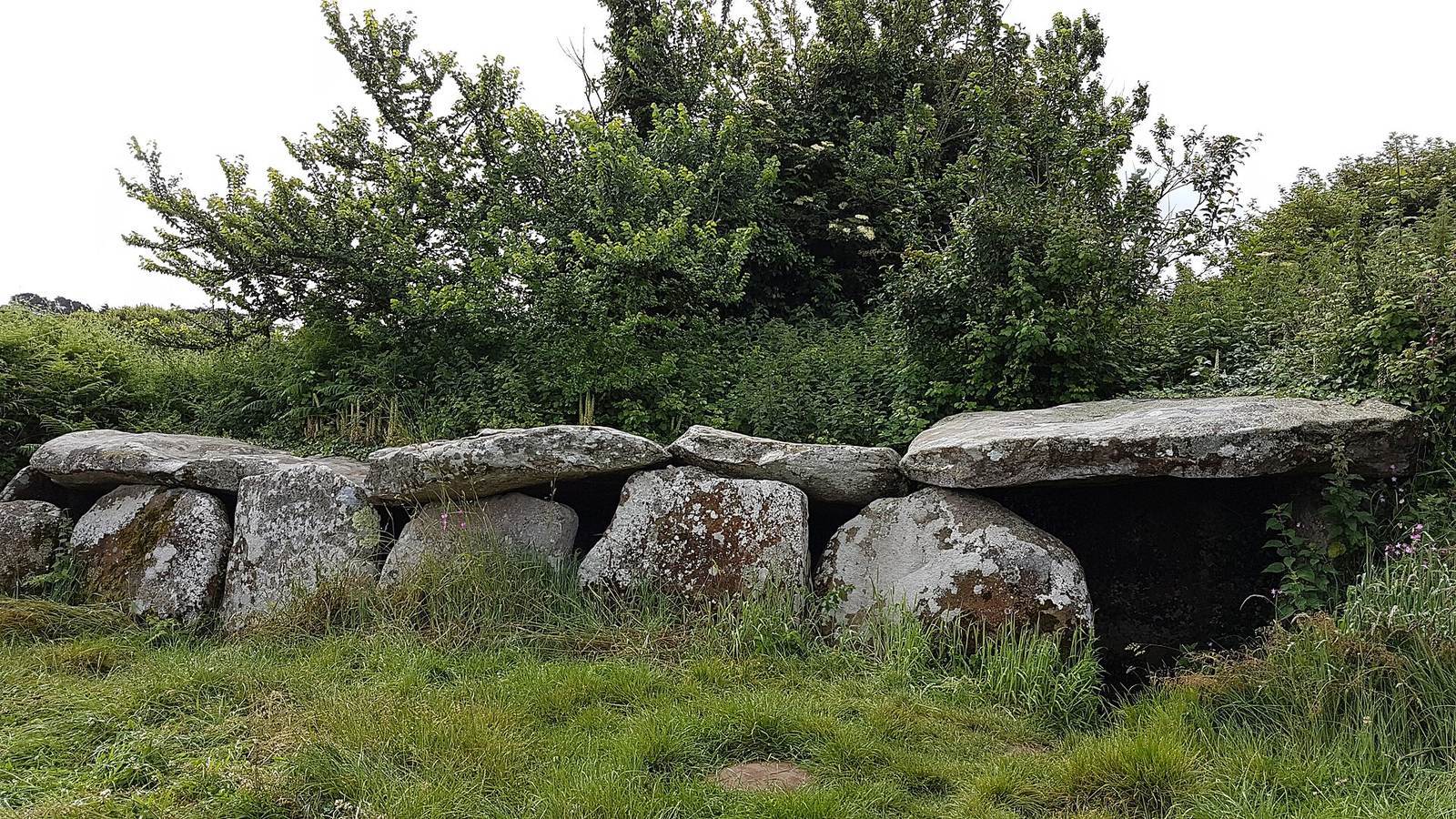
Three main supporting stones carry the dolmen’s capstone, a large slab laid across supports to form a roof. The capstone is 5.75 metres long, 3.55 metres wide, and 0.75 metres thick, and weighs about 20 tonnes. The chamber measures about 5 metres long, 3 metres wide, and 2 metres high. Two further supporting stones stand outside the covered area. The northern support is 2 metres high, 1.50 metres wide, and 0.20 metres thick; it extends west into a dry-stone wall that appears to be a later addition. The slightly convex western stone measures 2.55 metres wide and 2.305 metres high, with a thickness of 0.40 metres at its base and 0.30 metres at the top. The southern stone, set against an embankment, measures 2.50 metres wide, 2.40 metres high, and 0.35 metres thick. The embankment may preserve part of the original burial mound.
Stonework and later additions
Stonework assembled without mortar fills the gaps between the dolmen’s supports. At the eastern end, a separate wall made of cut stone blocks joins the northern and southern sides. It contains two niches opening into the chamber and was added when the monument was reused.
The covered gallery
Structure and access
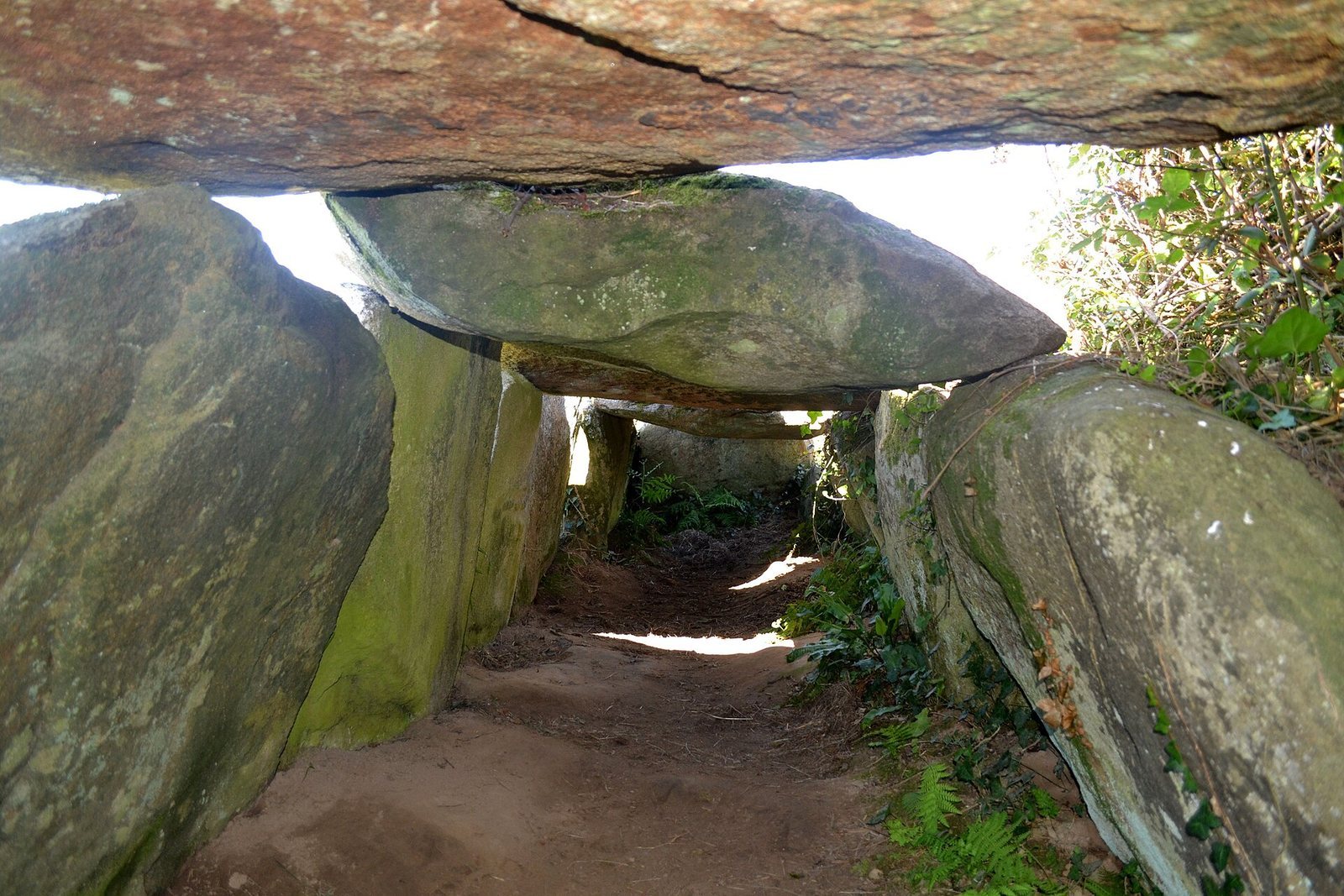
The gallery is 8.50 metres long. Its width ranges from 1.40 metres at the eastern end to 1.75 metres at the western end, and its height varies between 1 and 1.20 metres. Oriented east-southeast to west-northwest, it has six standing stones along the north side, seven on the south, two granite stones at the ends, and four capstones. The southern side rests against an embankment. The largest capstone measures 3.30 by 1.95 metres and is 0.50 metres thick; the smallest measures 1.30 by 1.10 metres and is 0.40 metres thick. The original entrance is uncertain, but it is thought to have been on the southern side, perhaps toward the southeast. The present northern access occupies the position of an earlier supporting stone.
Carved decoration
The northern interior stones carry carved motifs. Numbered from east to west, stone 4 has six roughly aligned pairs of raised breasts, each with a recessed necklace made by pecking into the stone. The breast outlines are polished, and the forms are about 5 centimetres across. Several palette-shaped motifs also appear on this stone. Stone 5 carries two further pairs, one accompanied by a necklace. Stone 2 may have had a pair of breasts, now concealed because the slab was reset upside down. Four stones have projections. The breast-and-necklace designs have been interpreted as sacred symbols of the Magna Mater, meaning “Great Mother,” a mother goddess associated with Cybele in Roman religion and also regarded as a goddess of the dead. Later incisions on stones 4 and 5 are vandalism.
Excavated floors, tools, and pottery
Excavation revealed two layers of large stone floor slabs. These slabs have since disappeared or were reused during restoration. Stone tools and pottery lay in the clay between the floors. The tools included five or six polished axes, possibly as many as ten, including one of flint, and a flint dagger of the Grand Pressigny type. The pottery comprised two collar-rim bottles, a flowerpot-shaped vessel, and fragments of flat-bottomed and round-bottomed pots. A third collar-rim bottle may have been taken away by Dutch archaeologists before the excavation. Collar-rim bottles of this kind are characteristic of megalithic pottery from northern Germany, with related examples known across northern and central Europe. Their presence may point to contacts between communities on the Channel and North Sea coasts.