Schloss Hersberg: A Monastic Palace and Pallottine Educational Complex in Germany


Site at a Glance
- Rating
- 4.5
- Popularity
- Low
- Country
- Germany
- Primary era
- Early Modern
- External website
- Open
- Eras represented
- Early Modern
- Civilizations
- Holy Roman Empire
- Site type
- Domestic
- Remains
- Palace
On this page12 sections
History
Schloss Hersberg is a historic palace complex in Germany, located at Immenstaad am Bodensee, whose southern front took its present form around 1600. The estate was first associated with the von Hersberg family before becoming a representative monastic outpost of the Imperial Abbey of Ochsenhausen and later a princely property.
From the Hersberg family to Ochsenhausen
The name Hersberg probably derives from the Old High German root hari or heri, referring to a ridge or mountain range. The earliest uncertain written reference dates from 1276 and mentions the brothers Berctoldus and Heinricus of Herisberg. By 1466, the estate was securely recorded as a fief held by Konrad Rudolf von Härsberg, a citizen of Überlingen who later became a vassal of Fürstenberg.
In 1621, the Benedictines of Ochsenhausen Abbey purchased Hersberg from the descendants of the Härsberg family. Ochsenhausen was an imperial abbey, meaning that its abbot governed a self-administering monastic territory within the Holy Roman Empire. Hersberg consequently became a representative residential outpost of the abbey. Abbot Alphons planned the estate as a princely-style residence, and its expansion continued through the seventeenth century.
Secular and princely ownership
Secularization, the early nineteenth-century abolition and transfer of church territories to secular rulers, ended the abbey’s ownership in 1803. The former monastic property passed to Prince Franz Georg Karl von Metternich. The House of Württemberg acquired Hersberg in 1806, and Prince Konstantin zu Salm-Reifferscheidt purchased it in 1838.
The Württemberg exclave of Herrschberg, the territory surrounding the estate, became part of Baden in 1846 through an exchange involving Waggershausen near Friedrichshafen. Schloss Hersberg also entered literary history when the poet Annette von Droste-Hülshoff, a friend of Konstantin zu Salm-Reifferscheidt’s wife, stayed there in 1847.
Pallottine period and wartime history
Franz zu Salm-Reifferscheidt-Dyck, a descendant of Konstantin, sold the estate to the Pallottines, formally the Society of the Catholic Apostolate, on 7 February 1929. This Roman Catholic community was founded for apostolic, pastoral, and educational work. From 1930 to 1992, it operated the St. Josef-Hersberg seminary for late vocations, together with a school.
During the early years of the National Socialist regime, the community faced a shortage of new entrants. In 1940, the authorities ordered the closure of the house and school. In April 1945, during the final days of the Second World War, high-ranking opposing officers, German officers connected with the 20 July 1944 plot against Hitler, and relatives detained under the principle of collective family responsibility were imprisoned in the house chapel and threatened with death. The relatives had been seized in the Aktion Gitter, a National Socialist mass-arrest operation directed against political opponents and relatives of those linked to the plot. They were hidden from the SS and rescued in dramatic circumstances.
After the war, Schloss Hersberg accommodated 200 internees and then served as a French barracks until 1947. These uses damaged the buildings and parkland. The Pallottine brothers reopened the school afterward, and major twentieth-century building works adapted the complex for educational purposes and later for a nursing home. In 1994, it reopened as a Pallottine spiritual house and continues to be used as an educational institution of the community.
Remains
Palace front and older fabric
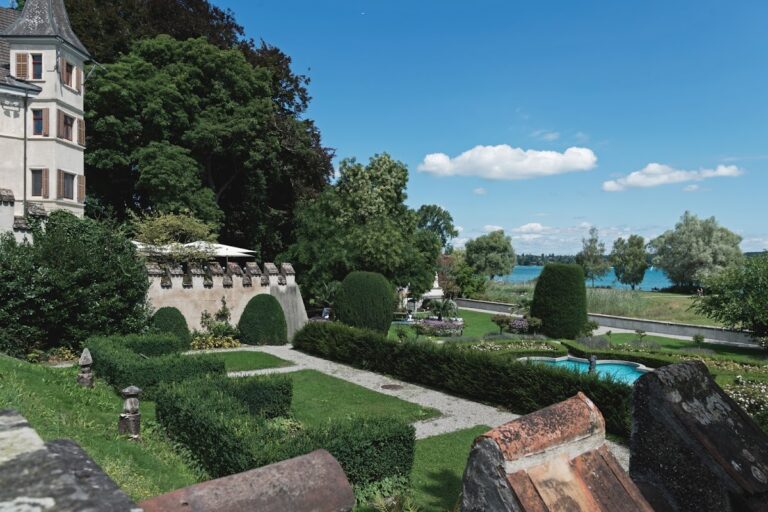
Schloss Hersberg occupies a vine-covered hill approximately 500 metres from the shore of Lake Constance, west of Immenstaad between Friedrichshafen and Meersburg. It stands near Hochberg, an elongated hill formed beneath glacial ice that rises 55 metres above the lake. The former Schloss Kirchberg lies below Hersberg toward Hagnau.
Southern frontal building
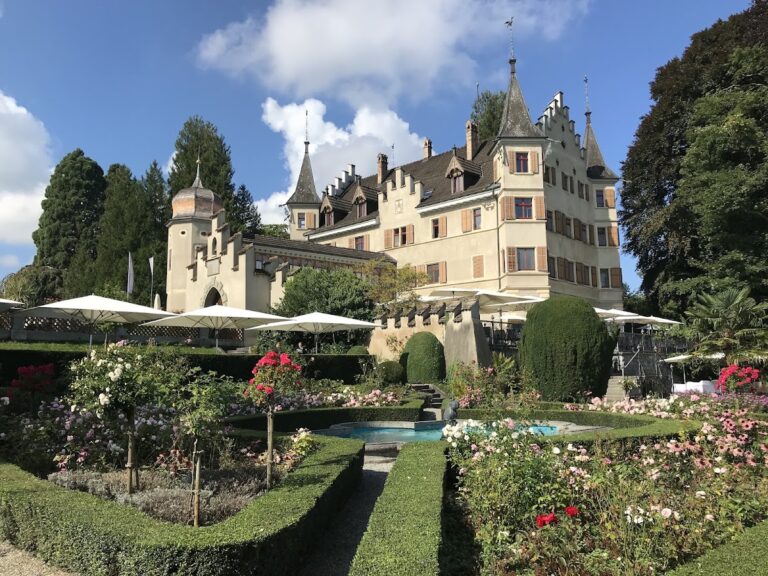
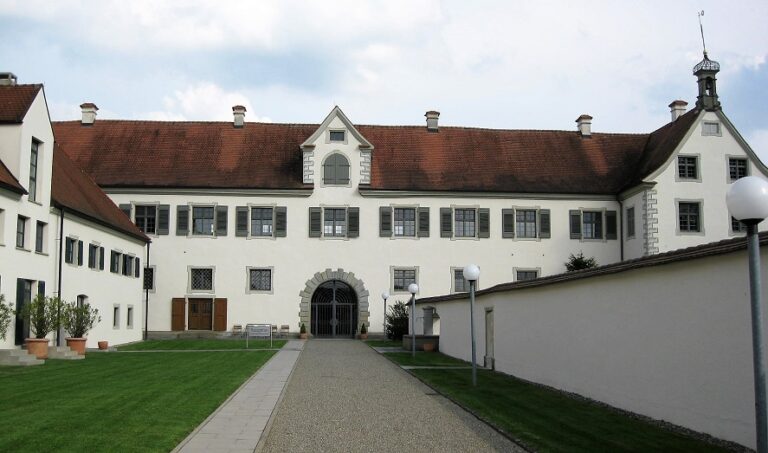
The southern front, whose appearance dates from around 1600, is formed by a 44-metre-wide frontal building with a central belvedere turret and side wings. A belvedere is an elevated architectural feature designed to provide an outlook. The wings have Gothic stepped gables, while old trees frame the complex on its southern side. Twentieth-century adaptations for educational and care functions left this exterior substantially unchanged.
Northeastern oldest section
The oldest part of Schloss Hersberg dates from before 1551 and lies in the northeast. It was incorporated into the later palace complex, preserving an earlier phase of the estate within the building that developed around it.
Monastic quadrangle
Work began in 1670 to complete a quadrangular arrangement that remained open to the north. The building campaign continued until 1696 and added structures connected with the estate’s residential, agricultural, and religious functions.
Agricultural building and wine press
The additions included an agricultural building and a wine press, an installation used for pressing grapes. Their inclusion reflected the estate’s relationship with the surrounding vineyard landscape and formed part of the seventeenth-century completion of the quadrangular layout.
House chapel
A house chapel was also added during the building campaign. It later became the place where prisoners were held and threatened during the final days of the Second World War, linking the chapel’s physical survival with one of the most dramatic episodes in the modern history of the complex.
Prelate’s room
The prelate’s room received a Rococo stucco ceiling in 1740. This decorative work belongs to the period when Hersberg served as a representative residence of the Ochsenhausen monastic outpost.
Nearby sites