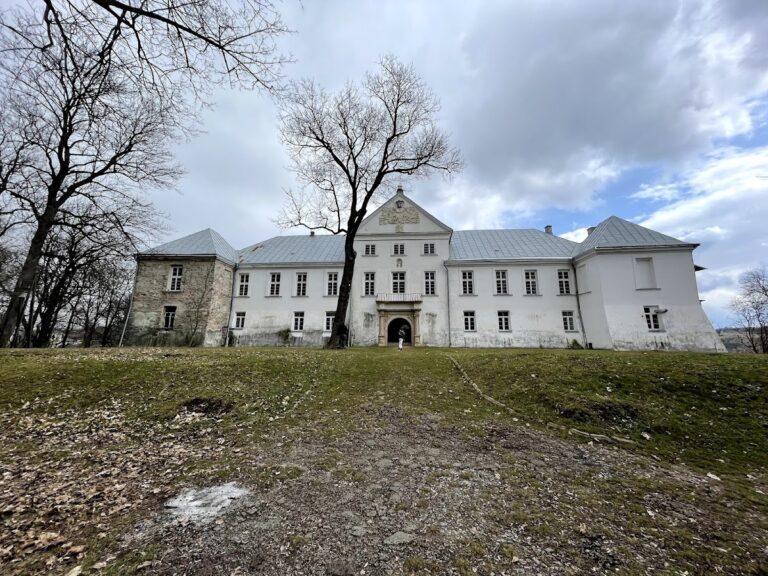
Castle in Yahilnytsia: A Polish-Lithuanian Fortress and Lanckoroński Residence


Site at a Glance
- Rating
- 4.1
- Popularity
- Low
- Country
- Ukraine
- Primary era
- Early Modern
- Eras represented
- Medieval, Early Modern, Modern
- Civilizations
- Kingdom of Poland, Polish–Lithuanian Commonwealth
- Site type
- Military
- Remains
- Castle
On this page8 sections
History
Castle in Yahilnytsia is a historic fortress in Ukraine, now located in Nahiryanka, whose masonry phase was built in 1630 under Stanisław Lanckoroński, Voivode of Rus and Great Hetman of the Crown. A voivode was a high-ranking territorial governor, while a Great Hetman of the Crown was the highest permanent military commander in the Polish Crown. The site developed from a wooden fortification known by the late fifteenth century and first mentioned in 1538. It later became the seat of the Lanckoroński family and is regarded as one of the best-preserved architectural monuments in Ternopil Oblast.
Early fortification and Lanckoroński residence
The original wooden stronghold stood at Yahilnytsia by the end of the fifteenth century. Its recorded appearance in 1538 places the site within the political and military landscape of the Polish-Lithuanian Commonwealth, when fortified residences protected local estates and strategic positions. The Lanckoroński family, known from the fourteenth century, supplied the Commonwealth with officials including hetmans, generals, voivodes, starostas, and bishops. A starosta was a royal or administrative official responsible for a district or estate.
Stanisław Lanckoroński ordered the masonry castle in 1630. He held the offices of Voivode of Rus and Great Hetman of the Crown, linking the building to both territorial administration and the highest level of military command. The castle remained associated with the family as a residence after its principal construction. Parts of the complex were completed or enlarged during the eighteenth and nineteenth centuries, and one additional building was constructed in the twentieth century.
Cossack and Ottoman conflicts
The fortress resisted a Cossack assault in 1648 connected with the uprising led by Bohdan Khmelnytsky. The Cossacks were frontier military communities whose seventeenth-century uprisings challenged Polish-Lithuanian authority in eastern Europe. During the wider fighting, Stanisław Lanckoroński was defeated by Colonel Ivan Bohun in the Vinnytsia region.
In 1655 the castle was captured after several days of siege, when treachery among the defenders opened the way to the attackers. Its position became even more important during the Ottoman advance into Podolia. In 1672, after Poland lost its eastern territories to the Ottoman Empire and the Polish fortress at Kamianets-Podilskyi capitulated, the castle received the evacuated garrison from that fortress. Hieronim Lanckoroński, its owner, then surrendered Yahilnytsia to the Turks, and the castle became the seat of Ibrahim Szejtan.
Ensign Sieniawski, a junior military officer, recaptured the castle in September 1673. In January 1674 Hieronim Lanckoroński left it to fight the Turks under Voivode Jan Potocki. Ottoman forces captured the castle again in 1680, but Polish troops permanently recovered it in 1683 during Hetman Andrzej Potocki’s campaign in Podolia. The Treaty of Karlowitz in 1699 formalized major Ottoman territorial losses in central Europe, and Yahilnytsia formally returned to Poland. War damage was then repaired, and the castle again served as a Lanckoroński residence.
Factory conversion and later decline
Antoni Lanckoroński sold the castle to the Austrian government in 1817. The authorities converted the complex into a large tobacco factory, a new industrial use that continued intermittently until the 1990s. During the Soviet period, it operated as a tobacco-fermentation plant.
After Ukrainian independence, the castle passed into private ownership and gradually deteriorated. It has remained privately owned since 2000. The site is now in Nahiryanka rather than the neighboring settlement of Yahilnytsia because the older settlement was divided by the Cherkaska River. Ukraine protects the castle as an architectural monument of local importance. Countess Karolina Lanckorońska, a Polish patron, later helped restore the church at Yahilnytsia and reportedly intended to restore the castle, but her death prevented that plan.
Traditions of the underground spaces
Local tradition holds that a secret underground passage once linked the fortress with the forest, allowing defenders to escape. It was said that attackers never discovered it. Another tradition maintains that Ukrainian Insurgent Army fighters sheltered in the underground spaces during the Second World War. The Ukrainian Insurgent Army, or UPA, was a Ukrainian nationalist armed movement active during and after that conflict. Local stories also claim that passages reached the fortress at Chervonohorod near Nyrkiv, while the cellars were said to be wide enough in places for two wagons to pass.
Remains
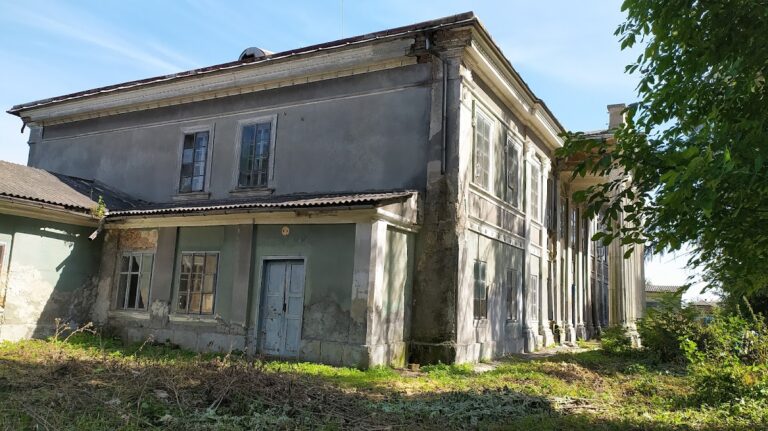
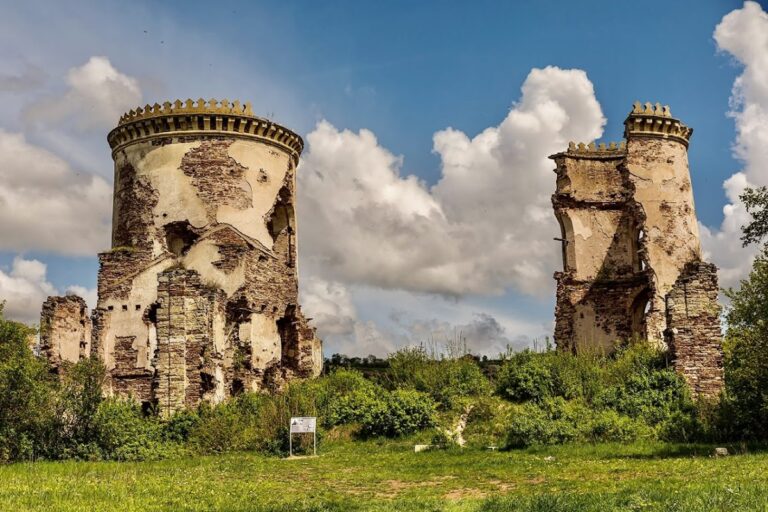
Castle in Yahilnytsia occupies a high, steep hill above the Cherkaska River, a naturally difficult position to conquer. The grounds contain residential and outbuilding structures, together with an outer terrace overlooking Yahilnytsia in the river valley and a neighboring forest. The surviving complex combines dressed stone, other stonework, and wood. Its present fabric is described as relatively well preserved or restored, although gradual deterioration followed the end of its industrial use.
Fortress and residential buildings
The defensive layout used bastion fortification, a system of projecting angular platforms and earthworks designed to protect walls from artillery and allow overlapping fields of fire. Two bastions stood on the southern side. Entry passed through a gate reached across a bridge over a deep ditch, and a stone coat of arms belonging to the Lanckoroński family survives on the gate. The walls were built from smooth, dressed stone. In the older buildings, wooden staircases and vaulted ceilings remain as elements of the earlier residential fabric.
Cellars and underground passages
Stone stairs descend to the castle cellars. Access to the underground passage system is only partial because entrances to long sections have been sealed with masonry. The accessible and enclosed spaces form part of the surviving fortress fabric, while the traditions surrounding routes beneath the castle have contributed to the site’s later historical interpretation.
Nearby sites