Schloss Bröllin: A Historic Manor Estate and Arts Centre in Germany


Site at a Glance
- Rating
- 4.5
- Popularity
- Low
- Country
- Germany
- Primary era
- Modern
- External website
- Open
- Eras represented
- Early Modern, Modern
- Civilizations
- German, Kingdom of Prussia
- Site type
- Domestic
- Remains
- Manor House
On this page15 sections
History
Schloss Bröllin is a historic manor estate in Germany, in Vorpommern near Pasewalk, whose agricultural buildings were developed over several centuries and which became a centre for the performing arts after 1992. Although residents began calling it a “schloss” in the 1970s, inspired by the tower of the manor house, the site is not a castle. It is a manor estate, a landed agricultural property organized around its owner’s residence and administrative facilities.
Medieval Origins and Changing Ownership
Bröllin was first recorded in 1233 under the name Bralin. In 1375, the same family was identified as the owner of the settlement, then called Brellyn. At that time, the estate comprised 50 hooves, a land measure that approximately corresponds to its present area. From 1375 to 1738, Bröllin belonged to the von Lindstedt family, who had lived at the estate since 1400.
After the young B. H. von Lindstedt deserted from the army, King Frederick William I of Prussia transferred Bröllin to a member of the von Görne family. The estate was later sold to the Prüwer family. Under the Prüwers, agricultural activity expanded, and the nearby village of Friedrichshof was established for agricultural workers and sheep farmers. Its residents paid taxes to Bröllin, and the village remained under the estate’s administration until 1931, when a municipal land-settlement company acquired it.
Agricultural Expansion in the Nineteenth Century
The Stoewahs family purchased Bröllin in 1854, during a period of rapid agricultural expansion in Germany. They introduced modern technologies and reorganized the estate, making it one of the region’s modern agricultural production facilities. Most of the farm buildings and the distillery date from this period, giving the surviving complex much of its nineteenth-century character.
Collective Agriculture and Post-1990 Transformation
After the Second World War, land reform redistributed rural properties in the Soviet occupation zone for agricultural use. Agricultural production cooperatives, collectivized farming organizations known as LPGs in East Germany, subsequently operated Bröllin with 2,500 animals and 300 employees. Following the political changes of 1990, the cooperatives were dissolved and the estate came under the responsibility of the Treuhandanstalt, the state agency that administered and privatized state-owned enterprises and properties in the former East Germany.
In 1992, the newly founded non-profit schloss bröllin e. V. rented the estate from the Treuhandanstalt and began renovating it as a production centre for the performing arts. The RA.M.M. Theater, led by theatre director Arthur Kuggeleyn, was based at Bröllin from 1992 through the mid-1990s and contributed to its early development as an arts and cultural centre. Other groups and artists later helped shape its artistic identity, including POPE, Ziguri Ego Zoo, the Anna Totó Company, tatoeba-theatre danse grotesque, Daniel Weissrot, Delta Rai, Martin Mengdehl, Yumiko Yoshoíoka, Joaxhim Manger, and Jens Femerling.
Schloss Bröllin received legal protection as a heritage site in 1993 and was acquired by schloss bröllin e. V. in 2000. The association maintains the buildings and surrounding land with employees and volunteers. The estate now operates internationally as a location for artistic production and research, residential programmes, workshops, youth projects, conferences, and regional and international networks. More than 500 dance, theatre, and performance works have been produced there in whole or in part.
Remains
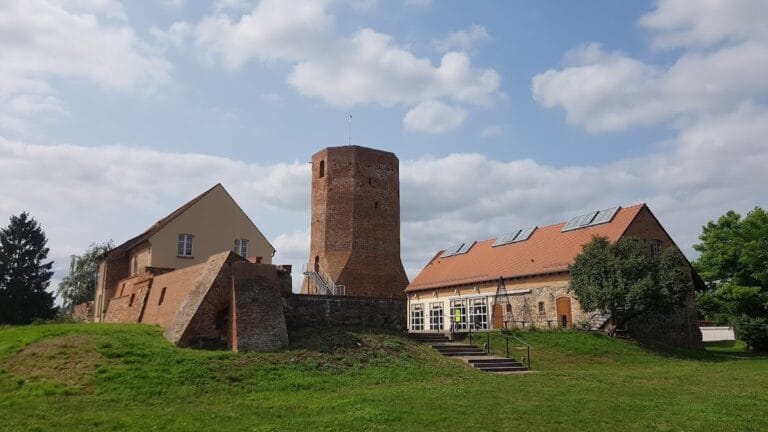
The estate covers approximately 50,000 square metres. Its historic farm buildings form a rectangular enclosure, and the complex is preserved as a whole agricultural estate. The former granary occupies the centre beside the old distillery, while the manor house stands on the eastern side. Other former agricultural buildings define the northern and southern edges and now accommodate storage, studios, workshops, guest rooms, rehearsals, and conferences.
Manor House and Garden
Manor House
The manor house is the oldest building at Bröllin. Its first section was built in the early eighteenth century, probably by the von Winterfeld family. A southern section with the tower was added in 1890. The building now provides living quarters for residents and volunteers, administrative areas, offices, a common room, and a small library.
Estate Garden
Behind the manor house, the estate garden extends eastward. It contains an old ice cellar and a historic bee house, features associated with the practical operation of the manor estate.
Central and Religious Buildings
Granary and Distillery
The former granary stands at the centre of the rectangular farm complex, next to the old distillery. The distillery was built after the Stoewahs family acquired Bröllin in 1854, when the estate was being reorganized and modernized for expanded agricultural production.
Fieldstone Church
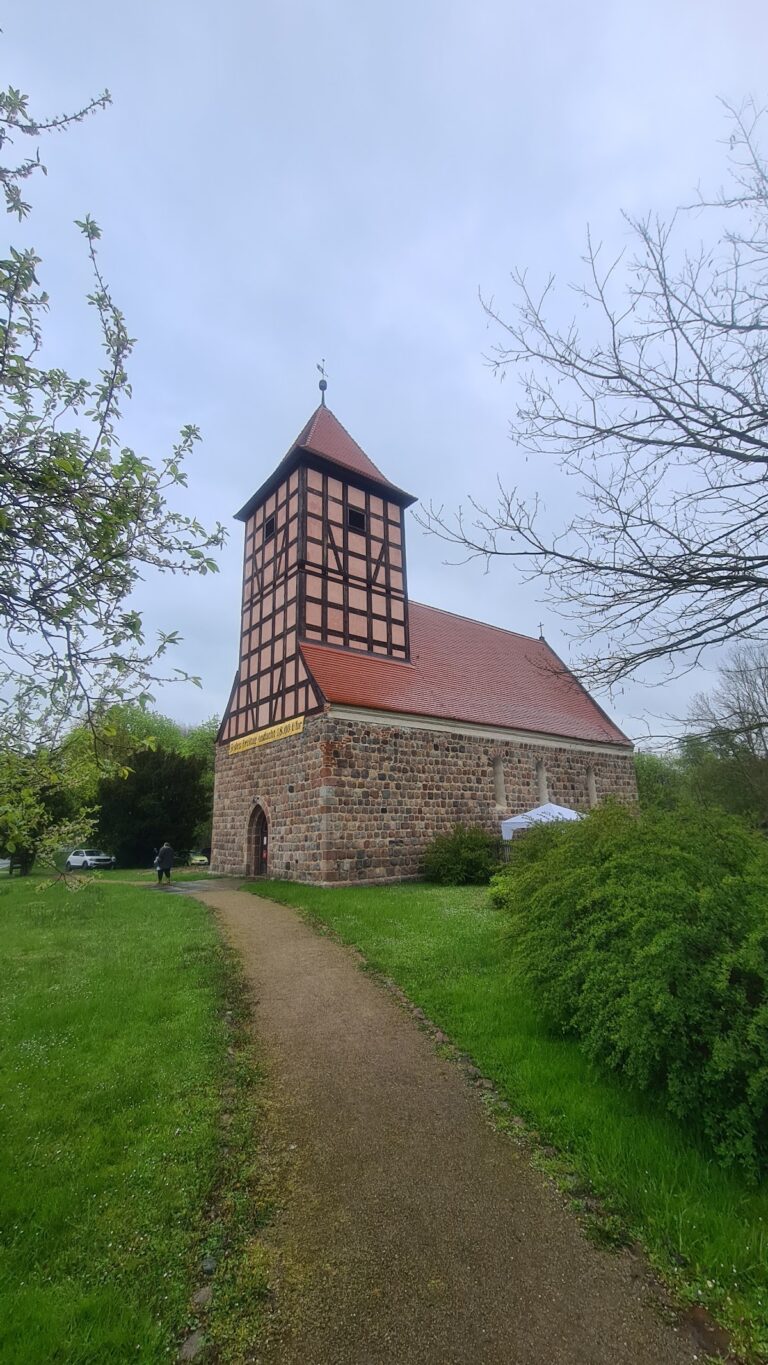
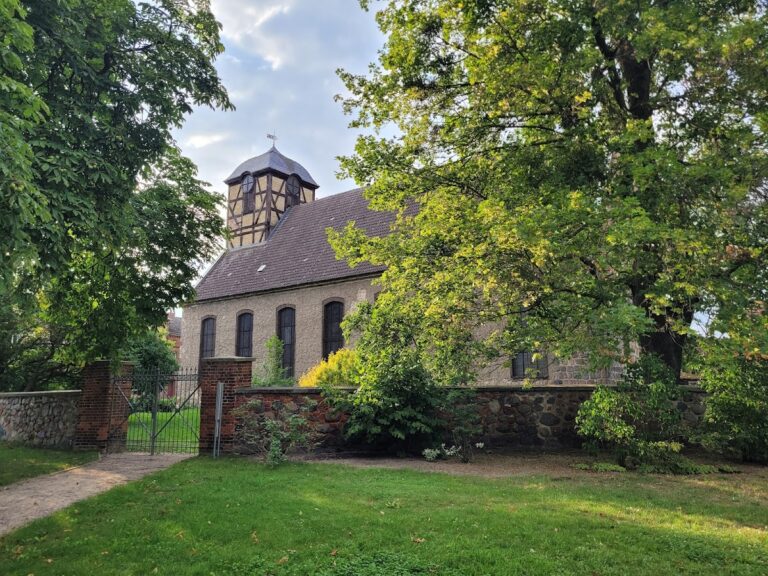
A fieldstone church was built beside the estate in 1888. It belongs to the Protestant parish of Brüssow.
Former Agricultural Buildings
Sheep Stable and Riding Hall
The former sheep stable runs for approximately 100 metres along the northern edge of the complex and is used mainly for storage. Its western end contains a workshop and the former riding hall, which has a concrete floor and a high ceiling.
German-Polish Centre
The former bull stable on the southern side of the estate now houses the German-Polish Centre. It was completely renovated in 2005–2006 and converted into a multifunctional facility containing guest rooms and spaces for rehearsals, workshops, and conferences.
Dance Studios
A second former bull stable contains three studio spaces with sprung dance floors for rehearsals and productions. These adapted agricultural buildings allow the historic estate to continue serving as a working centre for performance and artistic research.
Nearby sites