Saint Anthony of Padua Church in Buk: A Medieval Parish Church in Poland


Site at a Glance
- Rating
- 4.3
- Popularity
- Very Low
- Country
- Poland
- Primary era
- Medieval
- Eras represented
- Medieval, Early Modern, Modern
- Civilizations
- Duchy of Pomerania, Holy Roman Empire
- Site type
- Religious
- Remains
- Church
On this page8 sections
History
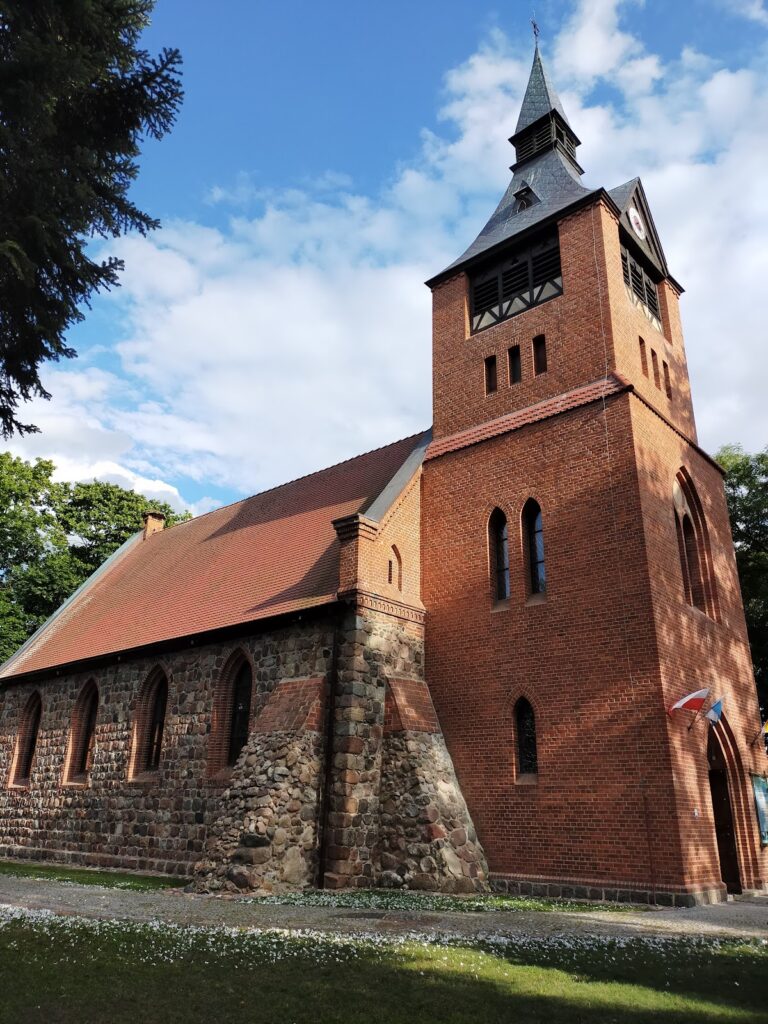
Saint Anthony of Padua Church in Buk is a medieval Roman Catholic parish church in Poland, built in the thirteenth century as a simple rectangular building. It belongs to the Parish of Saint Ursula Ledóchowska, the Szczecin Pogodno deanery, and the Roman Catholic Archdiocese of Szczecin–Kamień.
Medieval origins and later additions
The original church had no separate chancel or tower. During the sixteenth century, a tower and a porch beneath it were added at the west end. A high brick wall separated the porch from the main body of the church.
Eighteenth-century alterations
In the eighteenth century, the sacristy was rebuilt and a patron’s gallery was installed above it. The gallery contained a stove decorated with ornamental tiles, one of which has survived.
Nineteenth- and twentieth-century history
Around the middle of the nineteenth century, the earlier windows were bricked up and replaced with two wider pointed-arch windows in the east wall and four in the south wall. A new entrance was also made on the southern side.
The English novelist Elizabeth von Arnim, who lived in nearby Rzędziny from 1896 to 1908, visited the church around the turn of the nineteenth and twentieth centuries. She referred to it in her first book, Elizabeth and Her German Garden.
The main body of the church survived the Second World War without damage and reached the present with no major alterations. It was consecrated on 31 July 1960, followed by repair work in 1963. The building entered the heritage register under number A-498 on 14 May 1956.
Remains
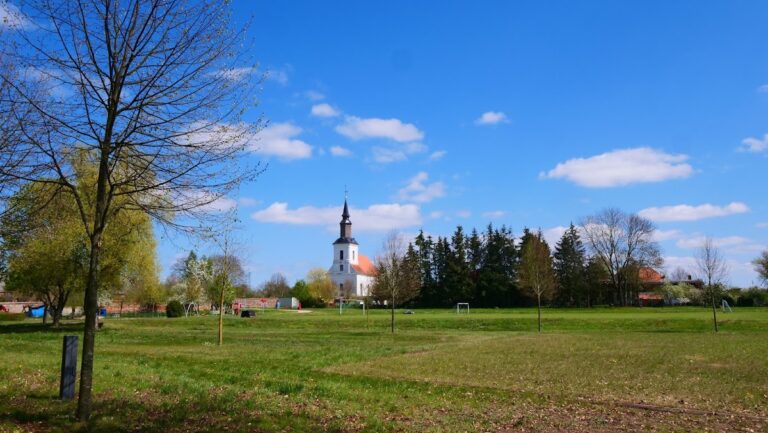
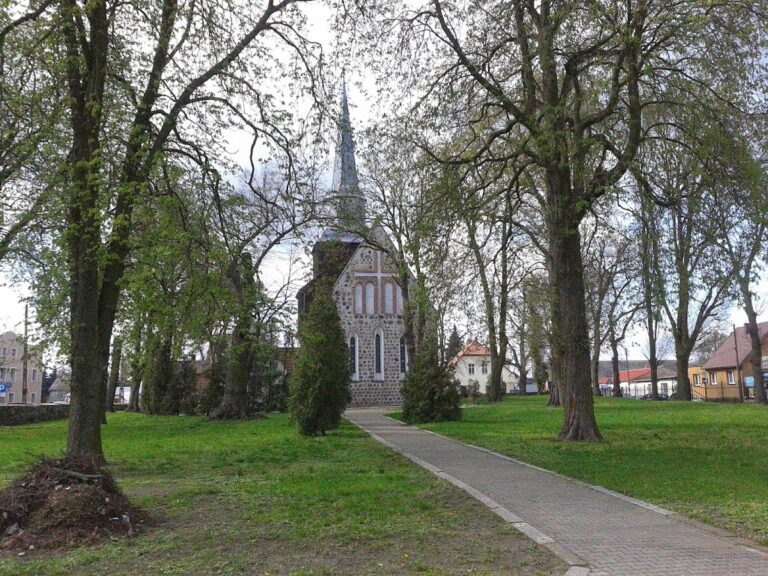
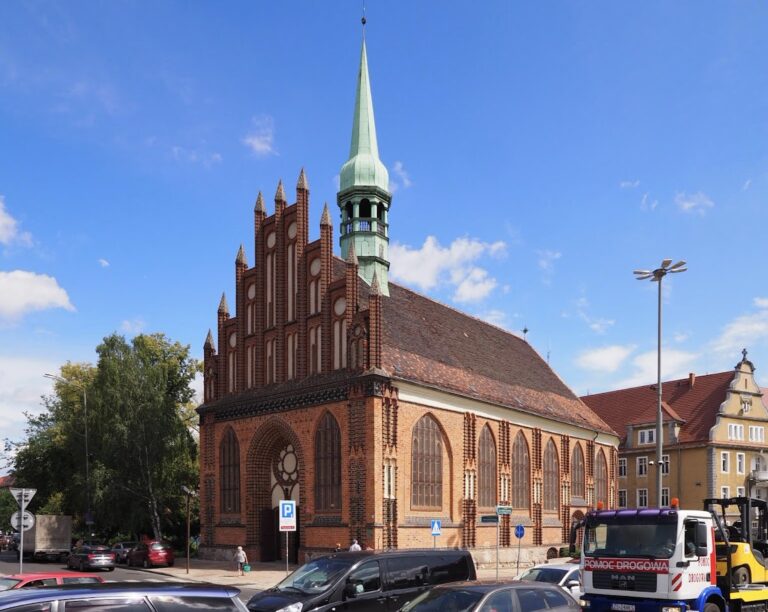
The church stands on a slight elevation in the centre of Buk. Its surviving form combines a rectangular granite nave with a narrower western tower, brick gables, a wooden interior ceiling, and later openings that preserve the pointed-arch shape of the medieval windows.
Layout and construction
The walls are made from 26 courses of granite blocks, and the building has no separately marked chancel. The church and its western tower both carry gabled roofs. The tower rises only slightly above the ridge of the church roof and is narrower than the nave. A small extension on the north side serves as the sacristy, with a burial crypt at ground level. The eastern and western gables are constructed of brick and decorated with panels of blind arches.
Entrances, windows, and roof drainage
The original principal entrance was a pointed-arch portal cut into the western gable wall. The portal survives but is no longer used. The first lighting arrangement consisted of six narrow pointed-arch windows in the south wall and three in the east wall. The nineteenth-century replacements are considerably wider but retain pointed-arch heads. The north wall has no windows and never had any, making the church the only free-standing church in Pomerania with this feature. The reason for the closed north wall is unknown.
Fragments of a stone sima, a channel along the edge of a roof that carries rainwater away, survive at the church. Buk is the only church in Pomerania where such fragments have been preserved.
Interior furnishings and memorials
The principal furnishing is a stone pulpit altar made in 1711 by Erhard Lōffler, an eighteenth-century sculptor associated with major church furnishings in the Szczecin region. A pulpit altar combines the preaching pulpit and the altar in one composition. This example is richly decorated, crowned by three angel figures, and supported by two spiral-twisted columns entwined with grapevine. The form was once common in Protestant churches of Western Pomerania but is now rare.
A large stone epitaph, a memorial honoring a deceased person, is mounted on the south wall for Major General Otto Gustav von Lepel. Lepel served as commandant of the fortress at Kostrzyn, died in 1735, and was buried in the church. A second stone epitaph commemorated Captain Theophilus Michaelis, who was wounded at the Battle of Poltava and died in Moscow in 1709. It stood on the north wall until the 1990s and is now displayed in the Szczecin Archcathedral.