Hauteroche Castle: A Ruined Medieval Fortress in Belgium


Site at a Glance
- Rating
- 4.4
- Popularity
- Low
- Country
- Belgium
- Primary era
- Medieval
- External website
- Open
- Eras represented
- Medieval
- Civilizations
- Holy Roman Empire
- Site type
- Military
- Remains
- Castle
On this page6 sections
History
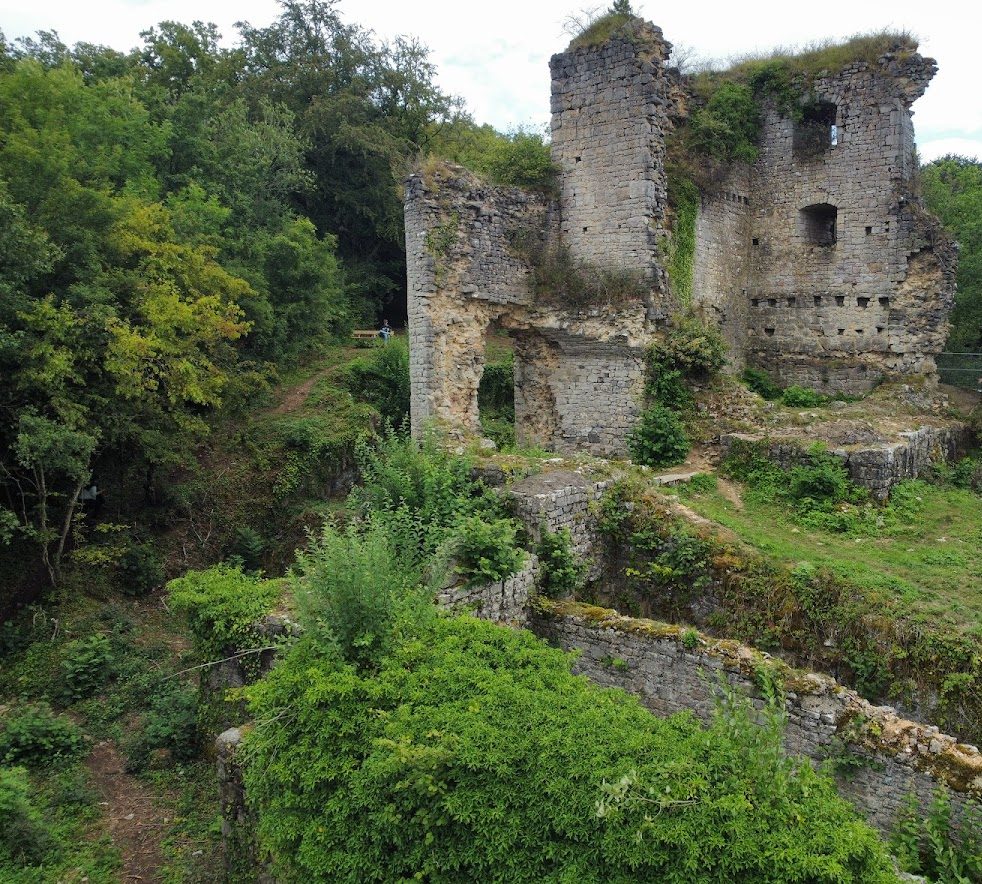
Hauteroche Castle is a ruined medieval fortress in Belgium, at Dourbes in the municipality of Viroinval, Wallonia. Generally described as a fourteenth-century castle, it incorporates surviving outer walls from the thirteenth century. The fortress occupied a naturally defensible rocky height above the Viroin and was destroyed after a siege in 1554 during the wars between Spain and France.
The lordship of Dourbes
The lordship of Dourbes-le-Val was held by Gilles de Jauche from the last third of the thirteenth century until the early fifteenth century. The castle is first mentioned at the beginning of the fifteenth century, when the lordship was passing through a period of dynastic change.
After the de Jauche family, the lordship was held by David, described as the illegitimate son of Aymeries. His rights were said to have come through his mother, Gillette, lady of Berlaymont and Hierges. The lordship later returned to the Berlaymont family, then passed from the house of Egmont to the Pignatelli and finally to the d’Arenberg family.
Destruction in the sixteenth century
In 1554, during the conflict between the Spanish monarchy under Charles V and France under Henry II, the Constable of Montmorency destroyed Hauteroche Castle after a siege. A constable was a senior military commander who could lead an army on behalf of a monarch.
In the following year, William of Orange, a leading Dutch nobleman who opposed Spanish Habsburg rule in the Netherlands, counterattacked and captured the castles of Fagnolle, Couvin, and Boussu. Those fortresses were dismantled. Dourbes probably suffered the same fate, although the extent of this later action remains uncertain.
Excavation and tradition
The Archaeological Circle of Fagnes undertook excavation and clearance at the site under the auspices of the National Excavation Service. Work included reconsolidation, restoration, and the classification of archaeological material. Scientific excavation took place between 1976 and 2002, helping establish the surviving remains and their historical sequence.
Hauteroche Castle is also associated with the legend of the Maiden of Haute-Roche and Sir Roger of Sautour. This tradition forms part of the cultural memory attached to the ruined fortress.
Remains
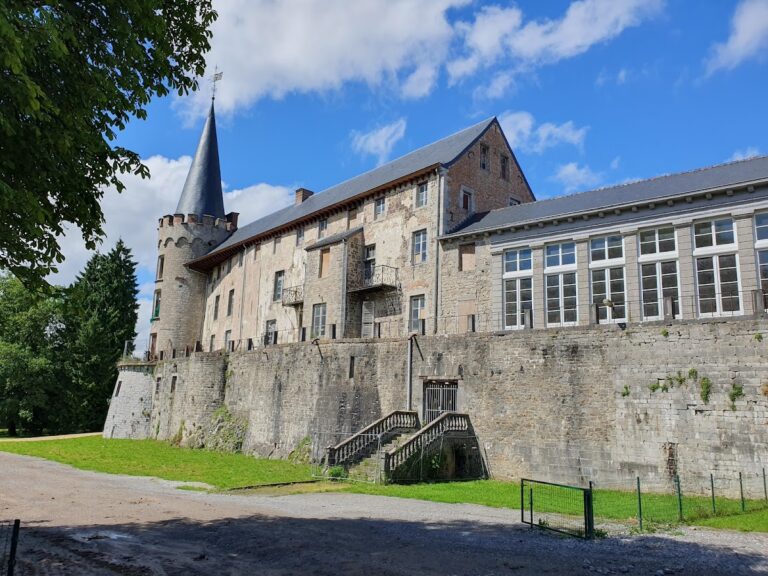
The ruins stand on the summit of a rocky spur rising approximately 50 metres above the Viroin. Steep ground provided natural defence around most of the site, while the eastern side faced the plateau and required additional fortification. Two successive ditches separated the castle from the plateau in this direction.
Walls and defensive entrance
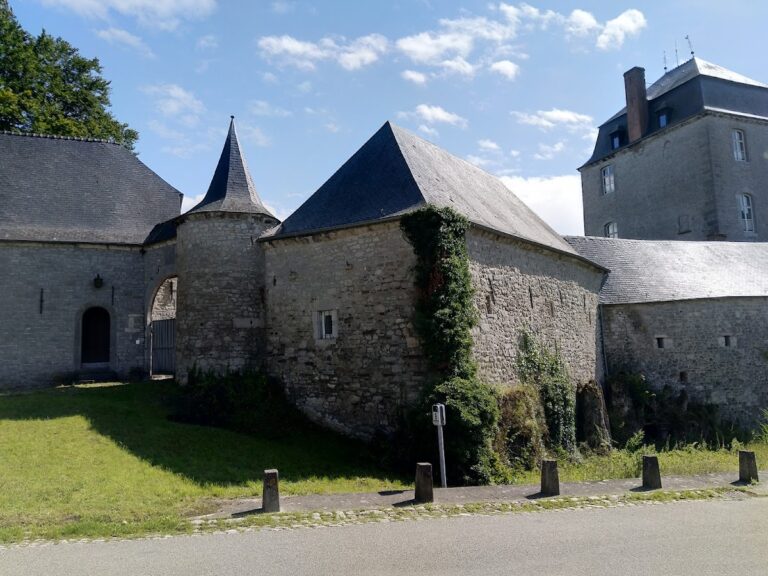
The outer walls form an almost rectangular plan measuring 28.70 by 21.90 metres. These thirteenth-century walls reflect the influence of French military architecture. Along the southern side, their line follows the underlying rock, adapting the fortification to the irregular shape of the spur.
Access was provided by a gate flanked by two turrets, small towers incorporated into or projecting from a fortification. The entrance was reached by a drawbridge, a bridge that could be raised to restrict passage into the fortified enclosure. Together, the gate, turrets, drawbridge, ditches, and steep terrain formed the castle’s principal defensive arrangement.
Nearby sites