Schloss Rothestein: A Neo-Gothic Castle near Bad Sooden-Allendorf


Site at a Glance
- Rating
- 4
- Popularity
- Low
- Country
- Germany
- Primary era
- Modern
- External website
- Open
- Eras represented
- Modern
- Civilizations
- German
- Site type
- Domestic
- Remains
- Castle
On this page9 sections
History
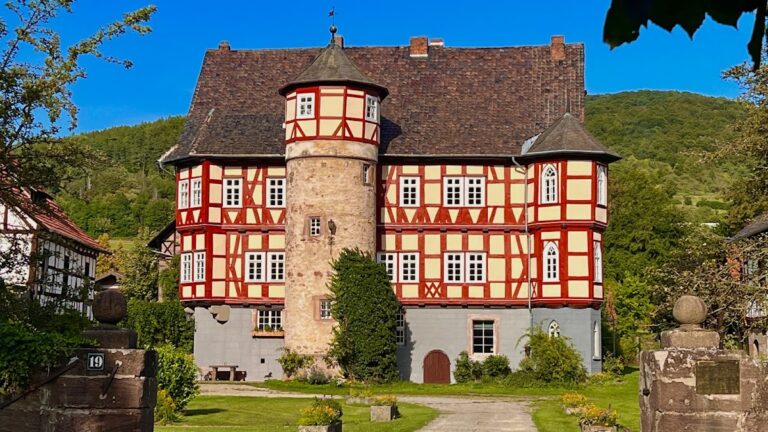
Schloss Rothestein is a neo-Gothic castle in Germany near Bad Sooden-Allendorf, Hesse, built in the 1890s on the site of a former medieval castle complex. The earlier site may have been the castle known as the Osterburg, although that identification remains uncertain; Gilsaburg and Osterburg are also associated with the location.
The medieval predecessor
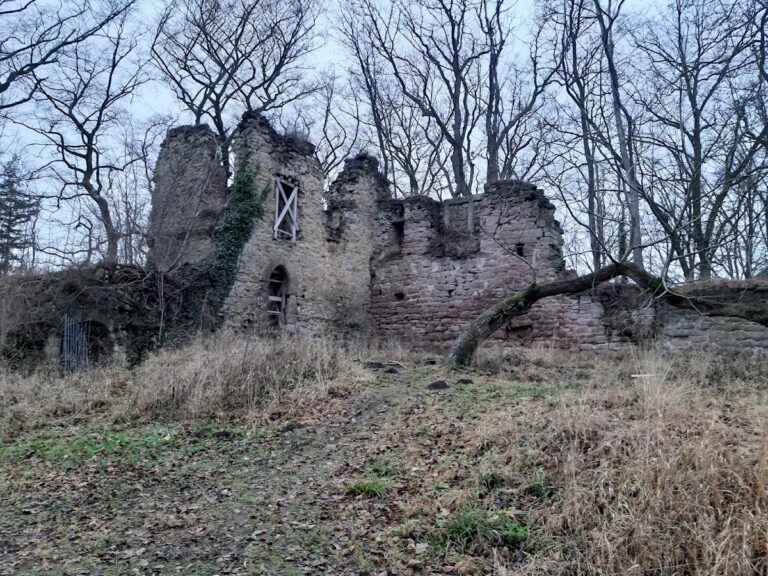
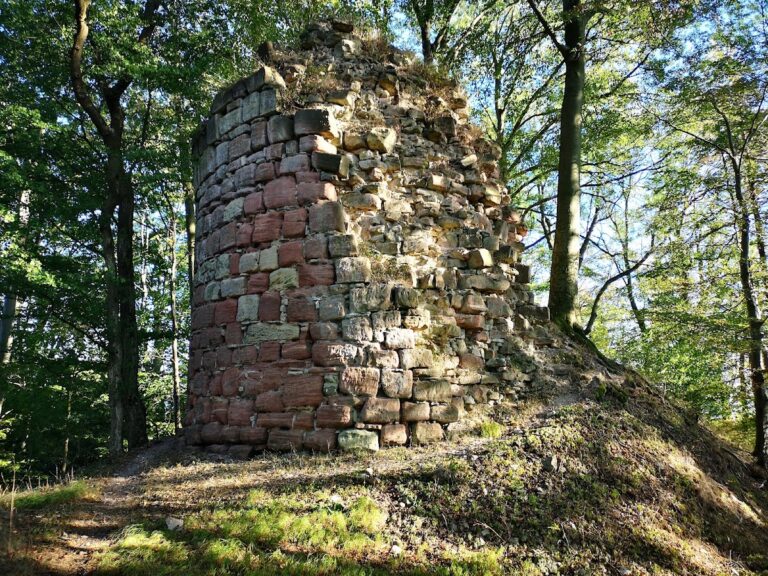
A medieval castle complex at Rothestein is mentioned in 1357. Its connection with the Osterburg has not been established with certainty, so the surviving castle belongs to a later phase of the site’s history rather than representing a direct continuation of a securely identified medieval building.
Construction and aristocratic ownership
Adolf Ludwig von und zu Gilsa, a senior administrator of the Kassel Court Theatre, laid the foundation stone for the present castle on 13 August 1891. The Kassel architect Georg Kegel prepared the plans. Building work proceeded slowly, but the castle was substantially complete by 1894.
The entire estate was sold in 1897 to Baron Ludwig, known as Louis, von Knoop, and his wife Gertrud, née Baroness von Keyserlingk. Von Knoop had the building fully completed in 1900 and added an extension in 1911. He used the estate as a hunting castle.
Twentieth-century changes
After von Knoop’s death in 1927, the Westphalian aristocratic family von Lüninck acquired Schloss Rothestein. The family retained the castle complex until 1989 and continues to own the gardening buildings.
Theo Becker of Bergisch Gladbach purchased the castle in 1994 and invested in the building and its access road. In summer 2009, he made the castle publicly accessible and opened a cafe there in cooperation with a local restaurateur. Becker died in 2010. The castle was offered for sale again from 2020 and received a new owner in 2021, with renewed public access intended for the future.
Remains
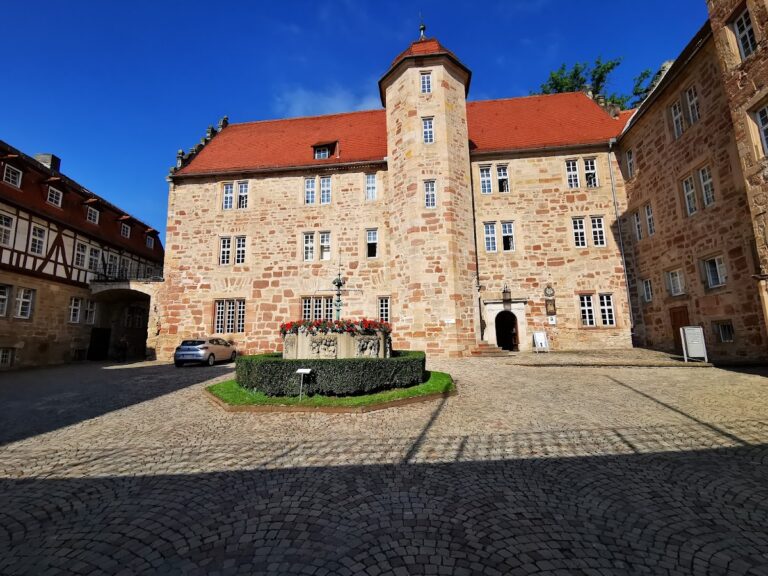
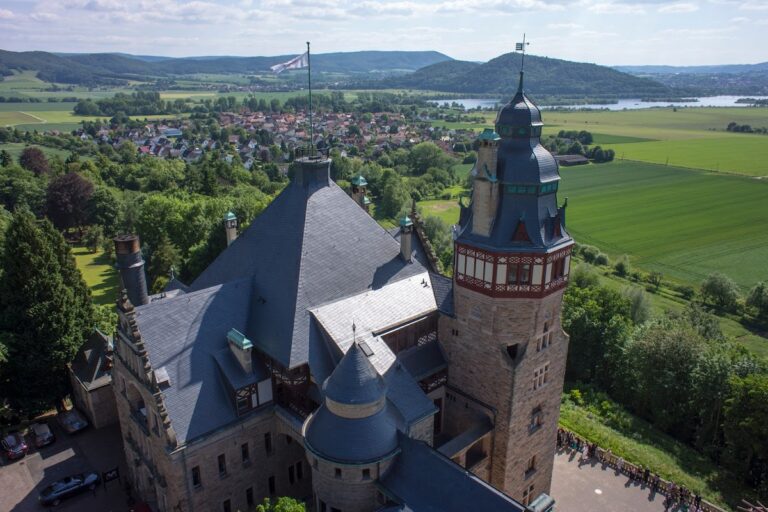
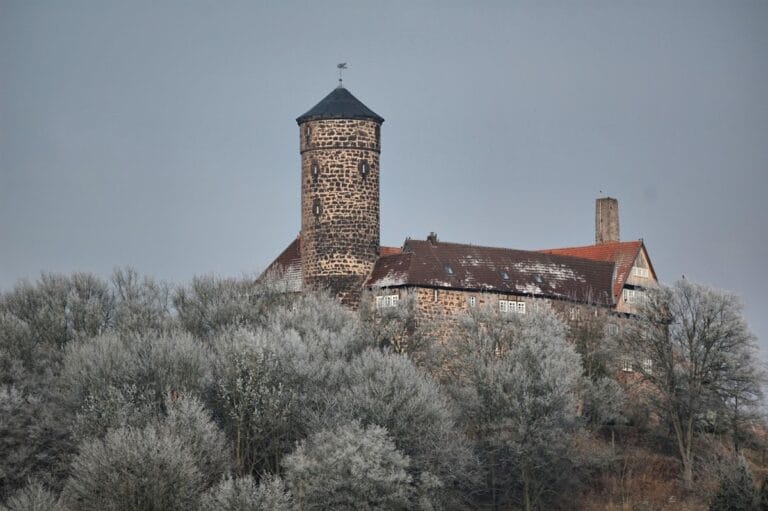
Schloss Rothestein is a completely preserved neo-Gothic Schloss, or castle, occupying the Schlossberg at about 308 metres above sea level. Neo-Gothic architecture revived medieval Gothic forms in the nineteenth century, often using pointed arches, strong vertical emphasis, and historically inspired details. The building stands on elevated ground on the western slope of the Gobert ridge, within the Southern Gobert Foreland, and retains the aristocratic character of a hilltop castle.
Hilltop setting and castle
The castle lies about 3.25 kilometres southeast of Bad Sooden-Allendorf and around 1.2 kilometres from Hörne, the westernmost Gobert summit, which reaches 522.7 metres. The Werra runs approximately 500 metres west of the building, about 150 metres lower, in a river loop below Kleinvach. The name Rothestein derives from the red sandstone of the Gobert.
The present castle occupies the grounds of the vanished medieval complex associated with the names Osterburg and Gilsaburg. Its construction began in 1891, reached substantial completion by 1894, and was finished in 1900. The surviving building was enlarged by an extension in 1911.
Estate buildings
Gardening facilities
Construction of the gardening facilities began at the northwestern foot of Hörne when work on the castle started. These buildings remain part of the estate and are still owned by the von Lüninck family.
Villa and ancillary buildings
A villa and ancillary buildings were erected for Adolf Ludwig von und zu Gilsa near the gardening facilities. Von und zu Gilsa lived in the villa while supervising the progress of construction at Schloss Rothestein.
Nearby sites