Logne Castle: A Medieval Fortress and Western Stronghold in Belgium


Site at a Glance
- Rating
- 4.4
- Popularity
- Low
- Country
- Belgium
- Primary era
- Medieval
- External website
- Open
- Eras represented
- Medieval, Early Modern
- Civilizations
- Holy Roman Empire
- Site type
- Military
- Remains
- Castle
On this page9 sections
History
Logne Castle is a medieval fortress in Belgium, near Ferrières, built in the early twelfth century as the western defense of the Principality of Stavelot. It became the seat of the County of Logne, the principality’s western district, and served the Stavelot-Malmedy abbey principality as both a military and judicial center.
Early occupation and the Stavelot principality
Human occupation of the site began in prehistoric times, probably because the high rocky position offered refuge. Logne stood in the Calestienne region, between the Condroz and Ardennes. Its elevated setting helped it withstand Germanic invasions in the fifth century and Norman attacks four centuries later.
The place was named Lomna in a charter issued in 862 by Lothair II, king of Lotharingia. The castle appears in records around 883 to 885, when it provided shelter for monks from Stavelot during Norman incursions. The name Logne is recorded from 1105.
During the time of Wibald, the twelfth-century abbot of Stavelot and founder of the Stavelot principality, Logne was organized as a fortified refuge and county within the ecclesiastical territory. A new settlement was established below the castle to provision the fortress and its permanent garrison. The defenses were strengthened in 1138 to secure the principality’s western frontier.
Counts, abbots, and the La Marck family
The lord of Logne was a ministerial, a medieval official or dependent noble who could exercise administrative, military, and judicial duties for a powerful institution. During the early thirteenth and fourteenth centuries, the counts of Luxembourg occupied the castle illegally on two occasions. They regarded it as inadequately defended by the abbey’s vassals and feared that enemies, particularly the bishop of Liège, might capture it.
In 1427, Abbot Jean Godeschalc de Gueuzaine faced serious financial difficulties and pledged Logne and its lands to Évrard de la Marck for 4,000 Rhenish florins. The debt was never repaid, and control eventually passed to the La Marck family, a powerful noble house active in the Low Countries and the Ardennes.
Guillaume de la Marck, known as Guillaume à la Barbe and lord of Lummen, occupied the fortress in 1478. Supported by France, he used Logne in his conflict with Louis de Bourbon, bishop of Liège, and with Burgundian interests in the Low Countries. Troops commanded by Maximilian of Austria captured the castle in 1480, but Guillaume recovered it in 1482 and appointed his son-in-law, Jeannot le Bâtard, as captain.
Under Jeannot le Bâtard, Logne served as a base for raids and became associated with counterfeiting. Guillaume de la Marck was executed at Maastricht in 1485, while his brothers continued their struggle against Jean de Hornes, the new prince-bishop of Liège. In 1514, control passed to another La Marck, in a succession associated with Guillaume de Jametz, Guillaume à la Barbe’s nephew, and with Guillaume de la Marck becoming castellan after Jeannot’s death.
The siege and destruction of 1521
In the late fifteenth century, Logne’s defenses were extended in response to the growing use of artillery, and they were remodeled and modernized during the early sixteenth century. On 12 February 1521, Robert II de la Marck, known as “the Devil,” entered the service of Francis I, king of France, and challenged the authority of Charles V, the Habsburg emperor and ruler of the Holy Roman Empire. Their wider conflict extended into the Low Countries.
Charles V responded by sending an army against the La Marck strongholds, including Logne. From 20 April to 1 May 1521, troops under Henri III of Nassau-Breda bombarded the castle with twenty cannons positioned on the surrounding hills. After twelve days, the defenders were overcome. Members of the surviving garrison either killed themselves or surrendered and were then executed. The castle was dismantled, and Charles V prohibited its reconstruction. On 2 May, the hill was returned to the monks of Stavelot.
Ruins and archaeological rediscovery
After the destruction, stone and other material from the castle were used in rebuilding villages in the valley. The ruins remained abandoned until 1898. Modest renovation and archaeological excavation began during the early twentieth century under Auguste Dupont, an Antwerp lawyer who owned the site, working with the Friends of Logne association.
Liège Province acquired Logne in 1968. Since 1984, maintenance and the site’s tourist operation have been managed by the Association for the Management of the Tourist Domains of the Lembrée Valley. The ruins and their surroundings were classified as Walloon immovable heritage in 1990, and the site remains owned by Liège Province.
Remains
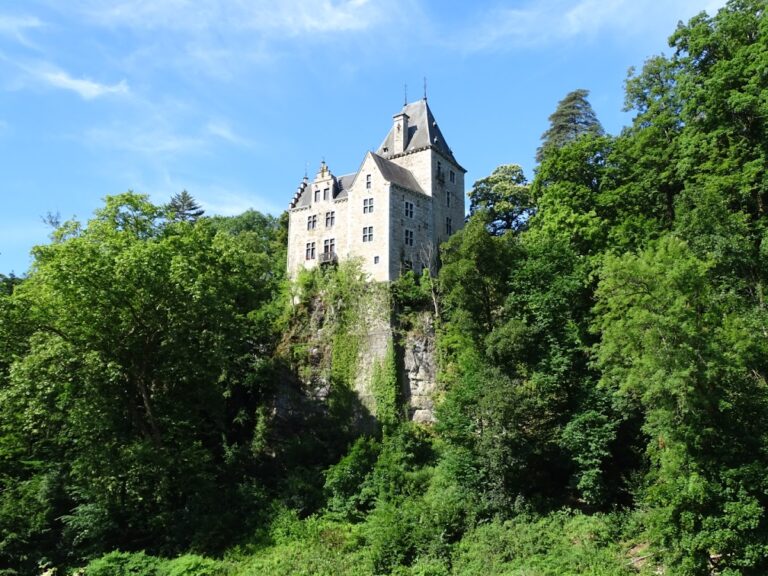
Logne Castle occupies a long, narrow rocky spur about 60 metres high, between the Ourthe valley on the west and the Lembrée valley on the east. The Lembrée joins the Ourthe farther downstream. This elevated position shaped the fortress’s defensive character. The surviving site is now a ruin, with remains extending along the ridge and down its slopes.
Fortified ridge and principal tower
The northwest keep, the castle’s principal fortified tower and a place of final defense, was built in the early twelfth century. It also served as the residence of Nicolas de Logne. The tower formed part of the original fortress established on the rocky height, whose position allowed the castle to control and defend the surrounding valleys.
A new outer enceinte, an enclosing defensive wall, was built lower down the slope in the late fifteenth century as artillery changed the requirements of fortification. The castle was subsequently remodeled and modernized in the early sixteenth century. These altered defenses belong to the last major phase of the fortress before its destruction in 1521.
The deep water well
The castle’s water well is nearly 56 metres deep and about 2.5 metres wide. It had been filled and abandoned for almost five centuries before being cleared and excavated between 1990 and 2003. A thick concrete layer was encountered during the archaeological work, and drilling in late 2002 reached substantial material more than 49 metres below the surface.
The well contained hundreds of mainly domestic objects, including bowls, dishes, and glasses, some of them well preserved. A small number of weapons was also recovered. Equipment for lifting water-filled buckets survived as well, including the remains of a large lifting wheel. Together, these finds provide material evidence for activity within the castle and for the operation of its water supply.
Museum collections
Numerous objects found at Logne Castle are displayed in the Logne Castle Museum, housed in the former Bouverie abbey farm about one kilometre from the ruins. The collections extend the physical evidence of the fortress beyond the surviving masonry and include objects recovered during the archaeological investigation of the site.