Schloss Ottersbach: A Noble Residence in Austria


Site at a Glance
- Rating
- 4.8
- Popularity
- Low
- Country
- Austria
- Primary era
- Early Modern
- External website
- Open
- Eras represented
- Early Modern
- Civilizations
- Habsburg, Holy Roman Empire
- Site type
- Domestic
- Remains
- Castle
On this page10 sections
History
Schloss Ottersbach is a historic castle in Austria, located at Mantrach in the municipality of Großklein beside the Sulm River. Its development as a noble residence began in the early seventeenth century, when Hans Murn rebuilt a building below Gleinstätten and received formal authorization to establish it as Ottersbach.
Origins and Noble Status
In 1593, Hans Murn acquired nearby Mantrach Castle, which was already ruined. He subsequently rebuilt a building on the Sulm below Gleinstätten. On 19 March 1616, Archduke Ferdinand formally granted the rebuilt residence noble status. An archduke was a high-ranking member of the Austrian Habsburg dynasty, a title associated with the ruling house of Austria and among the highest princely titles in the Holy Roman Empire. Murn was also authorized to call the estate Ottersbach and to use the related family designation.
Murn adopted a heraldic emblem that represented the estate’s name: a wavy bar with an otter holding a fish. He placed Ottersbach under the administration of his relative Elias Hemeter, but irregular payments of collected revenues led to a substantial debt by 1620.
Changes of Ownership in the Seventeenth Century
Ownership passed to Murn’s son Hans Jakob in 1629 and then to his brother Hans Wilhelm in 1633. Hans Wilhelm was murdered in 1650 by his ward, Christof Andree von Gleinz. The estate was sold from Hans Wilhelm’s inheritance in 1653 to Hans Georg Adam Adl von Adlstein, who sold it on 20 September 1675 to Sigmund Ludwig Graf Khünburg.
After Khünburg’s death, his widow administered the estate for their son Johann Max. Once he reached adulthood, Johann Max assumed control and sold Ottersbach in 1692 to Niklas Graf Lodron. After Lodron died, the estate passed first to his widow and later to his son following prolonged inheritance disputes.
Debt, Taxation, and Later Proprietors
Outstanding tax payments led to the seizure of Ottersbach in 1700. In 1708, Graf Josef Lodron was compelled to sell the estate to Johann Anton von Liscutin. After Liscutin’s death, the estate carried heavy debts and was sold in 1732 to Franz Josef von Hingenau.
Franz Josef von Hingenau soon faced financial difficulties and sought a reduction in taxation. He cited extensive damage to the estate’s forests caused by storms in December 1739. Ownership passed to his son Franz Xaver Gottlieb in 1742. The estate also included the village of Großklein, for which Franz Xaver Gottlieb obtained imperial permission to hold a second cattle market each year.
Later known as Alt-Ottersbach, the estate was inherited by Franz Xaver Gottlieb’s son and then sold to Moritz Edler von Pistor. After Pistor’s son died, Ottersbach was auctioned publicly. Kaspar Wilhelm Graf Khünburg purchased it on 3 September 1836. In 1870, it passed to his sister, Caroline Gräfin Cerrini. Later owners included the Koch, Hohenburger, and Germuth families, Baron von Wucherer from 1884 to 1893, and, from 1893, the Teutsch, von Plappart, and von Leenherr families.
Twentieth-Century Ownership and Use
The Abel family has owned Schloss Ottersbach since 1925. Its first comprehensive renovation under the family took place in 1926. Foreign troops looted and damaged the estate in 1945. Some rooms were made usable again in 1960, while major expansion and conversion work began in 1977. The south building was renovated in 1988.
A castle museum was established in 2005, and the ceremonial rooms were opened at the same time. The museum occupies the first floor of the main building. Schloss Ottersbach has also been used repeatedly as a filming location for film and television productions, including Lilly Schönauer – Umweg ins Glück.
Remains
Castle Ensemble and Access
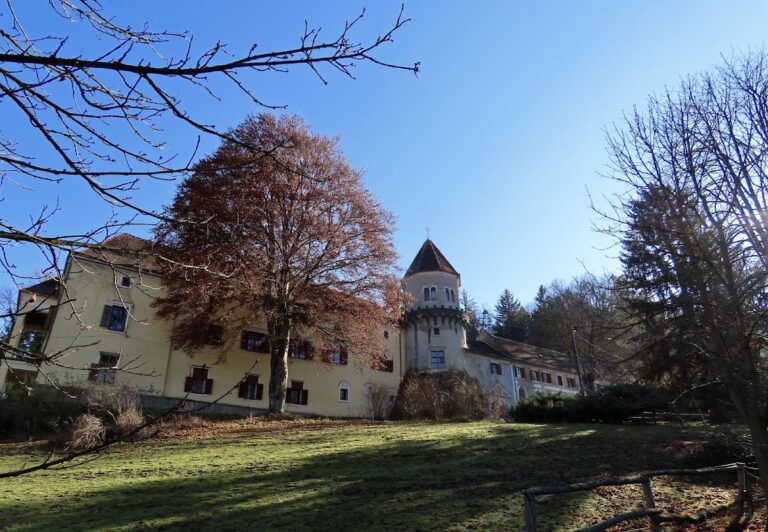
Schloss Ottersbach survives as an ensemble beside the Sulm that includes the main castle building, a south building, a court building, a garden pavilion, and a mill. Together with the historical mill complex, these structures form the preserved physical setting of the estate.
Main Building and Chapel
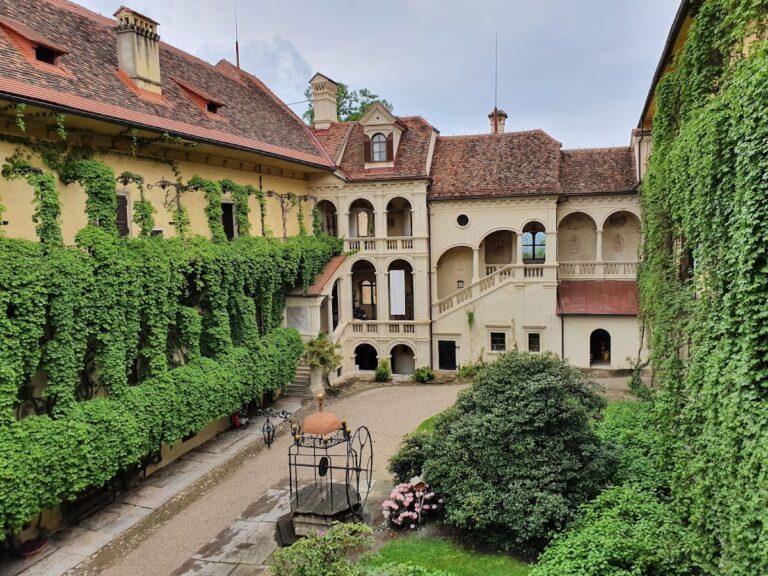
Hans Murn’s first wing, built in 1616, forms the present north tract. It is distinguished by its high hipped roof, which slopes downward on all four sides instead of ending in vertical gables. During the seventeenth century, a second adjoining tract was added toward the southeast. This east tract has a small roof turret and contains the gate building and a chapel dating from the same century.
The original entrance approached from the north and passed directly beneath the chapel into the courtyard, at the junction of the main block and side wing. The courtyard is bounded on its southern side by broad service buildings. The present approach follows the former agricultural entrance from the south, leading into the forecourt and then through the south building.
South Building and Mill Complex
The south building is an L-shaped service and agricultural wing. Its passage is flanked on both sides by two-aisled halls divided into three bays, or repeated structural sections marked by the spacing of supports. These vaulted halls, covered by curved masonry or plaster ceilings, formerly served as a horse stable and carriage shed. They now form part of the ceremonial-hall area. The estate’s surviving ensemble also includes the historical mill on the Sulm.
Park and Riverside Setting
The park contains a rose garden with an approximately 60-metre-long rose arbor and a metal rose about two metres high. Schloss Ottersbach stands beside the Sulm, whose impounded water reflects the Koralpe and the setting sun.
Nearby sites