Noer château: A Historic Manor House in Germany


Site at a Glance
- Rating
- 4.5
- Popularity
- Low
- Country
- Germany
- Primary era
- Early Modern
- External website
- Open
- Eras represented
- Early Modern, Modern
- Civilizations
- Danish, German
- Site type
- Domestic
- Remains
- Manor House
On this page12 sections
History
Noer château is a historic manor house in Noer, Germany, established in its present form between 1708 and 1711 under Joachim von Brockdorff. It stands within the former estate of Noer, which belonged to the Duchy of Schleswig, a historical duchy in southern Jutland whose political status was linked to the Danish crown before Danish rule ended there in 1864.
Noble ownership and the eighteenth-century estate
Noer was held by several long-established noble families of Schleswig-Holstein from the late Middle Ages. The Ahlefeld family owned the estate from 1417 to 1610, followed by the Rantzau family until 1675. After a brief period under the Rumohr family, the Brockdorff family acquired it in 1680 and retained it until 1763.
An earlier residence at nearby Grönwohld was replaced by a predecessor of the present château at the beginning of the eighteenth century. Between 1708 and 1711, Joachim von Brockdorff established the building underlying the current house together with its associated farm complex. In 1763, ownership passed to the Counts of Moltke. During their tenure, serfdom, a system that legally tied dependent rural inhabitants to an estate and its landholder, was abolished at Noer in the early nineteenth century.
The Prince of Noer and political change
Danish Princess Louise Auguste acquired Noer in 1832 as a residence for her second son, Friedrich Emil August. Known as the Prince of Noer, he served as a Danish governor and later became an important participant in the uprising against Denmark that began in 1848. The political upheaval forced him into exile.
After Danish rule in the region ended in 1864, the Prussian king appointed Friedrich Emil August Prince of Noer, and Noer became the family seat of his line. The estate’s agricultural operation was discontinued during the twentieth century. Manorial authority was dissolved from 1928, the former estate district gave rise to the village of Noer, and the land was leased.
Fire, reconstruction, and modern use
A fire in 1933 largely destroyed the château’s central block. It was rebuilt in approximately Baroque style, following its earlier appearance while using a simplified roof form. In 1960, Ehrengard, Countess zu Rantzau, transferred the property to the Schleswig-Holstein Society for Youth-Welfare Facilities. A youth education and meeting center was then established on the former estate and continues to operate there.
Remains
The château
Exterior form
The château retains the basic form established between 1708 and 1711. It is a broad, two-storey building with thirteen window bays. A three-storey tower stands at each narrow end, although these side towers were added only at the beginning of the twentieth century.
The representative façade faces the courtyard. Its central entrance lies beneath a portico, a covered porch supported by columns or piers, and the upper front is finished with a segmental gable, whose curve follows part of a circle. The rear façade faces the garden and has little architectural ornament.
Interior rooms
The historic interior layout survived the 1933 fire, although the building’s current use has left few traces of its former furnishings. The principal interior is the garden hall, reached after the vestibule. Its wall panelling carries Zopfstil decoration from the second half of the eighteenth century. This late eighteenth-century style is known for restrained, classicizing ornament.
Several smaller salons contain Rococo-style stucco restored after the fire. Rococo was an eighteenth-century decorative style characterized by light, ornate, and asymmetrical forms.
Estate buildings and park
Inspector’s House and riding stable
Several eighteenth-century buildings survive opposite the château, including the Inspector’s House and the riding stable. Both now serve the youth education and meeting center as recreation and accommodation buildings.
English-style landscape garden
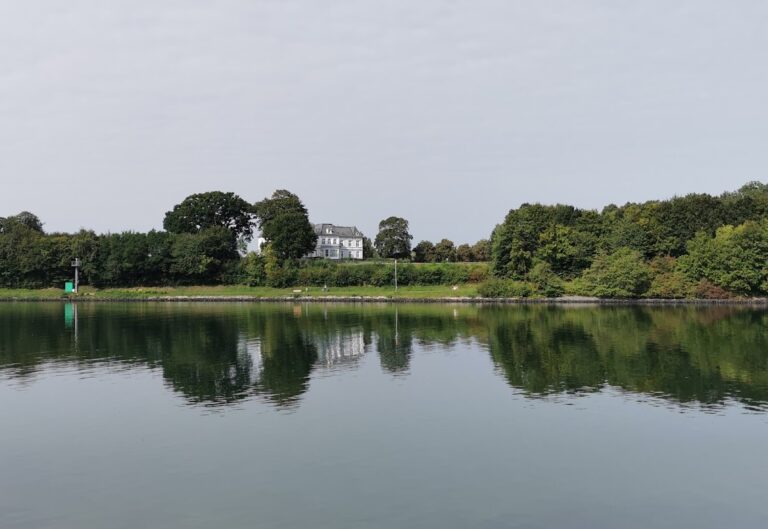
West of the château lies a landscape garden in the English style. It extends toward nearby woodland and from there to Eckernförde Bay. Lawns and groups of trees form its principal arrangement, and the garden is also used by the meeting center.
Mausoleum
A small mausoleum was built in the park during the second half of the nineteenth century as a contemporary garden-architecture feature. Heinrich Moldenschardt designed it; he had trained under Gottfried Semper, the nineteenth-century German architect and architectural theorist. The mausoleum became the burial place of Count Friedrich Carl August von Noer and his wife, Carmelita.
Nearby sites