Schloss Loersfeld: A Water Castle and Estate in Germany


Site at a Glance
- Rating
- 4.6
- Popularity
- Low
- Country
- Germany
- Primary era
- Medieval
- External website
- Open
- Eras represented
- Medieval, Early Modern, Modern
- Civilizations
- Holy Roman Empire, Kingdom of Prussia
- Site type
- Domestic
- Remains
- Castle
On this page11 sections
History
Schloss Loersfeld is a fifteenth-century water castle and estate in Kerpen, Germany, built during the period of von Büllesheim ownership. The brick complex developed within the historic lordship of Kerpen and Lommersum and has remained in the possession of the von Fürstenberg family since 1819.
Medieval estate and early owners
Loersfeld was first recorded in 1262, when the knight Eberhard von Belle and his wife Hildegunde held a farm there with 30 Morgen of arable land. A Morgen was a historical German measure of land whose exact size varied by locality. Neighboring property belonged to Bottenbroich Abbey, while Loersfeld apparently formed part of the Kerpen lordship.
The estate remained connected with the County of Kerpen and Lommersum until the French period. During the fourteenth century, it passed by marriage from the von Merode family to the von Horn family. The von Horns later adopted the additional designation “von Loersfeld,” linking their name to the estate.
The von Büllesheim and Eynatten periods
Heinrich Spies von Büllesheim zu Bodendorf acquired Loersfeld in 1435. The estate remained with the von Büllesheim family for about 140 years, and the present manor house was built during this period. The family belonged to the ancient nobility of the Duchy of Jülich, a major territorial state in the Lower Rhine region.
In 1559, Loersfeld passed to the von Eynatten family. They held the estate for 86 years, until it was sold to Dietrich von Leers in 1665.
From the eighteenth century to Fürstenberg ownership
The Cologne merchant Caspar Wilhelm von Hamm acquired Loersfeld around 1770. After the death of his daughter Anna Catharina, ownership passed in 1795 to her husband, Georg Albert Reinecker.
On 5 June 1819, Reinecker sold Loersfeld, together with its buildings, farms, and associated lands, to Friedrich Leopold Reichsfreiherr von Fürstenberg zu Herdringen, the hereditary seneschal of Westphalia. A hereditary seneschal held an inherited high household or administrative office within a territorial government. Loersfeld has belonged to the von Fürstenberg family since that sale.
Nineteenth-century residence and park
Friedrich Leopold’s sixth son, Franz Adolph Josef von Fürstenberg, born on 28 June 1805, became the first member of the family to make Loersfeld his residence. He carried out extensive building work in 1840 and 1865 and enlarged the grounds into a ten-hectare English landscape park. This type of designed park uses naturalistic lawns, plantings, and winding compositions rather than the geometric layout of a formal French garden.
Franz Adolph Josef served as Royal Chamberlain and castle commandant of Benrath Palace until his death on 14 February 1880. A Royal Chamberlain was a court official, while a castle commandant administered or oversaw a castle or palace. After his death, Loersfeld passed to his nephew Friedrich Leopold II von Fürstenberg of the Borbeck-Hugenpoet line.
When Friedrich Leopold II died, his son Clemens inherited the estate in 1901. Clemens, who had been born at Borbeck Palace, moved to Loersfeld with his wife Therese, née Countess von Korff gen. Schmising. Therese continued to live at the estate until her death.
Twentieth-century changes and present ownership
Clemens’s only son, Clemens August, renounced his inheritance in 1938. Loersfeld consequently passed in 1941 to relatives of the Fürstenberg-Hugenpoet line. Maximilian Freiherr von Fürstenberg-Hugenpoet is the present owner.
Members of the Fürstenberg family lived at Loersfeld until 1954. From 1960, the estate was leased to the Bellefontaine family, and Thomas Bellefontaine has managed the restaurant there since 1992. The restaurant received one Michelin star from 1999 to 2019 and again in 2022 and 2023.
In August 1980, the Dresden painter A. R. Penck found his first residence and workplace in West Germany at Loersfeld after leaving the German Democratic Republic. At that time, the castle was occupied by his gallery owner, Michael Werner. In March 2018, the Count Berghe von Trips Sports Foundation moved from Villa Trips to Loersfeld. The privately owned complex is described as restored and is regarded as one of Germany’s most beautiful castle complexes.
Remains
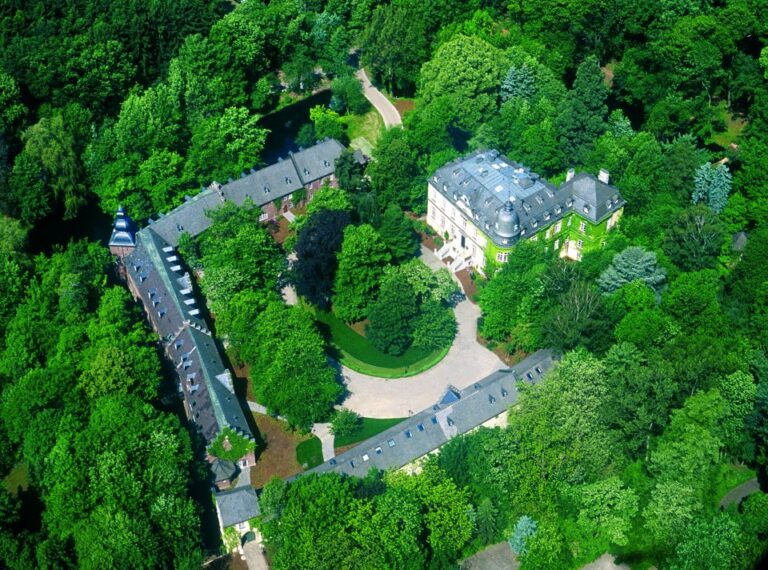
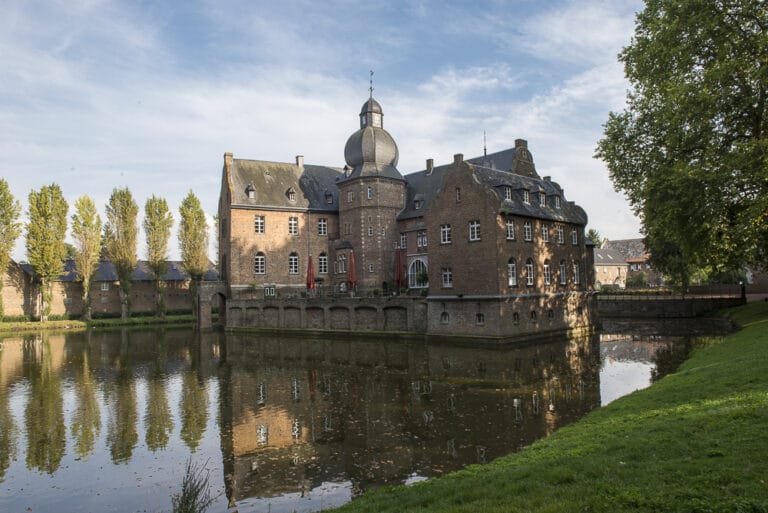
Schloss Loersfeld is a brick water-castle complex centered on a manor house and surrounded by a ten-hectare English landscape park. Its estate buildings reflect both the residential history of the site and its later use as a managed agricultural and administrative property. The estate lies between the present-day Loersfelder Busch and Parrig nature reserves.
Castle buildings
Manor house
The present manor house was built in the fifteenth century during the von Büllesheim period. It forms the principal residence of the brick complex and currently contains a restaurant. Its construction belongs to the phase when Loersfeld was held by the von Büllesheim family, whose ownership lasted from 1435 for about 140 years.
Forecourt complex
The present forecourt complex was built in 1771, replacing earlier buildings. A forecourt, also called an outer bailey, is an ancillary area outside the principal residence that contains service, agricultural, or administrative buildings. At Loersfeld, these buildings served estate-management purposes rather than functioning as fortifications.
Landscape park
The castle stands at the center of a carefully maintained ten-hectare English landscape park created during nineteenth-century alterations. The park replaced an earlier French-style garden, changing the designed grounds from a formal geometric arrangement to a more naturalistic landscape composition.