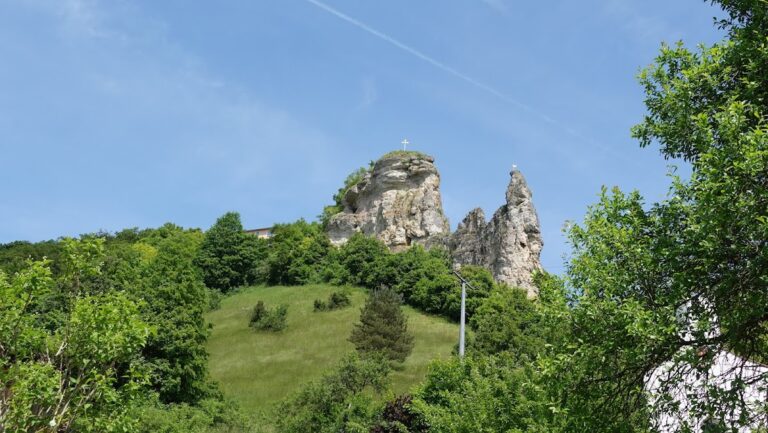
Schloss Rosenburg: A Medieval Hilltop Castle in Germany


Site at a Glance
- Rating
- 4.7
- Popularity
- Low
- Country
- Germany
- Primary era
- Early Modern
- External website
- Open
- Eras represented
- Medieval, Early Modern
- Civilizations
- Duchy of Bavaria, Holy Roman Empire
- Site type
- Military
- Remains
- Castle
On this page7 sections
History
Schloss Rosenburg is a medieval hilltop castle above Riedenburg in Germany, probably built during the second half of the twelfth century by the Babonen, an old Bavarian aristocratic family. The Babonen held regional titles including burgraves of Regensburg, landgraves of Stefling, and counts of Riedenburg.
From the Babonen to the Bavarian dukes
After the Regensburg burgraves died out in 1185 and the Stefling landgraves in 1196, the castle passed to Duke Ludwig I of Bavaria. Under the House Treaty of Pavia in 1329, a dynastic agreement governing the inheritance and division of territories, Schloss Rosenburg passed to Emperor Ludwig IV of the Wittelsbach dynasty.
In the third partition of Bavaria in 1392, the castle became part of the Duchy of Bavaria-Munich and was incorporated into the Munich Rent Office, a historical Bavarian administrative and fiscal district. The complex was repeatedly pledged to other lords. The Lords of Wolfstein and Hilpoltstein held it from approximately 1330 to 1367, the Counts of Abensberg from 1384 to 1424, and the Lords of Muggenthal from 1424 onward.
War, destruction, and reconstruction
Insurgents captured and largely destroyed Schloss Rosenburg in April 1525 during the German Peasants’ War, a series of uprisings by rural communities and townspeople in the German lands. The castle was rebuilt between 1556 and 1560.
During the Thirty Years’ War, a major European conflict of the seventeenth century, the castle was plundered several times between 1632 and 1634. Austrian forces captured it in 1703 during the War of the Spanish Succession, a struggle over the Spanish monarchy and its territories. In 1745, during the War of the Austrian Succession, the Austrian army used the complex as winter quarters.
Modern preservation and use
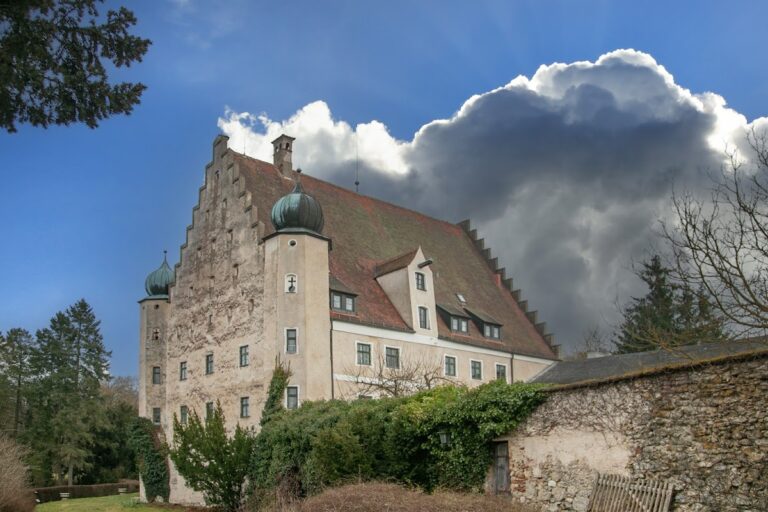
The preserved castle now functions as a museum administered by the Bavarian Palace Administration. A falconry center, Falkenhof Schloss Rosenburg, was established on the grounds in 1978. Extensive renovation took place in 2014 and 2015. Schloss Rosenburg is protected as an archaeological monument because of subsurface remains associated with the medieval castle and as an architectural monument of Riedenburg.
Remains
Hilltop setting and layout
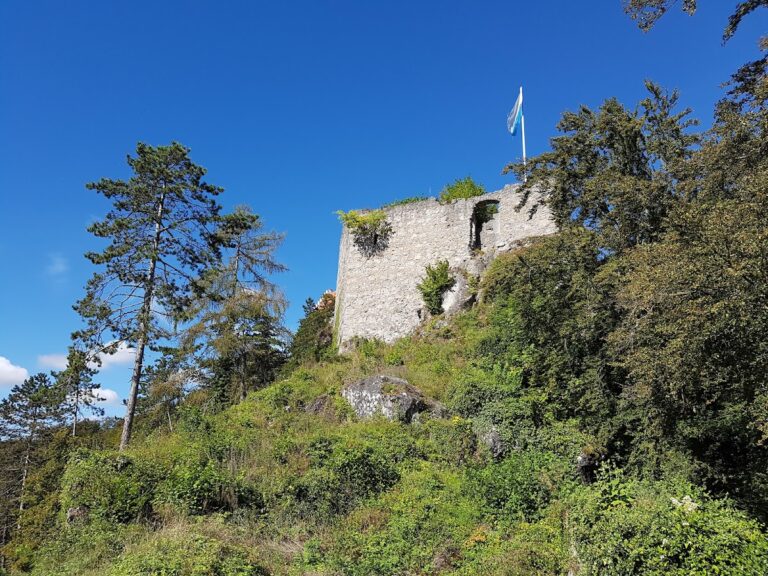
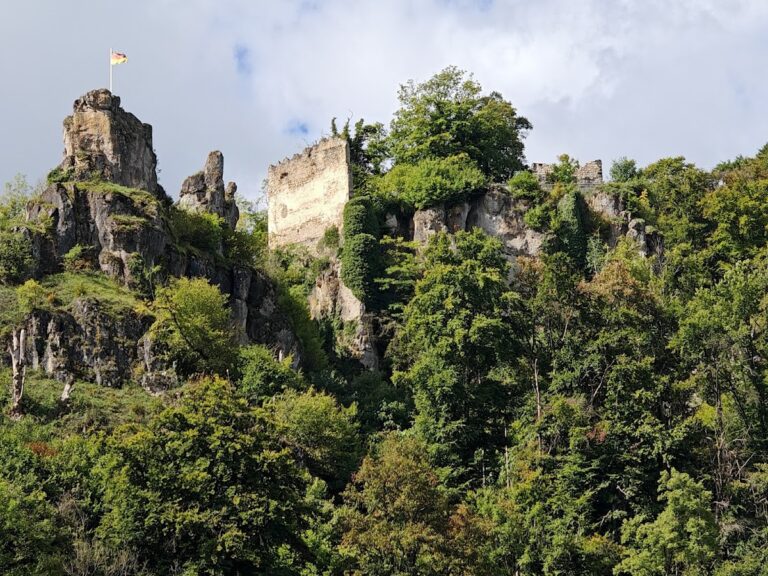
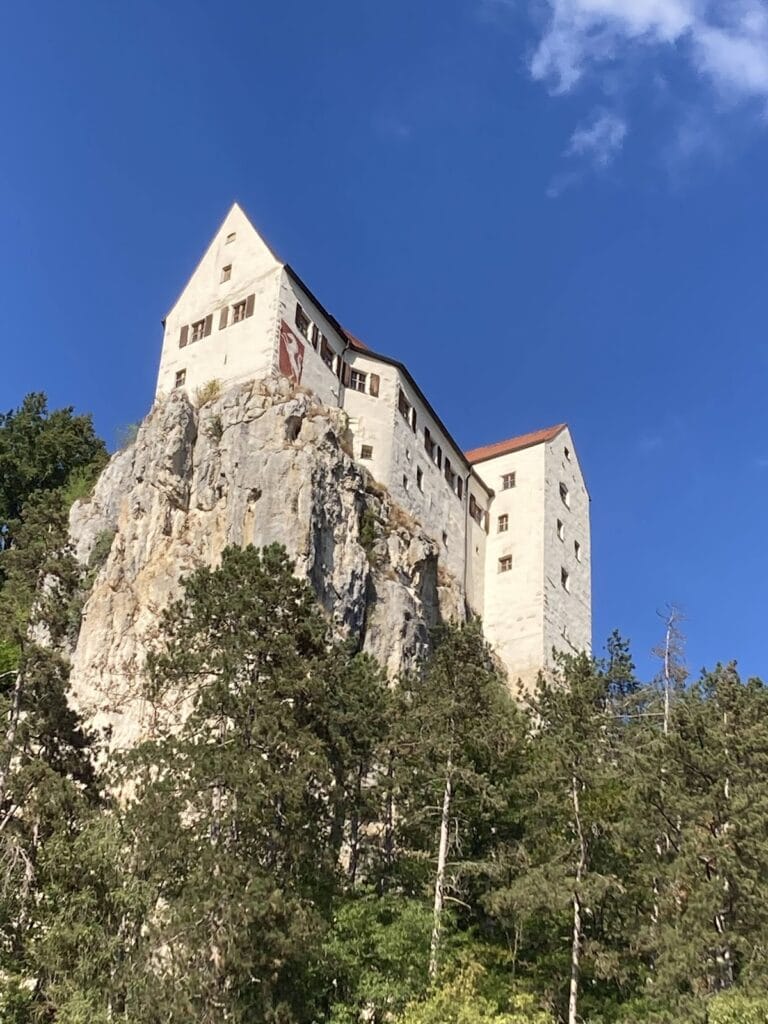
Schloss Rosenburg is a Höhenburg, or hilltop castle, positioned on a ridge in the Altmühltal within the Altmühltal Nature Park. The preserved complex includes an approach route leading to an inner gate and continues into the castle courtyard. Substantial parts of the historic castle survive, allowing the principal arrangement of the complex to remain legible.
Castle buildings and present features
The surviving complex contains a castle cellar now used as a tavern, as well as a museum. Its grounds also contain the falconry center, a facility for keeping, training, and demonstrating birds of prey. Flight demonstrations include appearances by a white-tailed eagle, a large sea eagle native to Europe and northern Asia.
Nearby sites