Burgruine Tachenstein: Medieval Castle Ruins in Riedenburg, Germany


Site at a Glance
- Rating
- 4.6
- Popularity
- Low
- Country
- Germany
- Primary era
- Medieval
- External website
- Open
- Eras represented
- Medieval
- Civilizations
- Duchy of Bavaria, Holy Roman Empire
- Site type
- Military
- Remains
- Castle
On this page10 sections
History
Burgruine Tachenstein, also called Dachenstein, is a medieval castle ruin in Riedenburg, Germany. A branch of the Babonen, a medieval Bavarian noble family, built the spur castle between approximately 1170 and 1180 for Friedrich I, whose family was associated with the Lords of Prunn, Laber, and Breitenegg. The castle’s name was first recorded in 1189, when the stronghold was already complete and its retainers appeared as witnesses to a property acquisition on the Tangrintel.
Foundation and early ownership
Friedrich I gained the lordship of Laber through his first marriage and Wolfertshofen through his second. Between 1160 and 1195 he used the name Wolfertshofen, while the new castle became associated with Tachenstein. In 1189, Friedrich Hartlieb and Heinrich of Tachenstein were identified as castle retainers, and Friedrich of Tachenstein also witnessed the transaction involving Werner III of Laaber. These records place Tachenstein within the network of noble lordships and fortified sites that shaped medieval Bavaria.
By 1329, Tachenstein belonged to the dukes of Bavaria. The Treaty of Pavia, a 1329 agreement regulating the division of Wittelsbach territories, assigned Riedenburg, Tachenstein, and Eggersberg to Emperor Ludwig the Bavarian. In the Bavarian territorial division of 1392, ownership passed to Duke Johann of Bavaria-Munich.
Pledges and ducal control
The first specifically named resident was Friedrich Hiltprant of Tachenstein, who made a peace agreement with the city of Regensburg in 1358. The stronghold then passed to Hilpold the Elder of Stein and Hilpolt the Younger of Stein, before Duke Stefan III redeemed it in 1367 or 1368.
In 1373, Dukes Stefan III, Stefan II the Elder, Friedrich, and Johann granted the fortresses of Riedenburg, Tachenstein, and Rabenfels to the knight Jörg Auer. Albrecht Hertenberger, known as “the Port,” lived at Tachenstein and acted as a guarantor in 1380 and 1382. Two years later, Albrecht of Abensberg received pledge rights that included the castle.
Dukes Ernst and Wilhelm redeemed Tachenstein from Jodokus of Abensberg on 13 May 1424. Two days later, they transferred the County of Riedenburg and Tachenstein to Erhart Mugentaler. Michael Walrab became the castle’s lifelong pledge-holder in 1445, while the duke retained the right to recover it. In 1453, Duke Albrecht pledged the stronghold to Leonhard Seetaler, his sons, and the legitimate male heirs of his sons. An agreement of 1479 required Seetaler to spend 200 florins on the fortifications.
Decline and later status
After the Seetaler heirs’ pledge was redeemed for 600 florins, Duke Wilhelm IV granted Tachenstein to Leonhard von Eck in 1545. Leonhard was followed as holder by his son Oswald von Eck and then by his grandson Hans Walter von Eck.
In 1613, Duke Maximilian sold Eggersberg Castle together with Tachenstein, its manorial jurisdiction, and associated rights and possessions to Wilhelm Jocher, a privy councillor and administrator of Dachau. The sale described Tachenstein as an ancient stronghold that was already almost ruined. On 28 August 1683, Elector Max Emanuel II confirmed Johann Dominikus Bassus von und zu Sandersdorf’s purchase of the manorial jurisdictions of Eggersberg, Tachenstein, and Harlanden for 13,000 florins. In 1703, Bassus made the three estates a family entail, an inheritable arrangement intended to keep property within a designated family line, for his son Ignaz Dominikus Bassus.
Today, the ruin is protected as both an architectural and archaeological monument of Riedenburg. It is listed under architectural monument record number D-2-73-164-14 and archaeological monument record number D-2-7036-0226.
Remains
Setting and layout
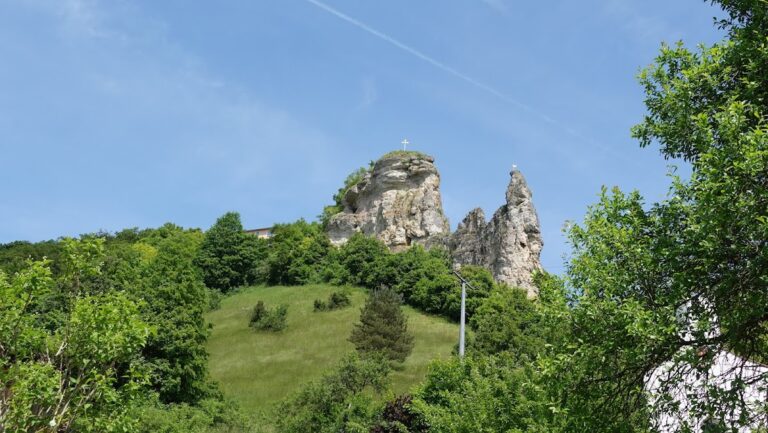
Tachenstein occupies the southeast-projecting spur of the wooded Jägerberg immediately west of central Riedenburg, in the eastern part of the Altmühltal Nature Park. The ridge reaches 476 metres above sea level, while the castle site lies at approximately 440 to 450 metres. The Altmühl, a tributary of the Danube, flows through Riedenburg about 90 metres below the ridge. A rock-cut neck ditch, approximately 15 metres wide, separates the castle grounds from the adjoining high ground. The approach was possible only on foot or with animals, and wheeled vehicles could not reach the site.
Fortifications and surviving buildings
Keep
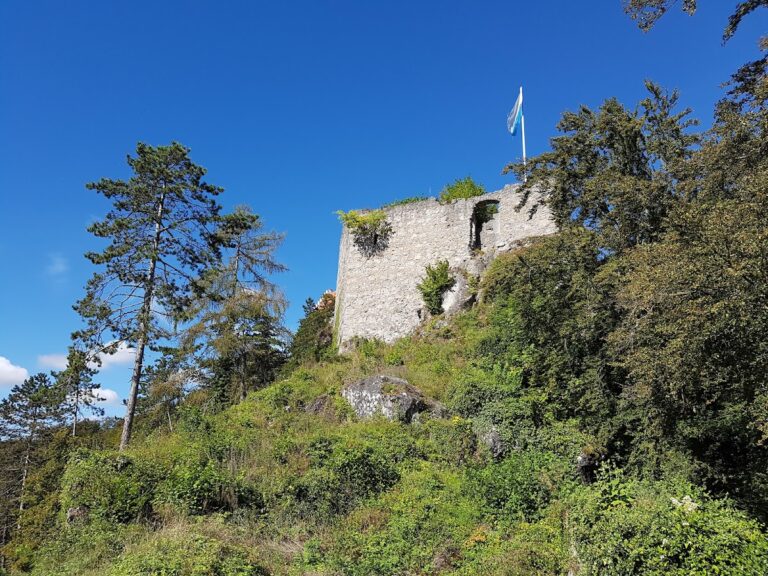
The surviving keep stands to the left of the entrance. This principal defensive tower has a square plan measuring approximately 7 by 7 metres and rises as much as 15 metres. Three sides were built from projecting ashlar blocks with dressed margins, a masonry technique used in medieval fortifications. Its entrance is a high-level doorway about 6.5 metres above the ground, positioned behind the former shield wall.
Enceinte and gateworks
Southeast of the keep, the remains of the northern wall rise approximately 1.5 metres and include a small window. At the extreme eastern tip of the site, an angled wall reaches as much as 6 metres. The southern enceinte, or enclosing defensive wall, survives down to the level of the castle courtyard. A gate structure with a defended outer passage was incorporated into the eastern part of this enclosure.
Residential building and ditch
The surviving remains also include the ruins of a residential building. Together with the keep, sections of the enceinte, and the neck ditch, these fragments preserve the principal elements of the castle’s fortified layout and its division between defensive and residential areas.
Nearby sites