Schloss Oelber: A Renaissance Castle in Germany


Site at a Glance
- Rating
- 4.6
- Popularity
- Low
- Country
- Germany
- Primary era
- Early Modern
- External website
- Open
- Eras represented
- Medieval, Early Modern, Modern
- Civilizations
- Holy Roman Empire
- Site type
- Domestic
- Remains
- Castle
On this page8 sections
History
Schloss Oelber is a castle in Germany, in Oelber am weißen Wege, now a district of Baddeckenstedt, whose present form was created by a Renaissance rebuilding around 1580 on the foundations of a twelfth-century water castle. The medieval site was a lowland water castle, a fortified residence protected by water or naturally wet ground, while the later rebuilding created a residence shaped by Renaissance architectural ideals.
Medieval origins and divided lordship
The medieval castle stood in a valley of the Lichtenberge, away from the principal military and trade routes. It therefore played a limited role in regional affairs. The bishops of Hildesheim initially held feudal authority over the castle and village. A feudal tenant held land or rights from a superior lord in return for defined obligations. After the Hildesheim Diocesan Feud, an early-sixteenth-century conflict over the territorial and political authority of the Hildesheim bishopric, the Principality of Brunswick-Wolfenbüttel became the feudal lord of the castle lords in 1543.
The surviving ownership history begins in 1274, when the Edelherren von Meinersen sold the property to the von Krebs family. Documents from 1296 and 1299 show the von Cramm family as owners. A marriage connection between the von Meinersen and von Cramm families may have influenced the transfer of the fief, although its precise role is uncertain. Ludolf and Burghard von Cramm are recorded as castle men. The von Steinberg family held a co-ownership share in 1390, after which the von Bortfeld family took its place.
Ownership remained divided among noble families because the territorial boundary between Hildesheim and Brunswick-Lüneburg passed through Oelber. The von Cramms held the property from an early period, while the von Bortfelds shared possession with them until their family became extinct in 1686. These divided rights created separate upper and lower courts associated with the main castle and the outer bailey. The estate consequently contained four knightly seats until the eighteenth century. A dispute among the von Cramms followed the extinction of the von Bortfeld line. The von Cramms were officially sole owners by 1766, and the ownership arrangements were finally settled in 1771.
Brunswick borderland and Renaissance rebuilding
From 1523, Oelber belonged to the Principality of Brunswick-Wolfenbüttel. Its position at the principality’s southwestern edge, surrounded by foreign territories, gave the estate a sensitive political setting. The Brunswick dukes retained control through subsequent political upheavals.
Around 1580, Burchard VI von Cramm transformed the strongly enclosed medieval building into a Renaissance castle. He was then lord of Oelber and a governor for a Hessian landgrave, a high-ranking territorial ruler broadly comparable to a count palatine or prince, in the territories along the Lahn at Marburg. Marburg Castle served as the model for the reconstruction. The medieval water protection was removed as the surrounding moat was drained and filled, and the rebuilding effectively created a new Renaissance residence.
War, estate life, and the von Cramms
Oelber was drawn directly into the Thirty Years’ War, the European conflict of 1618 to 1648 that combined dynastic, territorial, and religious struggles within the Holy Roman Empire and beyond. In 1626, the Imperial commander Count Tilly quartered his troops at the castle for three months. After his departure, a Danish army commanded by Count Philipp Reinhard of Solms occupied and devastated the castle and village. On 27 August 1626, Tilly’s forces defeated the Danish army under King Christian IV at the Battle of Lutter am Barenberge, approximately 15 kilometres south of Oelber.
The village remained closely connected to the castle and its owners. The estate’s agricultural land and large herds of livestock provided employment and income for local residents. Its associated enterprises included a distillery, brewery, brickworks, and limeworks. The von Cramm family, which appears in twelfth-century documents, was a wealthy knightly family and a prominent feudal tenant of ecclesiastical and secular lords in the region. In later centuries, members of the family served the Welf dukes as generals, chamberlains, and ministers. The Welfs were a major German ruling dynasty whose branches included the dukes of Brunswick-Lüneburg and Brunswick-Wolfenbüttel.
Gottfried von Cramm, known as the “Tennis Baron,” was buried near the castle chapel after his death in a car accident in Egypt. He lived from 1909 to 1976 and reached the Wimbledon final three times. Schloss Oelber remained under von Cramm ownership for most of its history, and Egbert Freiherr von Cramm has been its lord since 1974.
Modern restoration and public image
After Egbert Freiherr von Cramm took over the castle complex in 1974, he had the historic property extensively renovated. Restored estate buildings were later used alongside the castle for cultural and public events. The castle’s picturesque exterior also led to its use as a filming location for Das Spukschloß im Spessart, the 1960 film directed by Kurt Hoffmann and starring Liselotte Pulver.
Remains
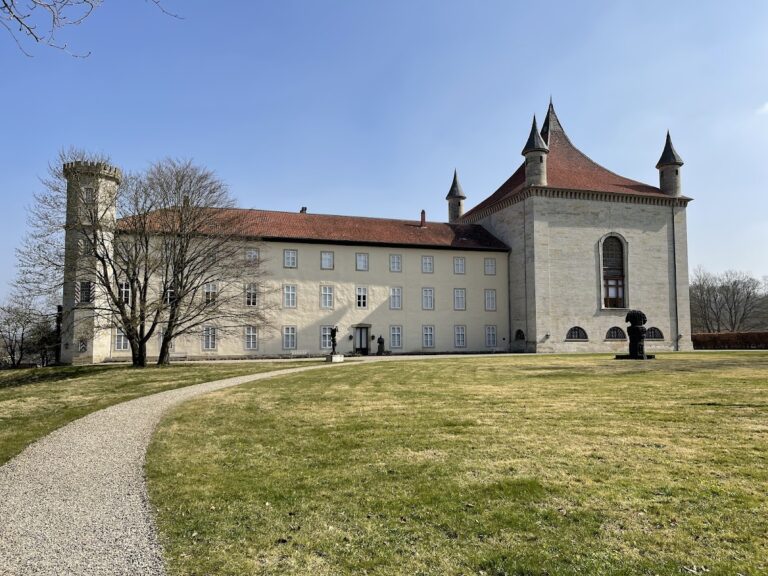
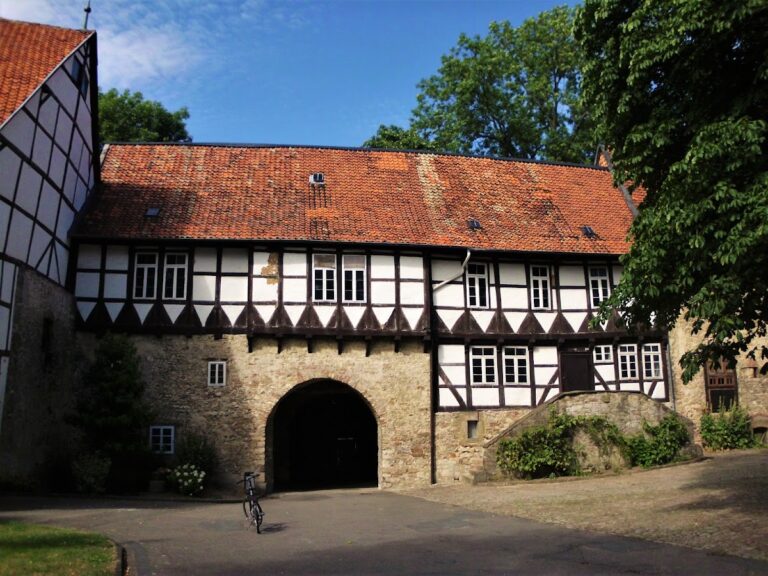
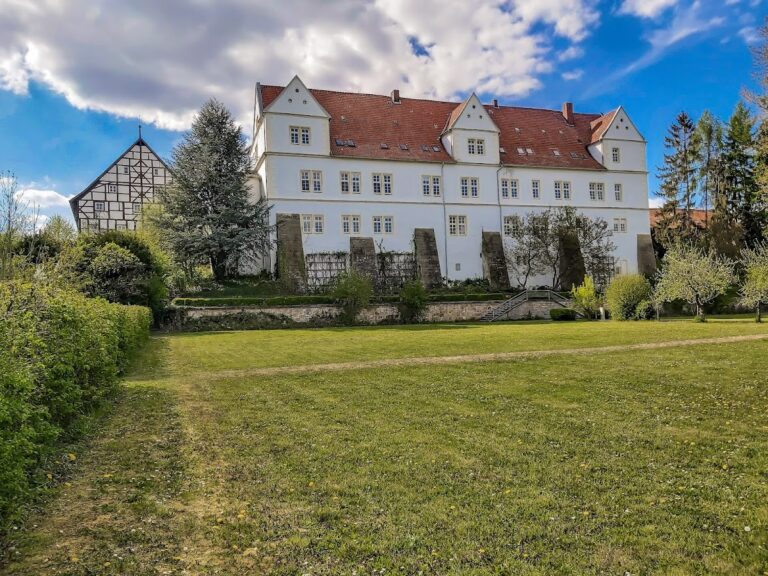
The circular castle complex stands on the foundations of the medieval water castle. Its present arrangement is centered on a small inner courtyard enclosed mainly by three-storey buildings. Some sections use half-timbering, and a short gap in the building group is closed by a wall. The principal castle, or upper castle, is spatially separated from the outer bailey, giving the complex a distinction between its main residential enclosure and its secondary estate building.
Main castle
The main castle was rebuilt around 1580 in the Renaissance style after the medieval moat had been drained and filled. Its southern entrance passes through a gate passage with a barrel vault and Renaissance architectural detailing. The courtyard contains a round stair tower that was heightened during nineteenth-century alterations, creating the impression of a keep. The east wing was also redesigned in the nineteenth century, and a larger park was laid out to the east during the same period. A room known as Tilly Hall commemorates Count Tilly’s three-month occupation of the complex in 1626.
Outer bailey and chapel
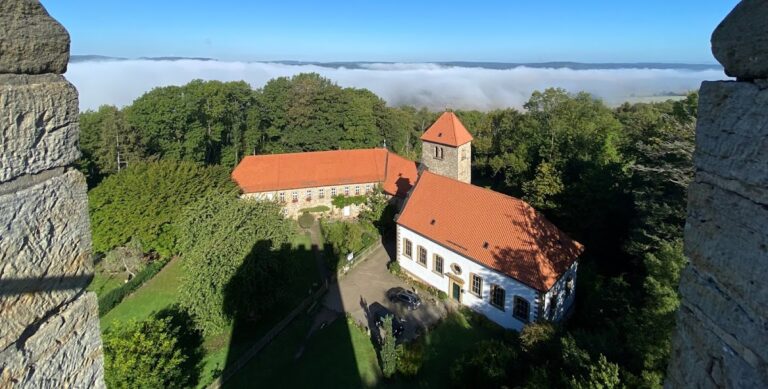
The outer bailey dates to 1594 and is a simple, two-storey rectangular building in the Renaissance style. It formed part of the divided arrangement of the estate, which historically associated the outer bailey with a separate lower court. The castle chapel stands near the burial place of Gottfried von Cramm, linking the surviving religious space with the family history that shaped Schloss Oelber for centuries.
Nearby sites