Tucherschloss: A Renaissance City Palace in Nuremberg


Site at a Glance
- Rating
- 4.5
- Popularity
- Low
- Country
- Germany
- Primary era
- Early Modern
- External website
- Open
- Eras represented
- Early Modern
- Civilizations
- Holy Roman Empire
- Site type
- Domestic
- Remains
- Elite Residence
On this page8 sections
History
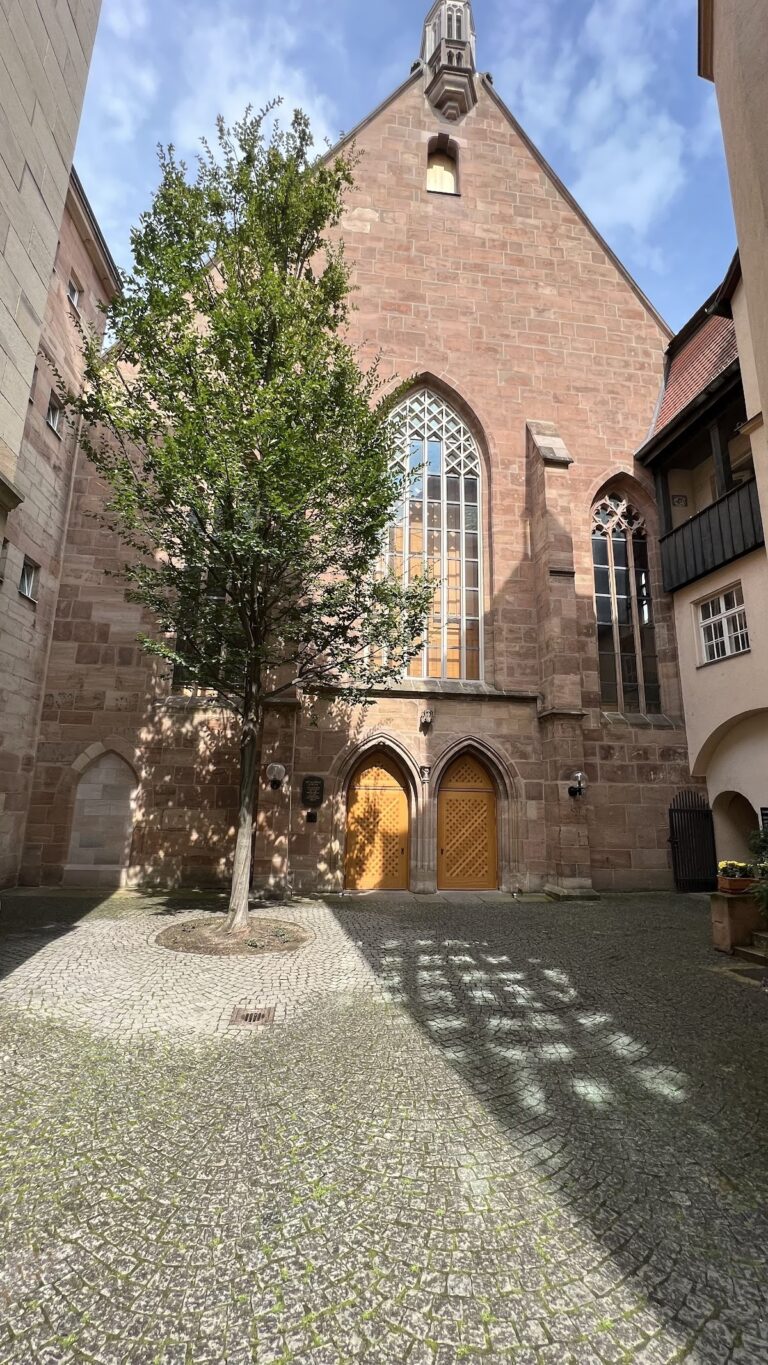
Tucherschloss is a Renaissance city palace in Nuremberg, Germany, built for the Tucher family between 1533 and 1544. The Tuchers were a prominent patrician family, part of the wealthy urban elite involved in Nuremberg’s civic and economic life. The palace was commissioned under Lorenz II Tucher as the family’s city residence, with a design probably created by Paulus Beheim and influenced by French Renaissance castles, residences that combined medieval elements with Renaissance forms.
A sixteenth-century patrician residence
The palace reflected the status of its owners within Nuremberg’s urban society. Its Renaissance design introduced forms associated with renewed interest in classical architecture while retaining features suited to a substantial fortified-looking residence. The complex served as the Tucher family’s city palace and remained connected to the family’s possessions and collections over the following centuries.
War damage and reconstruction
Tucherschloss suffered severe damage in 1945 during the Second World War. Parts of the main building survived, including the west courtyard facade up to the second upper floor, much of the staircase tower, the street facade with its sandstone oriel, and most of the ground-floor vaults. The ancillary buildings were almost completely destroyed. Reconstruction followed in 1967 to 1969, when the ancillary buildings were rebuilt in a slightly altered form.
After the reconstruction, the Tucher family transferred the building to the City of Nuremberg. The collections remained the property of the family foundation or of individual family branches. The museum is administered equally by the Free State of Bavaria and the City of Nuremberg. Tucherschloss now presents the history of the Tucher family, while the ancillary buildings accommodate the administrative headquarters of the Museums of the City of Nuremberg.
The Hirsvogel Hall
The Hirsvogel Hall was destroyed during the Second World War, but its carved wall panelling and ceiling painting had been removed before the destruction and were thereby preserved. The hall was reconstructed in the garden of Tucherschloss by 2000. Its interior was designed by Peter Flötner with Italian-influenced Renaissance elements that were unusual in Nuremberg at the time.
Remains
Principal building
The complex stands in the St. Sebald district of Nuremberg’s old town. Its principal building is a three-story structure made of sandstone ashlar, with a facade that is closed toward the street. A small first-floor oriel projects on the street-facing side. Its sandstone parapet carries a relief depicting the Fall of Man. At the courtyard entrance, two arches are separated by a Tuscan column, a plain classical column with a simple shaft and base.
Inside, the ground floor contains a hall covered by a late Gothic net-rib vault, whose ribs form a network-like pattern. Surviving elements of the building include much of the staircase tower, the courtyard facade to the second upper floor, the street facade, and most of the ground-floor vaults. The reconstructed ancillary buildings form part of the present museum complex.
Hirsvogel Hall
The reconstructed Hirsvogel Hall stands in the Tucherschloss garden. Its Renaissance interior includes carved wall panelling and a large ceiling painting titled The Fall of Phaeton. Georg Pencz painted the work on 20 canvases. In classical mythology, Phaeton was the son of the sun god Helios, and the scene represents his failed attempt to drive the solar chariot.
Museum collections
The museum’s rooms contain portraits, furniture, furnishings, Renaissance furniture and tapestries, Baroque interiors, and a room devoted to the nineteenth century. The displays also include objects associated with Nuremberg’s prosperity around 1500. Among the portraits is an image of Hans VI Tucher painted by Michael Wolgemut, the leading Nuremberg painter who taught Albrecht Dürer.
Decorative objects include the Tucher pouring set, which was specially enamelled in Limoges, and a silver double cup by Wenzel Jamnitzer, a sixteenth-century Nuremberg goldsmith known for elaborate works in precious metals. Together with the preserved architectural elements and the reconstructed hall, these collections connect the palace’s physical remains with the history of the family that commissioned it.
Nearby sites