Schloss Haigerloch: A Renaissance Castle and Hohenzollern Residence in Germany


Site at a Glance
- Rating
- 4.5
- Popularity
- Low
- Country
- Germany
- Primary era
- Early Modern
- External website
- Open
- Eras represented
- Medieval, Early Modern
- Civilizations
- Habsburg, Holy Roman Empire
- Site type
- Domestic
- Remains
- Palace
On this page11 sections
History
Schloss Haigerloch is a medieval hilltop castle in Germany, first mentioned in 1095 and transformed into a Renaissance palace during the late sixteenth century. It occupies a rocky elevation about 500 metres above sea level, within a deep bend of the Eyach River in the northwestern Swabian Jura. The surrounding area lay near important trade routes during the early Middle Ages.
Medieval Origins and Habsburg Rule
The original castle complex was probably located at the site now known as the Roman Tower, on the opposite side of the valley in the present upper town. The earliest recorded owners were the Counts of Wiesneck. During the second half of the twelfth century, the complex passed to the Counts of Hohenberg, who established an additional castle at the site of the present Schloss Haigerloch.
In 1381, the entire County of Haigerloch, including its castle, came under the authority of the Habsburgs, a major European ruling dynasty whose territories included much of the German-speaking lands. The castle’s defensive installations were subsequently strengthened considerably.
Hohenzollern Residence and Palace
Haigerloch passed in 1497 to Count Eitel Friedrich II of Zollern through an exchange for the Lordship of Rhäzüns in Switzerland. The complex thereby entered the possession of the Hohenzollerns, a German princely and royal dynasty. After the division of the Zollern inheritance in 1576, Haigerloch became the independent seat of the newly established Hohenzollern-Haigerloch line.
Count Christoph of Hohenzollern-Haigerloch ordered the medieval fortress to be radically rebuilt as an extensive Renaissance palace. Renaissance architecture was a classicizing movement that developed in Europe from the fifteenth century onward. The rebuilding was directed by the master builder Michael Beer. The castle church was also designated as the burial place of members of the family from the sixteenth century. The Hohenzollern-Haigerloch line ended in 1634, when its last male representative died without a male heir, but the castle remained with the main Hohenzollern line.
In 1700, the palace’s New Building was added and the principal residence was carefully restored. Its façades were not substantially changed, while the interiors received luxurious decoration. In 1745, Prince Joseph Friedrich of Hohenzollern-Sigmaringen temporarily moved his residence from Vienna to Haigerloch and encouraged further construction in the surrounding complex. Three years later, he ordered the complete rebuilding and Baroque transformation of the castle church.
Decline in Residence and Twentieth-Century History
During the nineteenth century, Schloss Haigerloch became less important as a major representative residence because the Hohenzollerns increasingly preferred other palaces and castles. It continued to be maintained, however, with funds from the treasury of the Kingdom of Prussia keeping the complex ready to receive distinguished guests. The First World War, the end of the Hohenzollern monarchy, the November Revolution, and the establishment of the Weimar Republic did not materially change its condition. Its external appearance and art collections were preserved.
After the Nazis came to power in Germany, several secret laboratories were established in the castle. During the Second World War, work connected with the regime’s so-called wonder weapons intensified. Shortly before the war ended, an experiment involving nuclear fission, the splitting of an atomic nucleus in a process that can release substantial energy, was conducted in the rock beneath the castle church as part of the Third Reich’s nuclear program. The site escaped destructive Allied bombing because its importance was not recognized.
Until 1975, the complex housed an agricultural school and various local administrative institutions. It was then purchased by a German entrepreneur and has remained privately owned. From the 1970s until 2022, parts of the site operated as a hotel and restaurant and as a cultural, conference, and congress centre. In 2022, the hotel entered indefinite conservation after activity at the complex declined following the COVID-19 restrictions. The former castle church remains Haigerloch’s parish church, while the underground installation linked to the wartime experiment houses the Atomkeller Museum.
Remains
Upper and Lower Castle
Upper Castle
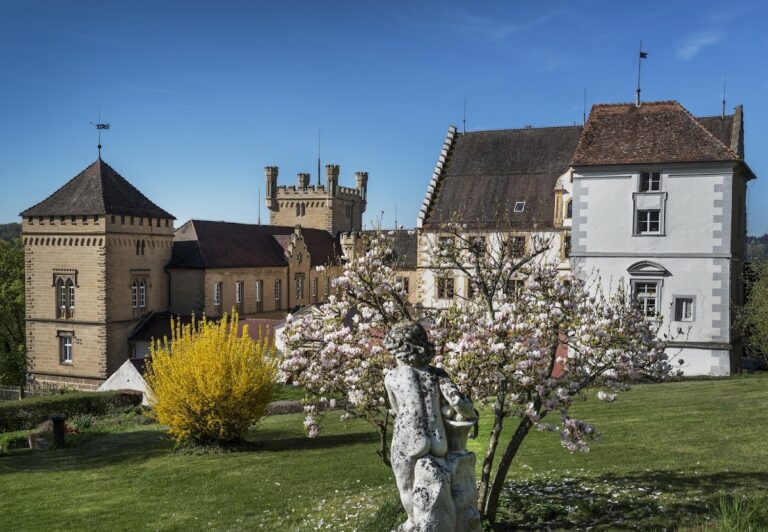
Schloss Haigerloch is a stone-built hilltop complex divided into two autonomous sections, the Upper Castle and the Lower Castle. The Upper Castle served as the citadel and the residential palace of its owners. Its surviving form is principally the result of the extensive Renaissance rebuilding directed by Michael Beer, with only minor later alterations. The section includes a gatehouse tower, entrance gates, and the Upper Castle courtyard. It was approached by a drawbridge.
Lower Castle
The Lower Castle functioned as the foreburg, the outer or lower fortified part of a castle, and was approached by its own drawbridge. It contained the practical facilities needed by the household and garrison, including farm buildings, storehouses, stables, a forge, a bakery, and barracks. Together, the two sections formed a fortified complex that combined the owners’ residence with service, agricultural, and military functions.
Church and Underground Installation
Church of Holy Trinity
The castle church of Holy Trinity was completely rebuilt in 1748 in the Baroque style, a later architectural movement known for elaborate forms, dramatic spaces, and richly ornamented interiors. Before that rebuilding, it had served as the burial church of the Hohenzollern-Haigerloch family. Its high altar was consecrated in 1609 and is regarded as an especially important work of Renaissance sculpture in Hohenzollern. More than 60 wooden sculptures survive on the altar. The former castle church is still used as Haigerloch’s parish church.
Atomkeller
The rock beneath the church contains the site of the nuclear-fission experiment conducted during the final phase of the Second World War. This underground installation is associated with the present Atomkeller Museum, which preserves the physical setting connected with that episode of the castle’s history.
The castle is described as restored, and its external appearance remains substantially similar to that created by the Renaissance rebuilding more than four centuries ago.
Nearby sites