Schloss Schönebeck: A North German Water Castle in Bremen


Site at a Glance
- Rating
- 4.5
- Popularity
- Low
- Country
- Germany
- Primary era
- Early Modern
- External website
- Open
- Eras represented
- Early Modern
- Civilizations
- Holy Roman Empire, Swedish
- Site type
- Domestic
- Remains
- Castle
On this page8 sections
History
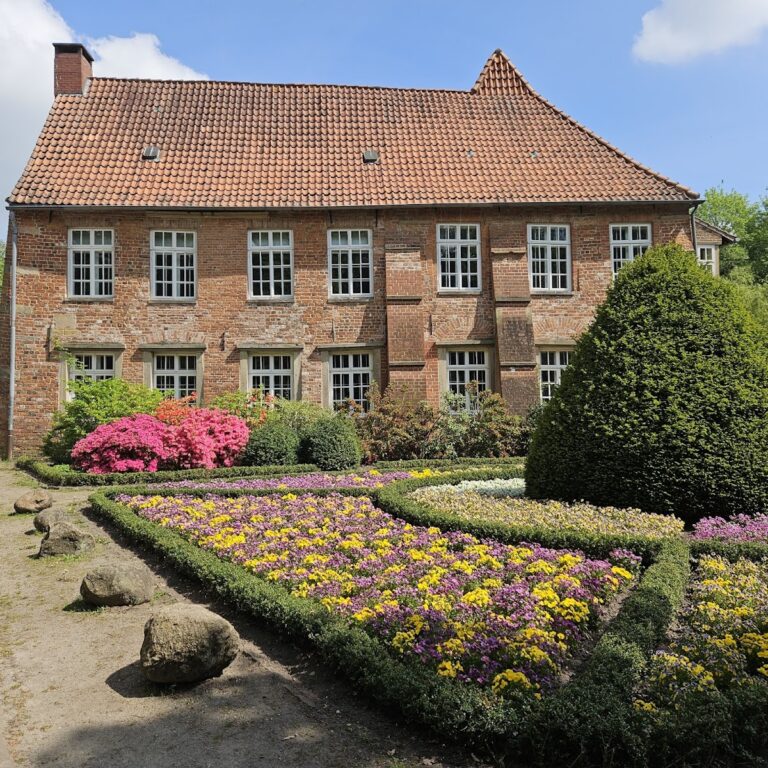
Schloss Schönebeck is a North German half-timbered water castle in Bremen, Germany, whose present form developed through building phases beginning in the late seventeenth century. Its precise origin and the construction date of the existing castle remain unresolved, but the estate is connected with the local knights of Oumünde, who were reportedly recorded as von Schönebecke in 1357.
The estate in the seventeenth century
The indebted estate was purchased in 1662 by Baron Jacob von Schlebusch, who died in 1675. Two years later, the City of Bremen tried to buy the property from his widow, Anna Elisabeth von Schlebusch. The attempt was blocked by the Swedish government because the castle and its possessions lay within Swedish territory.
Friedrich von der Borch acquired the estate in 1682. An inscription on the southwest facade states that he built the castle in wood and stone in 1686, then removed a decayed side, reinforced its foundations, and replaced it with a brick wall in 1705. Dendrochronology, the dating of wooden elements through their tree-ring patterns, together with observations of the building, has led Steffen Albracht and Sophie Seiser to propose that von der Borch first created a half-timbered castle around 1686. The dated southwest masonry facade was then added as part of the 1705 renewal.
Later building phases
After 1749, another half-timbered building was attached to the earlier structure. Its builders may have been Ernst August Friedrich von der Borch and Henriette Charlotte Christiane von Friesen. Their association with the castle is also reflected in the Baroque alliance coat of arms on the grand staircase. Ernst August Friedrich von der Borch was a Hanoverian major general and the grandson of Friedrich von der Borch, while Henriette Charlotte Christiane von Friesen was a noblewoman; they married in 1726.
Municipal ownership and museum use
The von der Borch family eventually stopped using the castle for decades, and the building fell into danger of decay. The City of Bremen acquired it in 1952, after which it was restored and made available to the Museumsverein für Vegesack, an association founded in 1911. The local-history museum at Schloss Schönebeck has received the public since 1972 and also contains the archive and extensive research library of the Heimat- und Museumsverein für Vegesack und Umgebung.
The association was founded by Diedrich Steilen, Johann Friedrich Rohr, Bernhard Ahlers, and others. During its first year, it collected 672 donated exhibits. Its museum occupied the Havenhaus in Vegesack from 1911, the Suhrhaus on Rohrstraße from 1926, and the Logenhaus on Weserstraße from 1935, before moving to Schloss Schönebeck in 1972. Its displays address the history of the former port town of Vegesack, sailing and steam shipping, herring fishing vessels, whaling, the beginnings of maritime rescue, and the journeys of the Vegesack-born African explorer Gerhard Rohlfs. The collections also include objects from the former Witteburg stoneware factory and temporary exhibitions.
Schloss Schönebeck is also used for concerts and other events. Civil marriages have taken place there since late 2011, with the Schifffahrtssaal serving as the marriage room. In 1973, the castle grounds, the Administratorenhaus, and the castle pond were protected as a historic ensemble. The castle and the Administratorenhaus were also protected individually as monuments.
Remains
The castle and its water setting
Schloss Schönebeck stands in the valley of the Schönebecker Aue, a geest stream that flows through Vegesack Harbour into the Weser. At the castle, the stream was dammed to create the Schlossteich, or castle pond, giving the residence its water-associated setting. A water castle is a residence linked to nearby water, which may take the form of a moat, pond, or canal and does not necessarily imply heavy fortification.
The surviving building combines timber framing with masonry. The southwest side is formed by the brick facade associated with the 1705 rebuilding, while the later construction phase added half-timbered work and produced the castle’s present half-timbered facades. The grand staircase carries a Baroque alliance coat of arms, which combines the arms of two families to commemorate the marriage of Ernst August Friedrich von der Borch and Henriette Charlotte Christiane von Friesen in 1726.
Ancillary buildings and former watermill
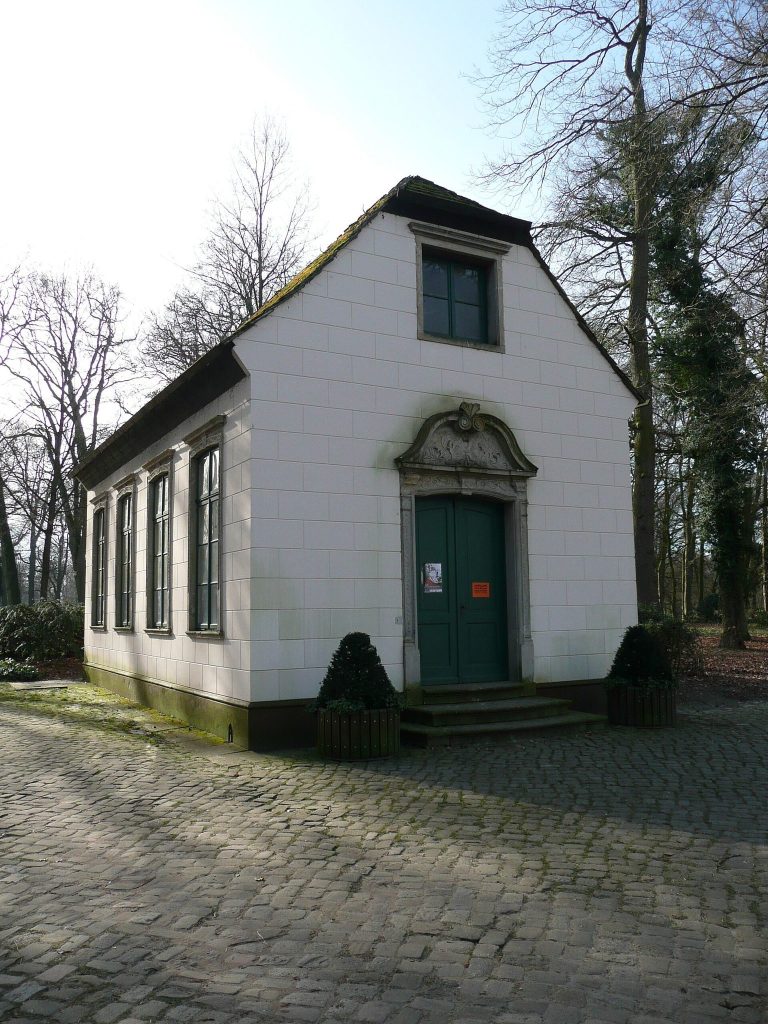
The castle grounds include the Administratorenhaus, a Classicist half-timbered building constructed in 1780, and the Schlosskate. The latter was rebuilt on its site during the 1980s with historic building elements, particularly half-timbering. At the transition between the castle pond and the Schönebecker Aue, a watermill formerly stood.
Museum spaces
The castle now accommodates the Heimatmuseum Schloss Schönebeck, a local-history museum, together with the archive and research library of the Heimat- und Museumsverein für Vegesack und Umgebung. Within the building, the Schifffahrtssaal functions as a marriage room.